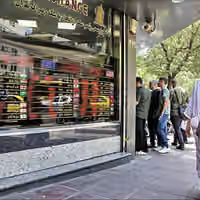
On Thursday, the end of Iran’s market week, the rial fell to another record low. Year-on-year inflation has reached almost 90 percent, with food prices rising even faster.
The deterioration comes as US sanctions and a naval blockade squeeze Iran’s sources of revenue. The blockade has severely constrained oil exports, while Washington on Thursday expanded sanctions into the automotive and rail sectors, targeting some of the country’s largest industrial companies.
US Treasury Secretary Scott Bessent has seized on the rial’s collapse as evidence that Washington’s pressure campaign is working, saying this week that it had driven the currency to its lowest level in history.
Iranian Economy Minister Ali Madanizadeh rejected Bessent’s assessment, telling the official IRNA news agency Thursday that predictions of an imminent economic collapse had repeatedly proved wrong.
“They want to create unrest and stress among the people so they rush to the currency market and the exchange rate increases; otherwise, these statements serve no purpose, and we will not allow this to happen,” he said.
The Central Bank has offered a similar diagnosis. It said Friday that the exchange rate was not “fully consistent with the economy’s fundamental variables,” attributing much of the gap to heightened uncertainty, psychological pressure and market expectations.
The bank announced Wednesday that it planned to inject $2 billion in banknotes into the market. So far, however, the intervention has failed to halt the rial’s slide.
‘The Central Bank shoots it into its own goal’
Hardliners have challenged the government’s explanation, arguing that sanctions and the war cannot by themselves account for the surge in the exchange rate and prices.
Nadergholi Ebrahimi, a hardline lawmaker, claimed in an online interview Thursday that the war had contributed no more than 25% to the recent rise in prices and accused government economic officials of deliberately fueling inflation.
Threatening to seek the impeachment of economic ministers, he accused them of waging an “economic sedition” that was reducing the public’s ability to withstand economic pressure and increasing dissatisfaction.
Hossein Samsami, an economist and hardline lawmaker, has also attacked the Central Bank’s handling of the exchange rate.
“Today, the currency is the enemy’s tool in an all-out economic war, and the measure of its success is the devaluation of our national currency,” Samsami wrote on X.
But he accused the Central Bank itself of helping drive that process by following an exchange rate he said was artificially determined by Iran’s enemies.
“The enemy passes the ball, and the Central Bank shoots it into its own goal!” he wrote.
Inflation approaches 90 percent
Whatever the relative weight of sanctions, war, expectations and domestic policy, their combined effect is increasingly visible in household finances.
According to the Statistical Center of Iran, annual inflation has reached 73.6%, while year-on-year inflation rose to a record 89.8%.
Food and beverage prices have risen substantially faster than overall inflation, hitting lower-income households particularly hard because they devote a larger share of their income to food and other essentials.
Accelerating prices have also eroded the value of government food vouchers introduced after subsidized foreign-exchange rates for a range of goods were removed amid a sharp depreciation of the rial and economic protests in December and January.
Although the government pledged to increase the value of the vouchers in line with rising prices, it has yet to do so.
Wages fall behind as prices surge
The pressure is also increasingly visible among salaried workers.
Videos circulating on social media in recent weeks have shown teachers and nurses saying low wages have left them with no choice but to resign after years in their professions.
Ali Farhadi, spokesman for Iran’s Education Ministry, dismissed reports of widespread teacher resignations as a “rumor” on Friday.
The dispute has become another front in the broader argument over the economic crisis, with government supporters alleging that expressions of discontent are being amplified to encourage unrest and critics accusing authorities of dismissing genuine economic grievances.
Samsami, however, has placed greater responsibility for the hardship on domestic economic policy than on Washington.
“The pressure imposed on people’s livelihoods by misguided economic policies is far greater than that caused by sanctions and the naval blockade,” he wrote, adding: “We are not at an impasse. By reforming our policies, we can control inflation even under these sanctions.”