• العربية
  • فارسی
Brand
  • Iran Insight
  • Politics
  • Economy
  • Analysis
  • Special Report
  • Opinion
  • Podcast
  • Live TV
  • Iran Insight
  • Politics
  • Economy
  • Analysis
  • Special Report
  • Opinion
  • Podcast
  • Live TV
  • Theme
  • Language
    • العربية
    • فارسی
  • Iran Insight
  • Politics
  • Economy
  • Analysis
  • Special Report
  • Opinion
  • Podcast
  • Live TV
All rights reserved for Volant Media UK Limited
volant media logo

Iran oil exports vanish as regional flows surpass prewar levels

Dalga Khatinoglu
Dalga Khatinoglu

Oil, gas and Iran economic analyst

Oct 1, 2026, 18:55 GMT+1
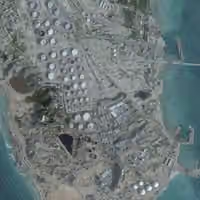
FILE PHOTO: A satellite image shows an oil terminal at Kharg Island, Iran, February 25, 2026.

New tanker-tracking data shows that Iran’s new oil exports have effectively ground to a halt, while crude exports from Arab countries in the region surpassed pre-war levels in the final week of September.

Data from commodities intelligence firm Kpler shows that regional crude exports reached their highest level since the war began in late February.

Average crude exports stood at around 16.5 million barrels per day in September, but the seven-day average rose to around 19.5 million barrels per day in the final week of the month, surpassing the pre-war level of approximately 17 million barrels per day.

By contrast, Iran has not loaded any new oil at its terminals since mid-August, while no Iranian oil cargo has crossed the US blockade line since mid-July. Data from tanker-tracking firm TankerTrackers also points to a halt in new Iranian crude shipments.

Homayoun Falakshahi, a senior analyst at Kpler, told Iran International that the halt in loadings has forced Iran to cut oil production to roughly the level required for domestic consumption, around 1.8 million barrels per day—roughly half its pre-war output.

Iran’s oil exports

Kpler data, seen by Iran International, shows that since mid-July, no Iranian oil cargo has crossed the blockade line and travelled through Asian waters toward China.

Iran continued loading oil for several weeks and, by mid-August, had stored around 67 million barrels aboard tankers anchored in its southern waters. But as access to empty tankers became increasingly limited, new loadings also came to a halt.

TankerTrackers data indicates that Iran’s oil terminals were effectively inactive in terms of crude loadings throughout September.

As of last week, around 15 million barrels of Iranian oil remained on the water in Asian waters. Falakshahi said most of those cargoes had already been sold, meaning Iran effectively has no new oil available for delivery to Chinese buyers.

China is the only major buyer of Iranian crude and purchased an average of around 1.5 million barrels per day from the Islamic Republic over the past year.

Iran also exported around 500,000 barrels per day of oil products and liquefied petroleum gas (LPG) last year to buyers including the UAE, China and other Asian countries. Those flows have also stopped since the start of the naval blockade.

Arab oil exports recover

By contrast, Arab countries in the region have restored much of their oil exports and established alternative routes for transporting crude.

Kpler says their crude exports averaged at least 16.5 million barrels per day in September, roughly matching their pre-war average. In the final week of the month, however, exports rose substantially further.

Before the war, nearly 17 million barrels per day of crude and 6.3 million barrels per day of oil products from Iran and Arab countries in the region, including Oman, were shipped to global markets through the Strait of Hormuz, the Gulf of Oman and the Red Sea—a combined 23.3 million barrels per day.

In the final week of September, crude exports from these countries reached nearly 19.5 million barrels per day, above the pre-war level. Oil-product exports, however, stood at around 3 million barrels per day, less than half their pre-war level.

Overall, crude and oil-product exports from the region reached more than 22.4 million barrels per day in the final week of September, just 900,000 barrels per day below the pre-war level.

The comparison is particularly striking because Iran accounted for around 2 million barrels per day of crude and oil-product exports before the war. Excluding Iran, exports from Arab countries in the region have therefore risen above their pre-war level, largely offsetting the disappearance of Iranian supplies from the market.

OPEC data shows that the UAE, which left the group in May, increased oil production to more than 3.8 million barrels per day in August—around 700,000 barrels per day above its pre-war level.

No new data has yet been released on UAE oil production in September. The country has production capacity of close to 5 million barrels per day.

Most Viewed

Iranian hardliners turn on Ghalibaf and judiciary after lawmaker’s sentencing
1
INSIGHT

Iranian hardliners turn on Ghalibaf and judiciary after lawmaker’s sentencing

2
INSIGHT

US ‘feedback’ leaves Iran debating the price of diplomacy

3

German-based aid worker gets 10-year prison sentence in Iran

4
INSIGHT

Tehran weighs what comes next if US diplomacy fails

5

Iran takes US response to cabinet, Hormuz clashes continue

Banner

Spotlight

  • Iran oil exports vanish as regional flows surpass prewar levels

    Iran oil exports vanish as regional flows surpass prewar levels

  • Iran turns to younger children in postwar ideological push
    ANALYSIS

    Iran turns to younger children in postwar ideological push

  • US ‘feedback’ leaves Iran debating the price of diplomacy
    INSIGHT

    US ‘feedback’ leaves Iran debating the price of diplomacy

  • ‘I never asked about regime change’: Student speaks out after El-Sayed exchange

    ‘I never asked about regime change’: Student speaks out after El-Sayed exchange

  • Iranian hardliners turn on Ghalibaf and judiciary after lawmaker’s sentencing
    INSIGHT

    Iranian hardliners turn on Ghalibaf and judiciary after lawmaker’s sentencing

Banner
Banner
Banner
Banner
•
•
•

More Stories

Iranian weapons, Chinese supplies fuel Houthi advance in Yemen - WSJ

Oct 1, 2026, 10:24 GMT+1
100%
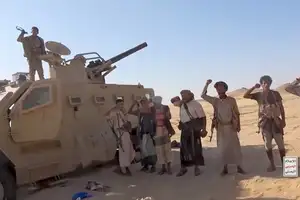
Iran-aligned Houthi fighters occupy a firing position in a screengrab from a video said to show Houthi fighters attacking Saudi-backed forces in the location given by the source as al Jawf governorate, Yemen, in this screengrab taken from a video released by Houthi Military Media on September 15, 2026.

Iranian weapons and growing supplies of Chinese dual-use components have helped Yemen's Houthis expand their territory and strengthen their ability to threaten shipping through the Red Sea, the Wall Street Journal reported.

The Iran-backed group has seized Red Sea islands and expanded along Yemen's mainland coast in recent weeks, including taking the port city of Mokha, according to the report. It has also asserted control over the Bab al-Mandeb Strait, a key route for global trade and energy shipments.

The Houthis, estimated to have about 350,000 fighters, had prepared for the offensive for months, moving weapons and thousands of troops toward Mokha in August and using their control of telecommunications networks to monitor opponents, the Journal said.

  • US officials met Iran-aligned Houthis in Oman - Reuters

    US officials met Iran-aligned Houthis in Oman - Reuters

  • Iran-backed Houthis attack Saudi cities and energy facilities, wounding at least 73

    Iran-backed Houthis attack Saudi cities and energy facilities, wounding at least 73

Iranian technology at the core

The Houthis lack a conventional navy but use Iranian-designed missiles, explosive drones, sea mines, armed fast boats and drone boats to project power along Yemen's coast.

Their arsenal includes ballistic and cruise missiles, anti-ship weapons and drones drawing heavily on Iranian technology and components, according to the report.

Around 2015, Iran's Quds Force began sending components for Iranian-designed missiles and drones and dispatched trainers to help the Houthis build weapons themselves, the Journal said.

The assistance helped turn the group into a force capable of attacking Saudi oil infrastructure, disrupting Red Sea shipping and threatening US forces.

100%
Houthi fighters stand in front of what they say is a downed Saudi jet, at a location given as Yemen, in this still image from a handout video released on September 16, 2026.

China becomes another supply source

"The Houthis now have a new source for the supplies they need to launch their attacks: China," the Journal reported.

Chinese companies are supplying dual-use goods that can serve civilian and military purposes, including components important to Houthi drone programs, according to UN reports and arms experts cited by the newspaper.

The shift comes as traditional Iranian smuggling routes have faced greater disruption. For years, Iran's Revolutionary Guards used small fishing boats to move arms, drone components and missile parts to the Houthis, but many shipments have been intercepted by US forces and Yemeni groups opposed to the Houthis.

  • Iran’s weakened axis still bites as Houthis escalate against Saudi Arabia

    Iran’s weakened axis still bites as Houthis escalate against Saudi Arabia

  • Iran-backed Houthis advance near key Red Sea shipping route as Yemeni forces retreat

    Iran-backed Houthis advance near key Red Sea shipping route as Yemeni forces retreat

Red Sea threat grows

The Houthis have also used Djibouti as a transit point for weapons and traded small arms with al-Shabaab in Somalia, according to UN reports cited by the Journal.

Since announcing a blockade on Saudi shipping on July 20, the group has struck seven vessels in the Red Sea and one in the Gulf of Aden, the report said. Four of the ships were Saudi-flagged.

The Houthis have also targeted Saudi energy infrastructure with missiles and drones, although Riyadh has reported no damage from those attacks.

UK points to Iran role in suspected plot near RAF Fairford

Sep 30, 2026, 20:31 GMT+1
100%

British Prime Minister Andy Burnham said on Wednesday there are “strong indications” Iran played a role in a suspected plot near RAF Fairford airbase used by US forces to carry out strikes on the Islamic Republic.

“But of course, it remains an ongoing, complex and serious police investigation,” he told BBC. “We are working closely with our colleagues in the United States of America.”

Five British men in their 20s were arrested on suspicion of terrorism and explosives offenses after three white vans were found near the base.

Police recovered petrol but found no viable explosives, and all five suspects were later released on bail as the investigation continued.

The base is home to the US Air Force’s 501st Combat Support Wing and also serves as a forward operating site for Air Force Global Strike Command.

Fairford has supported major US military operations, including the 1991 Persian Gulf War, the 2003 invasion of Iraq and this year’s US-Israeli strikes on Iran.

US Secretary of State Marco Rubio subsequently said a foreign state was involved, without naming it, while President Donald Trump said the men had planned "big damage."

Iran has denied involvement. Iran’s Revolutionary Guards (IRGC) said in July that bases used for attacks on Iranian territory could be considered legitimate targets.

Before Burnham’s remarks, British authorities had not publicly linked the incident to Iran, though counter-terrorism police said they were investigating possible foreign state involvement, including whether proxies may have been “knowingly or unknowingly working on behalf of a foreign state.”

Police said Tuesday that petrol, but no improvised explosive device, was found in the vans used by the men. They also defended releasing the suspects on bail after criticism, including from Trump.

The Times reported that one suspect called emergency services shortly before his arrest, with investigators considering whether the incident was surveillance, a “dry run” or an attempt to send a message to the British government.

Britain said in January that its services had tracked more than 20 potentially lethal Iran-backed plots over the previous year targeting dissidents, journalists and members of the Jewish community.

In June, 24 Western governments accused Iran’s IRGC intelligence apparatus, the Quds Force and Iran’s intelligence ministry of plotting attacks in Europe, North America and Australia, including against Iranian dissidents and Jewish and Israeli interests.

Flydubai flight diverts to Saudi Arabia after suspected cockpit stabbing

Sep 30, 2026, 12:03 GMT+1
100%

Both pilots of a flydubai flight from Dubai to Tel Aviv were injured after what Israeli officials said may have been an attempted terror attack in the cockpit, forcing the aircraft to make an emergency landing in Saudi Arabia on Wednesday.

Prince Sultan bin Abdulaziz International Airport in Tabuk said it was alerted at 8:44 a.m. local time after air traffic control received a distress call from flydubai flight FZ1073 requesting an emergency landing.

The Boeing 737 landed safely at 9:45 a.m., the airport said. The captain and first officer were taken to hospital, while passengers were assisted at the terminal.

Flydubai was working to arrange a replacement aircraft, the airport said, adding that the relevant authorities were investigating the incident.

What happened in the cockpit?

Three Israeli officials said the co-pilot was believed to have stabbed the captain in what was being investigated as a possible attempted terror attack.

The officials said cabin crew entered the cockpit and took control of flydubai flight FZ1073 before it diverted to Saudi Arabia while flying over Jordanian airspace. One of the officials identified the co-pilot as an Omani national.

Israeli authorities were still investigating the circumstances and had not reached a final conclusion about the motive.

Flydubai said the aircraft had experienced an "incident" while flying to Tel Aviv and diverted to Tabuk. The airline said all passengers were safe and accounted for but gave no details about what had happened.

Neither Saudi authorities nor flydubai had publicly explained the cause of the incident.

Passenger reports screaming and knife

Yasmin Abu Kasis, whose daughter Miriam was among the passengers, told Reuters that her daughter had heard screaming and said a man holding a knife forced one of the pilots to the floor.

She also said there was blood inside the aircraft.

Israeli media published a photograph said to have been taken aboard the plane showing what appeared to be a passenger with blood on his shirt. Reuters could not independently verify the image or the passenger's account.

The airport statement confirmed that both pilots had been injured but did not say how they were hurt.

Emergency signals and sudden descent

The flight had been traveling from Dubai to Tel Aviv when it diverted from Jordanian airspace toward Saudi Arabia, according to flight-tracking website Flightradar24.

The aircraft first transmitted a general emergency signal and several minutes later sent another signal indicating possible unlawful interference, Flightradar24 said. It later transmitted the general emergency signal again.

Flight data also appeared to show the plane dropping nearly 14,000 feet in less than 30 seconds before the first emergency alert, according to Flightradar24.

The signals prompted a major security response in Israel.

Israeli media said about 150 Israeli passengers were aboard the flight. The Israeli prime minister's office said the situation was "under control" and that authorities were taking steps to bring the passengers back to Israel.

US blockade divides Iranians online over pressure on rulers, cost to public

Sep 29, 2026, 22:15 GMT+1
•
Hooman Abedi
100%
A woman walks past a person using an ATM outside a Bank Saderat branch in Iran.

Iran’s deepening isolation is drawing divided reactions from Persian-language social media users, with some welcoming US pressure to weaken the country’s rulers and others warning that ordinary people will bear the cost without producing political change.

The posts reviewed by Iran International reflect individual online reactions and are not representative of public opinion in Iran. But they show how the growing economic pressure is being interpreted by people arguing both for and against the blockade.

That pressure has intensified as the US naval blockade sharply curtailed Iran’s oil exports, a major source of foreign currency. Iranian crude loadings fell from about 2 million barrels per day in March to roughly 220,000-255,000 in August, according to shipping data cited by Reuters.

“Great. An air and sea blockade, then a land blockade, will lead to the government’s fall,” one Persian-language social media user wrote.

“The economic blockade is choking it,” another wrote.

  • Tehran ‘ashamed’ as Iranians struggle to make ends meet

    Tehran ‘ashamed’ as Iranians struggle to make ends meet

Support for continued pressure has also appeared on Reddit. “I said months ago that the blockade is a good strategy,” one commenter wrote, expressing hope that US President Donald Trump would maintain it.

Another user in the discussion described maintaining the pressure as “Great for Iran.”

Taken together, the posts illustrate a view among supporters of the blockade that restricting trade and government revenue could weaken the Islamic Republic’s ability to withstand domestic pressure.

One user argued that the blockade could erode the authorities’ ability to administer and control the country by reducing oil revenue, weakening internal cohesion and increasing economic pressure.

“The blockade is not the objective, but the instrument,” he wrote, arguing that the aim was to increase pressure until the authorities struggled to maintain stability and manage the economy.

Others say ordinary Iranians will pay

Other users rejected the idea that economic isolation would bring political change and warned that the greatest burden would instead fall on the public.

“I don’t know of an example in history where sanctions and an economic blockade caused a revolution. Ordinary people just suffer,” one user wrote on X.

Another said prolonged isolation could strengthen corruption and preferential access, leaving politically connected people better placed to profit from shortages while the wider population becomes poorer.

“This situation could continue for years,” the user wrote, adding that the authorities could blame worsening economic conditions on the blockade.

For others, the consequences are already visible far beyond politics and trade.

“You can’t leave the country by air or sea. All the language exams have sanctioned us. Eighty percent of online games are restricted for Iranians. You can’t even create a Gmail account,” another person wrote on Instagram.

  • Iranian test-takers head abroad as exam access shrinks

    Iranian test-takers head abroad as exam access shrinks

“It’s as though the project to erase Iranians from the face of the earth has officially begun,” the user added.

Dark humor over growing isolation

The restrictions have also prompted sarcasm directed at official assertions of resilience.

After Turkish Airlines suspended its Iran flights until at least March 2027, one commenter ironically invoked a familiar phrase in Iranian political rhetoric: “America can’t do a damn thing.”

  • Turkish Airlines says all Iran flights suspended until March 2027

    Turkish Airlines says all Iran flights suspended until March 2027

“They just keep announcing victories one after another,” another wrote with laughing emojis.

A longer sarcastic comment mocked rhetoric about missiles, drones and military strength before concluding: “If the blockade continues, soon we’ll have to eat grass.”

Economic hardship also featured in discussions on Reddit. One commenter said half their monthly salary went on groceries and food and the other half on rent, leaving them dependent on savings. Another described paying 15 million rials for a kilogram of cold cuts and pickles.

The rial has fallen sharply during the economic squeeze, trading at more than 2.3 million to the dollar in September.

Iran’s official minimum monthly wage is about 166 million rials, worth roughly $71 at that exchange rate, meaning the purchase described by the commenter would amount to about 9% of a minimum-wage worker’s basic monthly pay.

Iran says awaiting US response on Hormuz proposal

Sep 29, 2026, 13:28 GMT+1
100%
Vessels transit the Strait of Hormuz, a key route for global oil shipments.

Iran said on Tuesday it is awaiting a US response to its proposal for reopening the Strait of Hormuz, as regional oil flows continued to recover and the rial sank past 2.5 million to the dollar.

The developments put Iran’s efforts to secure relief for maritime trade alongside mounting economic pressure at home and warnings from Iranian and US officials over further confrontation.

“We are awaiting an official response from the United States through the mediators,” Foreign Minister Abbas Araghchi said.

Qatar was expected to relay Iran’s proposals to Washington and return with a response, possibly by Wednesday, Araghchi said. Iran had made no concessions and reopening Hormuz remained conditional on its demands being met, he added.

“At present, the only issue is the Strait of Hormuz,” Araghchi said. “Iran’s conditions are entirely fair and reasonable. If the Americans say they want an agreement or a peaceful solution, we have presented that solution.”

Oil flows recover despite risks in Hormuz

Persian Gulf oil exports have recovered despite disruption around Hormuz, potentially reducing the impact of restrictions on one of the world’s most important energy routes.

Oil shipments through the strait and alternative routes have returned to nearly 80% of pre-war regional levels, the Wall Street Journal reported Monday.

Crude exports from major Middle Eastern producers including Saudi Arabia, Iraq and the United Arab Emirates have climbed to almost 13 million barrels per day this month, their highest level since February, according to ship-tracking data cited by the Journal.

Risks to shipping persist. A vessel transiting Hormuz was struck by a suspected unknown projectile Monday evening, causing a fire that was later extinguished, the UK Maritime Trade Operations said. The crew was safe.

Against that backdrop, Iran tied the security of regional energy infrastructure to its own ability to export oil. “If we do not sell oil in a region, no one will sell oil there, and if our security is not guaranteed, no infrastructure will be safe,” parliament speaker Mohammad Bagher Ghalibaf said Tuesday.

Rial crosses 2.5 million per dollar

Iran’s free-market exchange rate crossed 2.5 million rials to the dollar Tuesday, extending a currency decline that has increased import costs and eroded household purchasing power.

The dollar had reached 2.418 million rials Monday before gaining more than 80,000 rials, or over 3%, in less than 24 hours.

The decline comes alongside inflation, falling production, trade restrictions, foreign-currency shortages and difficulties transferring money.

Iran is seeking alternatives to maritime trade. Rail freight from China has increased tenfold since the US naval blockade began, lawmaker Meisam Zohourian said.

Three rail routes and expanded capacity at northern ports could provide overland capacity equivalent to about 400,000 barrels of oil a day, though they could not fully replace maritime trade, Zohourian said.

Revolutionary Guards prepare message to Americans

The Islamic Revolutionary Guards have addressed the American public in a letter portraying Iran as the victor in the war with the United States and crediting Mojtaba Khamenei’s leadership for the outcome.

“This is a letter, not a propaganda effort to shape the media narrative,” IRGC spokesman Hossein Mohebbi said Tuesday.

The letter said Khamenei’s “unparalleled command” had left “the world’s two leading military powers” unable to prevail and argued that his leadership gave Iran an advantage the United States lacked.

“A God-fearing and just leader, a wise scholar and a pure and courageous ascetic — this is what your armed forces and your country lack and do not have,” the Revolutionary Guards wrote in the letter to Americans.

Mohebbi also called US President Donald Trump “a big liar” and said Washington had no choice but to acknowledge failure and leave the region.

Washington, for its part, warned Iran against targeting US interests beyond the confrontation over Hormuz. US Secretary of State Marco Rubio said Iran had openly threatened American interests around the world and would face repercussions for any attack or attempted attack.

Iran’s government, however, coupled its readiness for further conflict with an openness to diplomacy. “We are not afraid of war and we do not run away from negotiations,” government spokesperson Fatemeh Mohajerani said.