Two Iranians charged over foiled plot targeting Manchester Jews

Two Iranian men have been charged over a terrorist plot targeting Manchester’s Jewish community that was disrupted before it could be carried out, British police said Friday.
Two Iranian men have been charged over a terrorist plot targeting Manchester’s Jewish community that was disrupted before it could be carried out, British police said Friday.
Rahman Salehi, 35, and Salam Ahmadyan, 36, were arrested on September 20, on the eve of Yom Kippur, in Manchester’s Northern Quarter and charged with preparing or assisting an act of terrorism.
Police allege the two men were in contact with a third party overseas who may have been in Iran, though authorities have not publicly established that the Iranian state directed the alleged plot.
Vicki Evans, the senior national coordinator for Counter Terrorism Policing, said: “This week also brought into sharp focus some of the wider threats being projected into the UK from Iran.”
The case follows a separate suspected plot near RAF Fairford, a British airbase used by US bombers in operations against Iran.
Five British men were arrested near the base on September 27 on suspicion of terrorism and explosives offences, while a dual UK-Iranian national was detained days later.
In March, police arrested four men suspected of spying for Iran and conducting surveillance of Jewish targets in London, while MI5 previously said it had disrupted 20 Iran-linked plots in Britain over a 12-month period.
In July, Britain formally designated Iran’s Islamic Revolutionary Guard Corps as a threat to national security, making public support for the organization or assistance to it punishable by up to 14 years in prison.
The IRGC is one of the Islamic Republic’s most powerful military and political institutions. Its overseas Quds Force oversees Tehran’s relationships with allied armed groups and has been accused by British authorities of directing operations against dissidents, journalists and Jewish or Israeli-linked targets in Europe.
British authorities said Quds Force members were behind the Islamic Movement of Companions of the Right which claimed responsibility for seven attacks this year against Persian-language media and locations linked to Jewish and Israeli communities in Britain.
Those incidents included an antisemitic arson attack that damaged four ambulances belonging to the Jewish emergency service Hatzola in Golders Green, north London, on March 23.








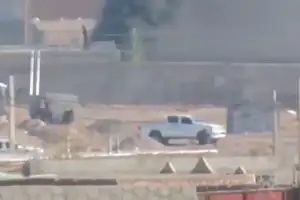
Haalvsh, which covers developments in Sistan-Baluchestan, said five members of the IRGC-Quds’s Fatemiyoun militia were killed in the Rudmahi area near Zahedan after an explosive device detonated beside their vehicle and gunmen opened fire.
Iran's Revolutionary Guards gave a different account, confirming a roadside bombing in the province but saying one fighter was killed. The IRGC Ground Force said what it described as "terrorists" had planted a bomb along a road in Sistan-Baluchestan and carried out an indiscriminate attack.
The Guards did not identify the person killed, mention Fatemiyoun or give a precise location for the incident.
Conflicting accounts of Zahedan attack
Haalvsh said the attack took place at about 6:30 a.m. as the men were patrolling the Kaleh-Pedeh route in the Rudmahi area in a Land Cruiser equipped with a DShK heavy machine gun.
Citing eyewitnesses, the outlet said an explosive device was detonated as the vehicle passed and that gunmen opened fire after the blast destroyed the vehicle.
The identities of those reported killed have not been released.
Haalvsh said local sources continued to put the death toll at five and identified all of those killed as Fatemiyoun members, but said it had not been able to independently verify the precise number of deaths.
Fatemiyoun is a militia linked to the IRGC's Quds Force and made up largely of Afghan Shiites. It was formed with Iranian support and fought alongside forces loyal to Bashar al-Assad during Syria's civil war. The United States sanctioned the group in 2019.
Haalvsh said Friday's incident was the second deadly attack on forces it identified as Fatemiyoun in Rudmahi in less than a month. It reported in September that four members deployed in the area by the IRGC were killed when gunmen attacked them during a patrol.
The outlet has also reported the deployment of hundreds of Fatemiyoun members to several parts of Sistan-Baluchestan, including areas around Zahedan, Mirjaveh, Rask, Saravan, Zabol, Chabahar, Konarak and Iranshahr.
Hours of fighting in Rask
The violence on Friday was not limited to Zahedan.
Haalvsh said Iranian military and security forces moved in Rask county at about 5:30 a.m., triggering fighting with armed men that lasted more than six hours.
Heavy gunfire and explosions were heard during the confrontation, according to the outlet, which said reinforcements and additional military equipment were sent to the area.
Armored vehicles, pickup trucks and civilian cars with private license plates were seen at the scene, while a vehicle carrying a heavy weapon was also deployed, Haalvsh reported.
Local sources cited by the outlet said reconnaissance quadcopters and explosive drones were used during the operation.
Haalvsh said the identity and affiliation of the gunmen remained unknown and that no reliable information had emerged about casualties or damage.
IRGC-linked Fars news agency, citing an unnamed source, said security forces had begun an operation against armed groups in Rask on Friday morning and that "a number" of gunmen had been killed. Fars said the operation was continuing.
Intelligence facility targeted
An intelligence ministry facility in Nokabad, the administrative center of Taftan county, was also attacked by gunmen early Friday, according to the Baloch Human Rights Documentation Network.
The group said the attackers fired at the building. Local sources also reported an explosion and said a grenade may have been used.
No casualties or damage were immediately reported, and no individual or group had taken responsibility for the attack.
Fighting follows deadly clash a day earlier
Friday's incidents came a day after another hours-long confrontation near Zahedan.
On Thursday, the IRGC said six gunmen were killed during fighting with security forces in the Manzelab area. The Guards' Quds regional headquarters said its forces had identified and "destroyed" what it described as an armed "terrorist-Takfiri" cell that had been preparing an attack.
Haalvsh said that clash began at about 6 a.m. and continued for several hours, with heavy gunfire and rocket-propelled grenade fire heard in the area.
The IRGC said explosive devices were recovered but did not identify the armed group or name those killed.
A police officer, Alireza Sanchouli, was also killed in a separate armed attack on a checkpoint at the entrance to Rask, according to Iranian reports.
At least one person was killed earlier in the week during another confrontation with security forces in Iranshahr.
Last month, a roughly nine-hour battle in the Bakhshan area of Saravan killed three IRGC members and four gunmen. Reports at the time linked the armed side to the People's Fighters Front, an alliance formed in late 2025 that includes several Baluch armed groups, among them Jaish al-Adl.
Iranian authorities regularly describe armed groups operating in Sistan-Baluchestan as terrorist organizations. The southeastern province has seen repeated armed attacks, insurgent activity and clashes between security forces and gunmen in recent weeks.
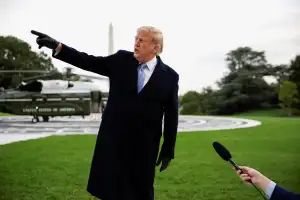
Asked directly whether Washington could ramp up bombing after the midterms, Trump replied: "Possible."
He declined to discuss potential targets but said the United States had spent the past six months replenishing its weapons stocks. "We're stocking up at levels we've never done before," he said.
Iran proposal 'not good enough'
Trump said he rejected an Iranian ceasefire proposal presented over the weekend because its terms fell short of what Washington now wanted.
"They made an offer to open up the Strait," he said, referring to the Strait of Hormuz. "It's just, it's just, it's not good enough. Nearly."
Trump said conditions he might have accepted a year earlier were no longer sufficient after months of war. He also said Iran wanted an agreement but that Washington was seeking broader terms.
"They want to make a deal, but I want to make the real deal," he said.
Trump says he chose to prolong campaign
Asked why the war had continued into a seventh month after he initially suggested a much shorter campaign, Trump said the decision was deliberate.
"Only because I wanted to go further," he said. "I could have stopped then, but I wanted to go further."
Trump said the initial US strikes had already achieved their objective against Iran's nuclear facilities, but he decided to continue because he did not want Tehran rebuilding its capabilities "in some different form."
He said Iran had been severely weakened, saying: “Their economy is gone. Their inflation is at 300% or something like that. Their navy is gone. Their air force is gone. Everything’s gone.”
Damage to Iran’s military
Trump said US operations had destroyed Iran's nuclear, naval, air and radar capabilities.
"I've destroyed their nuclear capability. I've destroyed their navy, 159 ships are at the bottom of the sea. I've destroyed their air force. All their planes are gone. I've destroyed their radar," he said.
He also said traffic through the Strait of Hormuz had reached a record level the previous night, arguing that Iran had lost its ability to control the waterway.
"They said we're going to close. I said, 'Well, you close it, you're going to have big trouble.' We took it over," Trump said. "You have to see the coastline. Everything is obliterated."
Says 'annihilating Iran' remains possible
TIME also asked Trump about his recent threat to "annihilate Iran."
"Yeah, I would do that. It's possible," Trump said.
Asked how such a threat fit with his description of himself as a president of peace, Trump replied: "Because by annihilating Iran, we've created peace in the world. With Iran, I don't think you could ever have peace."
He said Iranian authorities had killed between 72,000 and 75,000 protesters in protests earlier this year.
"It's unbelievable. It's a bloodbath," Trump said.
Nuclear issue remains central
Trump repeatedly said preventing Iran from obtaining a nuclear weapon remained his central objective.
"Iran cannot have a nuclear power because they are crazy and you can't let crazy people have nuclear weapons," he said while discussing US support for Israel.
Later, while talking about the US economy and the cost of the war, Trump said he had "no choice" but to confront Tehran.
"I have to put out the fire in the Islamic Republic," he said. "Let nut jobs have nuclear weapons, you'll see some real problems. I had no choice. I'd do it again today."
Trump also said he believed the eventual outcome in Iran would resemble the result of the US operation in Venezuela.
"We're doing very well in Iran too," he said. "It's a much bigger area, much bigger country, much further away. And - but the result is going to be the same."
Foreign Minister Abbas Araghchi received US feedback on Iran’s seven-day proposal during talks with Qatari mediators in Doha on Tuesday night, Reuters reported, citing an official briefed on the talks.
The main disagreement concerns the sequencing of the plan rather than its elements, the official said. The proposal outlines a seven-day process to build trust and return to an enhanced version of a memorandum of understanding reached by Iran and the United States in June.
Araghchi presented the US proposal at Wednesday’s cabinet meeting and briefed ministers on his trip to New York, including Iran’s conditions for reopening the Strait of Hormuz, government spokesperson said.
US President Donald Trump, meanwhile, said Iran would eventually “give up,” but suggested that point had not yet been reached.
Tanker struck in Strait of Hormuz
The diplomatic exchanges came with shipping risks persisting in the waterway at the center of the negotiations.
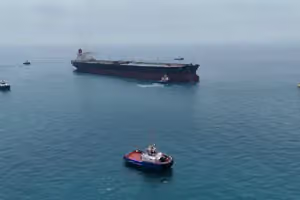
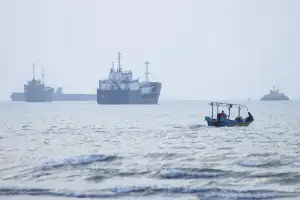
A tanker heading into the Strait of Hormuz was struck by an unknown projectile, the United Kingdom Maritime Trade Operations said, citing a verified source. Authorities were investigating the strike.
Separately, the Revolutionary Guards described near-daily confrontations with vessels in the strait. Guards spokesman Hossein Mohebi said Iranian forces were targeting ships every 24 hours but had received no US response for some time.
The disruption has also affected neighboring Iraq. Parliament speaker Haibat al-Halbousi said Iran had given Iraqi tankers no exemption from restrictions on navigation through Hormuz.
Iran expands military and civilian preparations
Beyond the strait, Iranian officials described efforts to strengthen the country’s military capabilities and prepare civilian infrastructure for further conflict.
Iran is rapidly expanding its missile, drone and air defense capabilities, deputy Revolutionary Guards commander Mostafa Izadi said.
“We are present in the Strait of Hormuz with strength. We are rapidly expanding our missile, drone and air defense capabilities,” Izadi said.
Iran will also hold drills covering schools, hospitals, banks, mobile phone operators, airports, ports, bridges, roads and aviation networks to prepare civilian infrastructure for wartime threats, Passive Defense Organization chief Gholamreza Jalali said.
Jalali said Iran had prepared for possible attacks on the Fordow, Natanz and Isfahan nuclear facilities before the war and conducted drills for such scenarios.
Two January protesters executed
Away from the military confrontation and negotiations, Iran carried out two more executions stemming from the January protests.
Ali Hemmati and Majid Nikandish were executed over demonstrations in Mashhad, with the judiciary accusing them of involvement in the deaths of four security personnel.
The judiciary said the two participated in protests in the city’s Tabarsi district on January 8 and accused them of attacking security personnel, setting buildings on fire and damaging public property.
Sources previously told Iran International that Nikandish was tortured and forced to confess after his arrest and transfer to Vakilabad Prison.
Wednesday thus brought movement in indirect diplomacy with Washington without an end to confrontations in Hormuz, while Iranian authorities prepared for further conflict and continued executions stemming from January’s protests.