• العربية
  • فارسی
BrandBrand
  • Iran Insight
  • Politics
  • Economy
  • Analysis
  • Special Report
  • Opinion
  • Podcast
  • Live TV
  • Iran Insight
  • Politics
  • Economy
  • Analysis
  • Special Report
  • Opinion
  • Podcast
  • Live TV
  • Theme
  • Language
    • العربية
    • فارسی
  • Iran Insight
  • Politics
  • Economy
  • Analysis
  • Special Report
  • Opinion
  • Podcast
  • Live TV
All rights reserved for Volant Media UK Limited
volant media logo

Iran's wartime rallies turn against officials, fuel political feuds

Maryam Sinaiee
Maryam Sinaiee

Iran International

Nov 18, 2026, 09:02 GMT+0
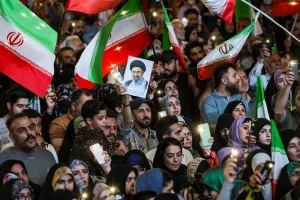
Supporters of the Islamic Republic wave Iranian flags during a nighttime rally.

Iran's nightly rallies by Islamic Republic loyalists have become platforms for opposing negotiations with Washington and targeting senior officials, drawing criticism over their political agenda, use of public resources and disruption to daily life in recent months.

The gatherings began in early March after the announcement that Supreme Leader Ali Khamenei had been killed in US and Israeli strikes. Supporters of the Islamic Republic took to streets and squares across the country and have continued gathering nightly.

Calls for revenge over Khamenei's killing and opposition to an agreement ending the war have become prominent features of the rallies, alongside attacks on officials involved in diplomatic efforts.

“A minority in the streets wants war, but the majority of people, who have no voice, just want to live their lives,” Mohammad-Ali Abtahi, a former first vice president under President Mohammad Khatami, said in an interview with Hamshahri television.

Abtahi's remarks circulated widely on social media and drew a backlash from supporters of the gatherings. Some Iranian media have also reported declining attendance, raising questions about the rallies' appeal beyond their most committed participants.

Khorasan newspaper, which is close to Parliament Speaker Mohammad-Bagher Ghalibaf, accused speakers of exploiting the gatherings for political score-settling.

“Turning an atmosphere of solidarity into an arena for political score-settling has not only reduced public participation but also endangered national cohesion,” the newspaper wrote.

During an online debate on the Azad platform, economist Mousa Ghaninejad challenged philosophy professor Bijan Abdolkarimi, who opposes negotiations with Washington, over the significance of the nightly crowds.

Ghaninejad argued that gathering in the streets did not make participants' positions correct and accused them of presenting themselves as the sole representatives of what was right while dismissing opposing views.

Protesters target senior officials

The rallies have increasingly targeted President Masoud Pezeshkian, Foreign Minister Abbas Araghchi and Ghalibaf, who is Iran's chief negotiator.

Placards have accused the officials of being too accommodating toward the enemy, with some demonstrators demanding their dismissal or resignation.

Organizers have also staged smaller daytime protests outside government and military institutions, extending their pressure beyond the nightly gatherings.

The conservative Jomhouri Eslami newspaper last week described the protests as unjustifiable, arguing that they threatened national interests and prevented Iran from “translating its military achievements into diplomatic gains.”

The newspaper wrote that the United States and Israel had infiltrated the gatherings, turning slogans against Washington and Israel into calls for the deaths of current and former Iranian officials.

It urged the judiciary and security agencies to intervene against those it accused of undermining national unity.

Khorasan also demanded judicial action after women wearing burial shrouds gathered outside the Armed Forces General Staff headquarters and accused military commanders of compromising with the enemy.

Khorasan urged the judiciary to take action against the protesters and organizers, as well as those it said had encouraged accusations of betrayal against military commanders and senior officials.

Public funding faces scrutiny

The rallies have also raised questions about the use of public resources to support political mobilization.

Rouydad24 news website last week described the gatherings as an “electoral campaign for the ultra-hardline faction,” questioning the use of public facilities to advance a particular group's political agenda.

The website highlighted the role of Tehran Mayor Alireza Zakani and his political allies in organizing and promoting the demonstrations.

It said no transparent financial information was available about their costs or the extent of direct funding by Tehran Municipality.

Residents complain of disruption

Beyond political infighting, residents have complained on social media about loudspeakers, traffic congestion and the nightly occupation of streets and public squares.

Some rally supporters have dismissed these objections, portraying participation as a wartime duty and criticism as disloyalty.

“The nightly gatherings are Iran's defensive shield, like air defenses, fighter jets and missiles whose noise we hear and fear, but they are on our side,” Kobra Asoupar, a journalist and defender of the nightly gatherings, wrote on X.

“If someone says during a war that we should not defend ourselves because we are being disturbed, that person is either an idiot or a traitor,” she added.

  • Iran’s nightly pro-state rallies become factional battleground

    Iran’s nightly pro-state rallies become factional battleground

  • Armed patrols and nightly pro-government rallies spread fear across Iranian cities

    Armed patrols and nightly pro-government rallies spread fear across Iranian cities

  • Iran ultra-hardliners accuse Ghalibaf, Pezeshkian of ‘coup’ over US deal

    Iran ultra-hardliners accuse Ghalibaf, Pezeshkian of ‘coup’ over US deal

Most Viewed

Iran’s dams may have been built to support missile bases - NYT
1

Iran’s dams may have been built to support missile bases - NYT

2

US Army seeks 17 bunkers in Israel, Saudi, Lebanon amid Iran threats - report

3

UK PM warns Iran against attacks on journalists and military bases

4

Iranian girl's suspected honor killing raises questions over school's role

5

Iran’s daily hardships find a voice in IRGC-linked media

Banner

Spotlight

  • How Iranians are turning grief into defiance
    OPINION

    How Iranians are turning grief into defiance

  • A cow's sit-in: why a comedy sketch struck a nerve in Iran

    A cow's sit-in: why a comedy sketch struck a nerve in Iran

  • Iran could launch dirty-bomb attack, but risks make it unlikely, experts say
    ANALYSIS

    Iran could launch dirty-bomb attack, but risks make it unlikely, experts say

  • Iran's wartime rallies turn against officials, fuel political feuds

    Iran's wartime rallies turn against officials, fuel political feuds

  • How Thai clerics in Iran were recruited to attack Israeli embassy in Bangkok
    EXCLUSIVE

    How Thai clerics in Iran were recruited to attack Israeli embassy in Bangkok

  • Iraq’s move on militia stronghold may do little to curb Iran’s influence
    ANALYSIS

    Iraq’s move on militia stronghold may do little to curb Iran’s influence

Banner
Banner
Banner
Banner
Banner
Banner
•
•
•

More Stories

Daily reports secret bread rationing in two Iranian provinces

Nov 17, 2026, 10:37 GMT+0
100%
File photo: People queue to buy bread outside a bakery in Iran.

Bread rationing has been introduced without public notice in two Iranian provinces, triggering queues and disputes at bakeries, the hardline daily Kayhan reported, as government officials confirmed a nationwide bread purchase management system on Tuesday, November 17.

Kayhan, published under the supervision of a representative of Iran's Supreme Leader, reported that the restrictions had been introduced in Khuzestan province in southwestern Iran and Zanjan province in the northwest without informing bakers or consumers in advance.

The measures prompted residents to rush to bakeries and led to verbal confrontations, the newspaper reported.

Under the system described by Kayhan, each person receives a monthly allocation equivalent to approximately eight kilograms of subsidized flour, priced at 23,000 rials ($0.009) per kilogram.

Purchases exceeding the allocation are charged at the commercial rate of 126,500 rials ($0.047), more than five times the subsidized price, with the additional payments transferred to government accounts, Kayhan reported.

The newspaper questioned why the measures had been introduced without informing bakers or consumers and accused “elements within the government” of contributing to “public anxiety” through simultaneous changes affecting bread, gasoline and electronic food vouchers.

Local media had previously reported restrictions in Shadegan, Andimeshk, Omidiyeh and Zeydun in Khuzestan province, where daily bread allocations were set at between two and 2.5 loaves per person.

Purchases exceeding those amounts were priced at 131,500 rials ($0.049), according to the local reports.

Officials confirm nationwide rollout, deny household restrictions

The bread purchase management system is being implemented across Iran, but ordinary households face no restrictions on their daily purchases, Omid Jahannejadian, director-general of Khuzestan's Grain and Commercial Services Department, told the official IRNA news agency on Tuesday.

The program is intended to regulate subsidized flour consumption, prevent potential misuse and identify purchases exceeding normal household needs, Jahannejadian said.

Consumption thresholds are calculated using purchasing data collected over the past two years, taking account of differences between urban and rural areas.

The system calculates allocations at the household level, with purchases by family members counted toward a combined household allowance, Jahannejadian added.

100%
File photo: A baker prepares traditional bread at a bakery in Iran.

In Zanjan province, Ali Eyvazi, director-general of the provincial Grain and Commercial Services Department, also confirmed that unusually large bread purchases would be charged at commercial rates.

Ordinary household purchases would not face higher prices, Eyvazi told IRNA.

The guidelines were issued on November 15, with the system subsequently updated at bakeries and flour mills.

Although the average monthly flour allocation per Iranian is approximately eight kilograms, applying an identical limit to every person without accounting for household circumstances and regional differences would be inaccurate, Eyvazi said.

The program was initially tested in Markazi province before authorities decided to expand its implementation to other provinces following an evaluation.

In a separate interview with the Mehr news agency, Eyvazi rejected descriptions of the measures as a two-tier bread pricing system, saying ordinary household consumption would remain unrestricted despite the introduction of purchasing thresholds.

Supermarkets must obtain bread from bakeries operating without government subsidies, while commercial purchases from subsidized bakeries must comply with the new rules, Eyvazi added.

Rising food costs put pressure on households

The introduction of bread purchase controls comes as Iranians face increasing difficulties affording basic food products.

Iran's minimum monthly base wage stands at about 166 million rials ($62), following a 60 percent increase in March. The cost of a basic monthly basket of goods for a working-class family had reached approximately 906 million rials ($337) by July, more than five times the minimum base wage, according to calculations cited by Iranian media.

Accounts sent to Iran International describe households turning to installment payments to purchase essential items, including bread, meat, chicken and eggs.

  • Inflation pushes Iranians to buy food in installments

    Inflation pushes Iranians to buy food in installments

In a video showing a bakery queue in Tehran, one resident described shortages alongside rising prices and shrinking loaf sizes.

"Bread has become scarce, and we have to stand in line to buy it. At the same time, the loaves have become smaller and more expensive. Can someone tell us how we are supposed to feed our children?" the resident said.

Other citizens have described reductions in flour allocations and changes in the taste and color of bread.

  • Flour shortages force bakeries to close across Iran

    Flour shortages force bakeries to close across Iran

Economic hardship is also affecting social relations as more households struggle to meet their basic needs, sociologist Hossein Ghazian told Iran International.

When survival becomes people's primary concern, competition increasingly replaces cooperation, potentially contributing to domestic violence, street confrontations and crime, Ghazian said.

The economic pressures can also contribute to depression, suicide, declining marriage and birth rates, and migration, reflecting diminishing confidence in the future, Ghazian added.

  • Food, medicine, hope: what Iran's economic crisis is costing its people

    Food, medicine, hope: what Iran's economic crisis is costing its people

The nationwide bread controls introduce new purchasing thresholds for a staple food even as officials insist that ordinary household consumption will remain unaffected.

'Our turn to play': Iran hardliners call for breaking US blockade

Nov 17, 2026, 04:29 GMT+0
•
Maryam Sinaiee
100%
Smoke rises from the stern of a St. Kitts-flagged cargo vessel following what US Central Command says was a strike on Saturday to disable the vessel, which was trying to break the US blockade of Iran, at a location given as the Gulf of Oman, in this still image taken from video released November 7, 2026.

Iranian hardliners are urging a more confrontational response to a tightening US blockade, arguing that Tehran must raise the economic and military costs for Washington to prevent the pressure from becoming permanent.

Participants in a roundtable discussion titled “How to Break the Blockade?” broadcast on state television on Saturday, said the prospects for a political agreement with Washington had diminished. They argued that while the United States was maintaining its military readiness for a possible resumption of hostilities, its main strategy had shifted toward intensifying economic pressure on Iran.

Citing statements by President Donald Trump, participants also suggested that Washington might be moving away from direct military confrontation and efforts to restrict Iran's nuclear program toward a combination of economic pressure, security operations and attacks on Iranian infrastructure, potentially aimed at overthrowing the Islamic Republic.

Vahid Khazab, a military analyst appearing on the program, Be Vaght-e Iran, said Trump had "gone back from the nuclear issue to the subject of regime change — regime change that would put the country's resources under his control."

He said economic pressure, alongside security and military operations, would be the instruments used to pursue that objective.

Breaking the blockade becomes the priority

Trump's refusal to accept conditions Tehran insists must be met before any agreement with Washington to end the war, combined with the continuation of a neither-war-nor-peace situation and the widening economic blockade, put breaking the restrictions at the center of hard-liners' agenda.

They argue that Iran should respond by increasing pressure in the Strait of Hormuz and preventing a return to normal conditions in the region. Their proposed strategy involves continuing military operations to disrupt oil flows to international markets and increase economic pressure on the United States and Europe.

Despite repeated predictions by hardliners that oil prices would climb to $150 a barrel and cripple the American and European economies, crude prices have moved in the opposite direction in recent weeks, falling again slightly in Monday's trading.

Khazab described what he called "impact-oriented [military] operations" designed to prevent oil from passing through the Strait of Hormuz as a way to influence global oil markets and alter Washington's economic and political calculations. Such operations, he argued, would increase the costs of maintaining the blockade for the United States and its allies.

Several tankers have encountered incidents in the Persian Gulf and the Strait of Hormuz in recent days. In statements, Iran's Islamic Revolutionary Guard Corps (IRGC) and the Army have claimed that the vessels were "violating" ships that struck naval mines and caught fire.

On Sunday, the IRGC also claimed to have successfully carried out drone a attack against a US. radar installation at the Riffa helicopter base in Bahrain. In its statement, the force warned: "The Strait of Hormuz is closed, and any aggression by the American enemy will be met with an even harsher and more crushing response."

The attack appeared intended to signal that Tehran would not accept a prolonged neither-war-nor-peace situation or the consolidation of the blockade.

The argument for a more aggressive response has also appeared in commentary by prominent conservative figures.

Mohammad Imani, a member of the editorial board of the hardline Kayhan newspaper, wrote in an article published Saturday on the Nameh News website that Iranian officials should concentrate on "a plan to break the blockade and make it costly for the enemy," regardless of the extent of Tehran's engagement with mediators or the messages conveyed through them.

"Strikes against the enemy's vulnerabilities must certainly be carried out through a combination of methods to force it to retreat," he wrote.

Referring to recent threats by Mohsen Rezaei, secretary of Iran's Supreme National Security Council, and senior military commanders to expand the geographical scope of the conflict if the United States attacks, Imani argued that the more pressing question was no longer how Iran would respond to another American strike.

"The real and immediate issue today is not what our response would be if America attacks," he wrote. "The more important issue is that, after its failure in the war, its request for a ceasefire and its pretense of seeking an understanding, America has launched another game in the form of a naval, aerial and land blockade. Now it is Iran's turn to play."

Imani accused Washington of trying to disrupt Tehran's response through threats and diplomatic overtures, including sending intermediaries, so that Iran would refrain from taking what he described as a "corresponding and offensive" response, keeping Iran on the defensive.

He also argued that the United States wanted to distract Iranian officials from immediately planning and implementing "symmetric and asymmetric methods of breaking the blockade" by keeping Iranian decisionmakers occupied with mediators, the details of possible responses and the terms of a potential agreement.

An article published Saturday in Sobh-e No, a newspaper supportive of parliamentary speaker Mohammad-Bagher Ghalibaf, similarly argued that the current neither-war-nor-peace situation kept the threat of conflict hanging over Iran's politics and economy, allowing Washington to use the uncertainty as leverage.

"The end of the neither-war-nor-peace game will come when the threat can no longer be used as a permanent instrument for imposing one's will without incurring serious costs," the article said. "Sustainable deterrence will be achieved when war becomes costly for the other side and endless pressure proves fruitless."

Hossein Ghatib, a political commentator who publishes under a pseudonym on social media platform X, also warned against allowing the blockade to become normalized.

"The greatest danger for Iran is the normalization of the blockade and its transformation into the region's new status quo," he wrote. "If this situation becomes entrenched, the blockade will turn from a temporary measure into a permanent instrument for imposing political demands. Preventing such an outcome must be at the center of Iran's military strategy."

Warnings against further escalation

Not all commentators have endorsed a more confrontational approach. Some have warned that escalating tensions could leave Iran facing prolonged economic pressure without securing a political or military breakthrough.

Kourosh Ahmadi, a former Iranian diplomat, wrote in an article published Saturday in the reformist Shargh newspaper that Trump's recent statements indicating he did not currently intend to launch another full-scale war against Iran, as well as the removal of Vice President JD Vance from responsibilities related to negotiations with Tehran, should be taken seriously.

"Now we are left with a naval blockade, continued American pressure on our neighbors to close their land borders, and the possibility of limited and intermittent attacks on the southern coasts and islands in connection with the Strait of Hormuz," Ahmadi wrote.

He also pointed to the roughly $20 decline in oil prices, which he said appeared to be linked to reduced fears of war, as an important indication of the changing calculations.

"If the threat of war is completely ruled out — which has not yet happened — oil prices could fall below $90 a barrel," he wrote. "In that case, the United States would have no problem with the continuation of this neither-war-nor-peace situation."

Ahmadi concluded that the only hope was for both sides to show flexibility and allow negotiations to reach a conclusion.

Iran’s daily hardships find a voice in IRGC-linked media

Nov 16, 2026, 21:28 GMT+0
100%
A man, a woman and a child wearing face masks ride a motorcycle in Iran, November 15, 2026. ISNA

The depth of hardship in Iran is evident even in messages published by the Revolutionary Guards-affiliated Fars news agency, which is airing accounts of families struggling to survive without examining the responsibility of its powerful patron.

Children leaving education to support their families, teachers struggling to afford their commute and a disabled parent awaiting assistance feature in the complaints, echoing what Iran International audiences have long described in its Voices from Iran coverage.

Their appearance in Fars brings those grievances into an outlet aligned with an institution that holds extensive political and economic power, and whose own role goes unexamined in the roundup.

Published under the heading “Messages you sent to Fars,” the accounts describe a recurring gap between promised support and what people say they can actually obtain.

The selection offers a bleak picture of daily life even through the accounts an establishment outlet chooses to publish.

The writers were not named in the roundup, and their individual accounts have not been independently verified by Iran International.

Children working, assistance falling short

One contributor, identifying himself as a painter, said his children had been unable to continue their education because the family could no longer afford it.

“Because I am a simple painter, my children had to work, and we pool our earnings to keep things going,” he wrote.

He said he paid 120 million rials (nearly $45) a month in rent and questioned his household’s placement in the fifth and sixth income deciles under the classification system used to determine eligibility for state assistance.

Iran's minimum monthly base wage stands at around 166 million rials ($62).

“For God’s sake, is it fair?” he asked, citing his rental deposit, several loans and two children of marriageable age.

Another contributor said shops were refusing electronic food vouchers, undermining assistance intended to help households buy essential goods.

“Most shops that supplied meat and chicken through food vouchers have stopped accepting them because they have not received their money,” the message said.

A parent with a severe physical disability said payments for care, living expenses and hygiene supplies had still not arrived.

“I am the head of a household with two schoolchildren and have a severe physical and mobility disability, meaning that even if I wanted to work, I could not,” the contributor wrote.

The accounts raise questions not only about the adequacy of assistance, but also whether it reaches recipients and can be used when they need it.

Struggling to get to work

Two teachers described the difficulty of meeting basic expenses despite being employed.

“I am a permanent teacher with 14 years of service. I earn 245 million rials ($91), part of which goes on commuting,” one wrote. “How can I live on this salary? How can I get married? How can I buy a car?”

Another, teaching in a nomadic community, said traveling to school and back required driving about 100 kilometers (62 miles) a day in a private vehicle.

“Without the stations’ fuel cards, how can I do this?” the teacher asked. “How much monthly gasoline allowance do I have to cover my car’s fuel needs?”

The complaint comes amid tighter restrictions on access to gasoline. Iran International reported on November 15 that shared station fuel cards, which allow motorists to refuel without using their personal cards, had been withdrawn in 11 provinces. A parliamentary energy committee official acknowledged that the restrictions had fueled public dissatisfaction.

Elsewhere, contributors described public services failing and officials passing responsibility between agencies.

A resident of a village in Bushehr province said fixed internet service had been disconnected for more than a month.

“Nobody answers. They keep putting us off until tomorrow.”

A resident of Rafsanjan in southeastern Iran described drinking-water pipes left broken for months despite persistent water shortages. The village administration referred residents to the water utility, which the writer said also failed to respond.

Grievances without accountability

The messages largely appeal to authorities for help. One contributor explicitly invoked what they described as workers’ support for the political system.

“The biggest supporters of this system are workers, the poor and the middle class,” the message said, before questioning why employers were not paying workers’ insurance contributions and why arduous jobs were not receiving special pension treatment.

The appeal highlights the contradiction in Fars’s role: it offers a platform for people seeking relief while being affiliated with an institution deeply embedded in the structures governing their lives.

The Revolutionary Guards’ influence extends beyond military and security affairs. Reports and investigations by Iran International, Reuters and many other outlets have documented its sprawling business empire across oil, construction, shipping, telecommunications and ports, alongside its growing political power.

Yet the roundup does not examine how that power is exercised, how the Guards’ economic interests affect ordinary Iranians or what responsibility the institution bears for public policy. Nor does it include responses from the agencies concerned or evidence that the complaints have been resolved.

The selection alone cannot establish whether Fars is seeking to pressure the government, retain readers’ trust or compete with independent media as a channel for public grievances.

Whatever the intention, the presentation allows an outlet tied to a major center of power to cast itself as an advocate for people seeking help, while leaving that center of power outside its scrutiny.

2019 crackdown failed to break cycle of Iran street protests

Nov 15, 2026, 11:45 GMT+0
•
Ata Mohamed Tabriz
100%
People protest against increased gas price, on a highway in Tehran, Iran November 16, 2019.

Iran's deadly crackdown on protests in November 2019 failed to prevent successive uprisings, fueling a cycle of unrest driven by economic hardship, restrictions on personal freedoms and increasingly forceful repression.

The November 2019 protests marked a turning point in Iran's political landscape, widening the divide between the Islamic Republic and much of society.

Authorities sought to deter further demonstrations through mass arrests, lethal force and nationwide internet shutdowns. But the grievances that brought people into the streets persisted, and new sources of discontent accumulated.

  • Grieving Mothers Speak Out On Anniversary Of Iran’s Bloody November

    Grieving Mothers Speak Out On Anniversary Of Iran’s Bloody November

The cycle continued through protests in 2021, the Woman, Life, Freedom uprising in 2022 and another nationwide wave in January 2026, which began over economic hardship and faced the deadliest crackdown in recent decades.

November 2019: From fuel prices to mass killings

The November 2019 protests erupted against a backdrop of rising inflation, regional inequality and growing poverty on the outskirts of major cities.

On November 15, authorities announced overnight increases of 200 percent in the price of unsubsidized gasoline and 50 percent for subsidized fuel, without prior public notice.

The decision triggered demonstrations that rapidly expanded beyond opposition to fuel prices into a broader rejection of the political system and Supreme Leader Ali Khamenei.

Within 48 to 72 hours, protests had spread to between 100 and 200 cities across 22 to 28 provinces, with major centers in Khuzestan, the outskirts of Tehran, Alborz and several western and central provinces.

Many participants came from what sociologists describe as the impoverished middle class: residents of smaller cities and urban peripheries whose expectations resembled those of the middle class but whose economic circumstances were closer to those of lower-income groups.

The demonstrations lacked established organizations and coordinated leadership, contributing to their rapid, decentralized spread.

The rejection of Iran's political establishment had already emerged during protests in December 2017 and January 2018, when demonstrators chanted that both reformists and conservatives had exhausted their political relevance.

  • Anatomy of a massacre, and the mothers who refuse to let November end

    Anatomy of a massacre, and the mothers who refuse to let November end

By November 2019, opposition to the Islamic Republic itself was evident from the beginning.

The government, backed by reformist political forces, implemented the fuel price increase and internet shutdown before distancing itself from responsibility for the consequences.

Officials described protesters as "thugs" and characterized the demonstrations as "urban warfare," presenting the crackdown as necessary to protect national security and public order.

Authorities imposed a nationwide shutdown of international internet access under a decision by the country's security council.

Special police units, the Revolutionary Guards and the Basij militia deployed alongside armed personnel using live ammunition. Between 7,000 and 8,600 people were arrested.

In Mahshahr, southern Iran, security forces fired bursts from heavy weapons at protesters and residents who had sought refuge in nearby marshlands.

Reuters subsequently reported, citing sources familiar with the decision-making, that Khamenei had ordered the protests stopped at any cost.

The scale of the killings became a central source of public anger, compounded by the absence of accountability for those responsible.

"Well, shots were fired at their legs too," then-Interior Minister Abdolreza Rahmani Fazli said when questioned about why protesters had been shot in the head, according to former lawmaker Mahmoud Sadeghi.

The remarks did not lead to the prosecution of officials who ordered the crackdown. An effort to impeach Rahmani Fazli also failed to advance in parliament.

Mojtaba Zolnouri, then head of parliament's national security committee, defended the minister's actions as implementation of presidential orders and decisions by the country's security authorities.

Estimates of the death toll varied widely. Then-Interior Minister Abdolreza Rahmani Fazli put the figure at between 200 and 225, while Amnesty International documented hundreds of deaths. Reuters, citing Iranian Interior Ministry officials, reported that approximately 1,500 people had been killed.

The wide differences between official and independent estimates of the death toll, coupled with the lack of accountability, helped sustain demands for justice long after the protests had subsided.

How the memory of 2019 shaped the 2022 uprising

The legacy of November 2019 extended beyond the immediate political consequences of the crackdown.

Cultural sociologist Jeffrey Alexander argues that suffering can become a collective trauma when a wider community identifies with the victims through a shared narrative of their suffering and those responsible.

Families seeking justice for those killed in November 2019 helped construct such a narrative.

Annual commemorations, repeated publication of victims' names and accounts shared by grieving mothers on social media transformed the losses of hundreds of families into a wider public concern.

The protest slogan "Aban continues," referring to the Iranian calendar month in which the killings occurred, captured the persistence of that memory.

The anniversary of the crackdown helped determine the timing of protest calls in November 2022, during the Woman, Life, Freedom uprising.

Families of those killed in 2019 also provided a model for relatives seeking accountability after subsequent crackdowns.

In April 2025, Kamelia Sajadian, whose son Mohammad Hassan Torkaman was killed during the 2022 protests, launched the "I too am someone's mother" campaign.

The initiative drew on words associated with Pouya Bakhtiari, killed in November 2019, and subsequently repeated by his mother, Nahid Shirpisheh. Mothers of victims from both the 2019 and 2022 protests joined the campaign.

But the persistence of protest cannot be explained by collective memory alone.

Economic conditions that helped fuel the 2019 demonstrations deteriorated over the following three years.

Persistent inflation, the declining value of the national currency and shrinking household purchasing power pushed more middle-class Iranians toward poverty and deepened hardship among those already struggling.

The Islamic Republic also consolidated political power following the 2021 presidential election, leaving reformist political forces with little remaining capacity to mediate between the state and society.

At the same time, authorities intensified restrictions on personal freedoms, particularly women's clothing.

A July 2022 decision tightening enforcement of mandatory hijab rules, alongside an expanded presence of morality police patrols, increased pressure on women.

  • Iran's Raisi Orders Strict Enforcement Of Hijab Amid Crackdown

    Iran's Raisi Orders Strict Enforcement Of Hijab Amid Crackdown

The death of Mahsa Amini in September 2022 after her detention by morality police triggered another nationwide uprising.

Unlike the initial fuel-price protests of 2019, the 2022 movement brought together women, young people, middle-class Iranians, lower-income communities and protesters from different ethnic backgrounds.

Its demands centered on personal freedom, dignity and opposition to compulsory hijab, alongside rejection of the Islamic Republic's political structure.

A younger generation with limited attachment to official ideology or traditional political organizations occupied a central role.

The decentralized character of the demonstrations resembled November 2019, although tactics such as nighttime rooftop chanting also drew on earlier protest movements, including those of 2009.

Repression contains protests but leaves grievances unresolved

The November 2019 crackdown did not end nationwide protest in Iran.

Demonstrations over water shortages in Khuzestan in 2021, the 2022 uprising and the protests of January 2026 demonstrated the continued importance of the streets as a place of confrontation between citizens and the state.

Each wave involved different immediate grievances, but all unfolded against a backdrop of accumulated economic and political dissatisfaction.

Authorities repeatedly used arrests, violence and communications restrictions to contain demonstrations.

  • Tehran quelled street protests but economic troubles persist

    Tehran quelled street protests but economic troubles persist

Those measures increased the risks of participation and disrupted protesters' ability to organize, without addressing the conditions that had brought them into the streets.

The January 2026 protests followed the same broader trajectory.

Beginning with economic grievances, the demonstrations developed into a wider challenge to the political establishment and were met with the deadliest crackdown in decades.

The recurrence of protest also highlights the limits of interpreting the absence of demonstrations as public acceptance of existing conditions.

Participation depends not only on the depth of dissatisfaction but also on people's assessment of personal risk, their ability to communicate and their expectations about whether others will join them.

Lethal repression raises the perceived cost of taking to the streets, while internet shutdowns make it harder to coordinate gatherings or learn where protests are taking place.

Such measures can temporarily reduce demonstrations even when the underlying grievances remain.

Economic hardship continues to affect access to basic necessities, while restrictions on clothing and personal behavior sustain another source of dissatisfaction.

Authorities have also linked opposition to some of these restrictions with espionage or cooperation with foreign adversaries, extending security enforcement into everyday life.

That approach can increase the consequences of dissent while generating additional resentment over state interference.

The continuing economic strain, restrictions on personal freedoms and reliance on security measures have left the conditions for renewed protest largely intact.

From November 2019 to January 2026, the Islamic Republic has repeatedly demonstrated its capacity to suppress demonstrations, but not to prevent the emergence of new ones.

The central pattern remains unchanged: authorities can regain control of the streets through force, but suppressing a protest movement has not eliminated the grievances that brought it into being.

Petrol restrictions spark public anger, fears of rising prices in Iran

Nov 15, 2026, 09:55 GMT+0
100%
A motorist refuels his car at a petrol station in Iran.

New restrictions on petrol sales have made fuel harder to access across Iran, prompting public complaints and warnings from transport operators that rising fuel costs could push up the prices of goods, officials and industry representatives said on Sunday.

Petrol stations' shared fuel cards, which allow motorists to buy fuel without using their own government-issued cards, have been withdrawn in 11 provinces. Unlike personal fuel cards, which provide access to subsidized petrol quotas, station cards allow drivers to refuel outside their individual allocations.

The restrictions have fueled public dissatisfaction, Abdolhossein Hemmati, secretary of parliament's energy committee, told ILNA news agency on November 15.

Under the allocation system, each vehicle receives 60 liters of petrol at 15,000 rials (about 0.6 US cents) per liter, 50 liters at 30,000 rials (1.1 cents) and another 50 liters at 100,000 rials (3.7 cents). Only the first allocation can be carried over to subsequent months, Hemmati said.

The restrictions come as Iran faces a deepening economic crisis, with inflation, declining purchasing power and rising living costs making basic necessities increasingly difficult to afford.

  • Inflation pushes Iranians to buy food in installments

    Inflation pushes Iranians to buy food in installments

Messages received by Iran International indicate that some households have resorted to installment payments for groceries, including bread, meat, chicken and eggs.

Higher fuel costs raise concerns for motorists

Motorists traveling longer distances could face substantially higher fuel bills once their allocations run out, Hemmati warned.

Drivers who exhaust their 100,000-rial allocation during a journey may have to purchase premium petrol costing 1.03 million rials per liter, a price many households cannot afford, he said.

A proposal to allow unused 30,000-rial petrol allocations to accumulate and permit motorists to draw on future months' quotas is under consideration, Hemmati added.

Esmail Saghab Esfahani, a vice president and head of Iran's Energy Optimization and Strategic Management Organization, previously said only the first petrol allocation could be stored for up to three months.

Motorists should plan their journeys and save fuel in advance, Saghab Esfahani said, confirming that station fuel cards had been withdrawn in some provinces and that the process had begun in several border provinces.

Parliament Speaker Mohammad Bagher Ghalibaf attributed public concern to repeated comments about petrol policy, saying Sunday that any decision must be accompanied by efforts to secure public understanding.

  • Iran weighs gasoline rationing as fuel deficit widens

    Iran weighs gasoline rationing as fuel deficit widens

The remarks followed criticism of Saghab Esfahani's comments by Iranian media.

News website Khabar Online accused him of unsettling the public, while the Khorasan newspaper, which is close to Ghalibaf, called his remarks personal and irrational.

Khorasan nevertheless supported removing station cards and identifying purchases made without personal fuel cards.

100%
A motorist refuels a car at a petrol station in Iran.

First Vice President Mohammad Reza Aref said Saturday that announcements concerning petrol and petroleum products should come exclusively from the government spokesperson or the head of the National Iranian Oil Refining and Distribution Company.

Transport operators warn of higher prices

The restrictions could also increase the cost of transporting goods, placing further pressure on household budgets.

Fuel allocations for pickup trucks are insufficient, and higher petrol costs could raise freight charges and consumer prices, Davoud Mohammadi, head of Tehran's urban light freight and motorcycle courier association, told Tasnim news agency on Sunday.

Commercial pickup trucks have been assigned quotas similar to private cars despite being used by drivers to earn their livelihoods, Mohammadi said.

Some drivers could exhaust monthly allocations of 100 or 200 liters within a week, even with careful fuel management, he added.

Removing unrestricted station cards would further limit access to petrol, with additional costs gradually passed on to consumers, Mohammadi warned.

Insufficient fuel for motorcycle couriers and pickup drivers could disrupt deliveries and slow urban transport operations, he said.

Officials deny new policy as petrol queues grow

The government has made no new decision on petrol, Mohammad Sadegh Azimifar, deputy oil minister and head of the National Iranian Oil Refining and Distribution Company, said Saturday evening.

A system requiring identification before using station fuel cards remains experimental, with technical problems being addressed before any decision on wider implementation, Azimifar said.

  • Seven years after ‘Bloody November,’ Iran rations gasoline it dares not reprice

    Seven years after ‘Bloody November,’ Iran rations gasoline it dares not reprice

Despite those assurances, videos sent to Iran International showed long queues at petrol stations, while motorists expressed concern about restrictions on unrestricted fuel purchases.

The Mehr news agency questioned why authorities were placing the burden of fuel shortages on consumers despite inefficient vehicles and inadequate public transport.

Access to petrol directly affects employment, commuting, medical treatment and the ability to live outside major urban centers, Mehr wrote Sunday.

Some citizens suspect the restrictions are intended to prepare the ground for higher petrol prices.

The government's ultimate objective is to gradually increase petrol prices, remove fuel subsidies and raise revenue, economic analyst Masoumeh Taherkhani told Iran International.

Economic and energy journalist Ata Hosseinian similarly described the restrictions as preparation for petrol prices reaching between 500,000 and 700,000 rials (about 19 to 26 US cents) per liter.