• العربية
  • فارسی
Brand
  • Iran Insight
  • Politics
  • Economy
  • Analysis
  • Special Report
  • Opinion
  • Podcast
  • Iran Insight
  • Politics
  • Economy
  • Analysis
  • Special Report
  • Opinion
  • Podcast
  • Theme
  • Language
    • العربية
    • فارسی
  • Iran Insight
  • Politics
  • Economy
  • Analysis
  • Special Report
  • Opinion
  • Podcast
All rights reserved for Volant Media UK Limited
volant media logo

Iran executes two men as protest-related hangings continue

Apr 5, 2026, 06:21 GMT+1Updated: 07:25 GMT+1
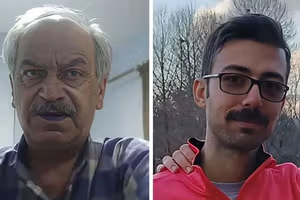
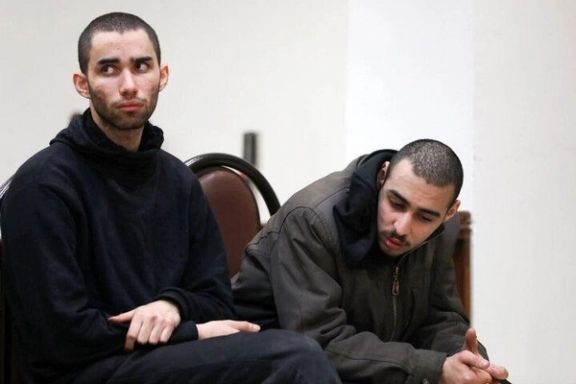
Mohammadamin Biglari and Shahin Vahedparast

Iran executed two men on Sunday over accusations that they tried to storm a military site and gain access to an armory during the January protests, according to Mizan, the judiciary’s news outlet.

Mizan identified the two as Mohammadamin Biglari and Shahin Vahedparast and said their death sentences had been upheld by the Supreme Court.

State media accused the two men of taking part in the protests in January 2026, entering a military site in Tehran, helping damage and set fire to the facility, and trying to reach its weapons storage area.

The report also said authorities accused a group involved in the case of trying to enter military and security sites, including police stations, Basij bases and other restricted locations, with the aim of stealing weapons and military equipment.

The two were among four defendants in the same case who had faced execution, according to Amnesty International.

On Saturday, Iran executed two men, Abolhassan Montazer and Vahid Bani-Amerian, over charges including “armed rebellion,” membership in the Mojahedin-e Khalq (MEK) opposition group and plotting attacks using rocket launchers.

Last week, Iran executed 18-year-old Amirhossein Hatami, who had been convicted in the same case linked to the nationwide anti-government protests that the Islamic Republic repressed in what became its broadest crackdown to date.

In a recent report, Amnesty said 11 men were at risk of imminent execution over participation in the protests. The rights group said they had been subjected to torture and other ill-treatment in detention before being convicted in grossly unfair trials based on forced confessions.

Most Viewed

Iran’s wartime messaging targets its own citizens
1
INSIGHT

Iran’s wartime messaging targets its own citizens

2

Two more political prisoners executed in Iran

3

Hardliners pile on 'traitor' Zarif, urge his arrest over call for end of war

4

Multiple US aircraft downed or damaged in bruising day of losses in Iran war

5

Iran executes two men as protest-related hangings continue

Banner
Banner

Spotlight

  • UAE crackdown could hit Iran’s wider shadow network, experts say
    PODCAST

    UAE crackdown could hit Iran’s wider shadow network, experts say

  • Trump’s ‘Stone Age’ threat draws fury from Iranians
    INSIGHT

    Trump’s ‘Stone Age’ threat draws fury from Iranians

  • Iran’s wartime messaging targets its own citizens
    INSIGHT

    Iran’s wartime messaging targets its own citizens

  • War follows us Iranian scientists far from home
    OPINION

    War follows us Iranian scientists far from home

  • War tests Iran’s Dubai trade lifeline
    ANALYSIS

    War tests Iran’s Dubai trade lifeline

  • Iran executes protest detainee over Basij base fire case

    Iran executes protest detainee over Basij base fire case

  • Two more political prisoners executed in Iran

    Two more political prisoners executed in Iran

•
•
•

More Stories

Two more political prisoners executed in Iran

Apr 4, 2026, 08:15 GMT+1

Iran’s judiciary said two political prisoners were executed on Saturday after their death sentences were upheld, in the latest use of capital punishment in security-related cases.

“Abolhassan Montazer and Vahid Bani-Amerian were executed on April 4,” judiciary outlet Mizan wrote, describing them as “terrorists” and listing charges including “armed rebellion,” membership in the Mojahedin-e Khalq (MEK) opposition group and plotting attacks using rocket launchers.

The report said the two were arrested while allegedly preparing to carry out an attack and that the court relied on what it described as confessions and evidence.

Charges and prior sentences

Mizan said Montazer was an “organizational member” of the MEK involved in armed activities, including preparing safe houses used to build launchers and improvised explosives.

Bani-Amerian was accused of conducting propaganda activities in support of the group and taking part in operations targeting various locations.

Both men were sentenced to death in December 2024 by Branch 26 of Tehran’s Revolutionary Court under Judge Iman Afshari, alongside four others.

The Islamic Republic had already executed four of those co-defendants – Akbar Daneshvarkar and Mohammad Taghavi Sangdehi on March 30, and Pouya Ghobadi Boostani and Babak Alipour on March 31 – on similar charges.

Rising executions and concerns

The latest executions come amid a broader increase in capital punishment tied to protest-related and security cases.

Authorities have also executed Amirhossein Hatami on April 2, as well as Saleh Mohammadi, Mehdi Ghasemi and Saeed Davoudi on March 18, all detained during January protests.

On March 17, the Islamic Republic also carried out the execution of Iranian-Swedish dual national Kourosh Keyvani on espionage charges.

  • Iran executes Swedish citizen accused of spying for Israel, judiciary says

    Iran executes Swedish citizen accused of spying for Israel, judiciary says

Rights groups have warned that thousands of detainees could face similar risks, citing an intensified crackdown that has expanded the use of charges such as “terrorism” against protesters.

The recent wave of executions underscores the continued reliance on capital punishment in Iran’s handling of political dissent, even as broader internal and external pressures persist.

Iran’s wartime messaging targets its own citizens

Apr 3, 2026, 16:38 GMT+1
•
Behrouz Turani

Iran’s state broadcaster has adopted a noticeably harsher tone toward dissent, increasingly framing domestic protests as part of a war waged by “enemies.”

One of the clearest examples came on March 10, when Police Commander Ahmad-Reza Radan addressed the possibility of protests during the conflict.

Speaking on state television, he warned that anyone who took to the streets “at the will of the enemy” would no longer be treated as a protester but as an “enemy combatant.”

The wording marked a significant escalation. By invoking the language of combat, the state effectively framed domestic dissent as participation in the war itself.

Such framing has appeared repeatedly in recent broadcasts. Commentators and officials frequently describe protests not as political grievances but as extensions of foreign military pressure.

The same rhetorical shift is evident in the way foreign adversaries are described. Television hosts increasingly employ dehumanizing metaphors to portray Western and Israeli leaders.

Israeli officials have been repeatedly referred to as “rabid dogs” on talk shows, imagery that casts them as biological threats rather than political opponents.

Foreign-based Persian-language media outlets are portrayed in similarly extreme terms. Iran International TV, for example, has been described on state television as a “satanic network,” while presenters have warned that its regional offices could be considered legitimate targets.

The tone is often even more unrestrained online, where state television presenters engage in public taunts and insults with Israeli officials and journalists on social media.

The language echoes wartime propaganda seen in many conflicts, where demonization of the enemy is used to mobilize domestic support. But the Iranian broadcasts go further by combining this rhetoric with arguments that dismiss international norms governing warfare.

On several television panel discussions in March, state-aligned analysts suggested that international humanitarian law and institutions such as the United Nations serve merely as tools of Western power.

Some commentators declared bluntly that “the age of diplomacy is dead” and that the West understands only “the language of missiles.”

In this atmosphere, messaging increasingly serves not only to condemn foreign adversaries but also to warn domestic audiences about the consequences of dissent.

When protests are described as actions carried out “at the will of the enemy,” the implication is that political opposition itself becomes a form of collaboration with hostile powers.

Wars have always reshaped political language. Governments under military pressure tend to simplify narratives, divide the world into allies and enemies, and suppress ambiguity. Iran’s state television now appears to be moving decisively in that direction.

When state television begins speaking about its own citizens in the language of the battlefield, it signals that the war is no longer being presented as something happening only beyond the country’s borders.
Iran child recruitment amounts to war crime, Amnesty says

Apr 3, 2026, 07:55 GMT+1

Amnesty International said on Thursday that Iran’s recruitment of children as young as 12 for roles linked to the Islamic Revolutionary Guard Corps amounts to a war crime.

The statement follows remarks aired on state media by IRGC official Rahim Nadali, who said the minimum age for participation in support roles such as patrols, checkpoints and logistics had been lowered to 12 under a campaign encouraging volunteers.

“Given that the age of those coming forward has dropped … we lowered the minimum age to 12,” Nadali said, adding that 12- and 13-year-olds could take part if they wished.

“The Iranian authorities are shamelessly encouraging children as young as 12 to join an IRGC-run military campaign,” Amnesty said, adding that “recruiting children under 15 into the armed forces constitutes a war crime.”

The group cited video and eyewitness accounts which it said showed minors deployed at checkpoints and patrols, some carrying weapons, exposing them to risk as US and Israeli strikes target IRGC-linked sites across the country.

  • Children as young as 12 can join war support, IRGC says

    Children as young as 12 can join war support, IRGC says

The development has revived concerns over the use of minors in security roles in Iran, including during the 2022 protests triggered by the death of Mahsa Amini, when images appeared to show children and teenagers in military-style gear.

Human rights groups have also accused Iranian authorities of killing child protesters during past crackdowns, with the Center for Human Rights in Iran saying more than 200 children were killed during unrest earlier this year.

Amnesty said the recruitment comes despite Iran’s commitments under the Convention on the Rights of the Child, which prohibits the use of children in military activities, and called on authorities to immediately stop enlisting anyone under 18.

Iran state TV warns public against disclosing officials’ hiding places

Apr 3, 2026, 01:53 GMT+1

Iranian state television has escalated its messaging by warning citizens not to reveal the locations of officials hiding among civilians.

As the regional conflict involving Iran, Israel, and the United States escalates, Iran’s state broadcaster, Islamic Republic of Iran Broadcasting (IRIB), has undergone a marked transformation in tone and language.

In a segment of a program on Iran’s state broadcaster, presenter Mohammad Jafar Khosravi acknowledged that officials are hiding in safe houses among ordinary citizens and urged the public not to reveal their locations, warning that otherwise they would be “finished” and targeted.

Alongside this shift, dehumanizing language toward foreign adversaries has become increasingly common. Following intensified strikes in late February, IRIB hosts and commentators repeatedly described Israeli officials as “rabid dogs,” portraying them as threats that must be eliminated.

The escalation in tone extends beyond broadcast television. On social media platform X, IRIB presenters have engaged in increasingly personal exchanges with Israeli officials.

Figures such as Ameneh Saadat Zabihpour and Ali Rezvani, both sanctioned by the United States in 2022 as "Interrogator Journalists", have traded insults with Israeli spokespersons, with some interactions descending into personal attacks, religious provocation, and inflammatory rhetoric.

"After blunt death threats by the Revolutionary Guard, aired on State TV and the televised intimidation of the women's football team, State TV presenters are openly calling for the murder of the people of Iran," the Iranian Independent Filmmakers Association (IIFMA) said in a post on its Instagram.

"The recent calls for 'shoot-to-kill' verdicts make the broadcaster an instrument of direct attack on a population already reeling from the violent suppression of January uprising," the Association said last month.

Drug shortages push essential medicines in Iran to record prices

Apr 2, 2026, 13:52 GMT+1

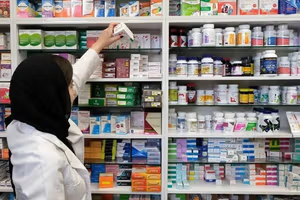
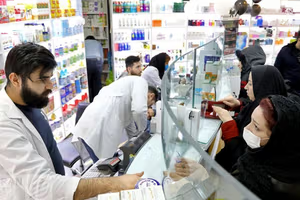
Residents told Iran International that severe shortages and soaring prices for key medicines, including insulin and blood thinners, have persisted over the past month, with some insulin brands reaching seventy million rials (≈$46.7).

Several citizens said the price of Ryzodeg insulin jumped from 12 million rials (≈$8) to 76 million rials (≈$51). Five-dose packs of NovoRapid and Lantus now sell for 15–18 million rials (≈$10–$12).

A resident reported that the blood thinner Plavix, crucial to preventing strokes and heart attacks, rose from 7.5 million rials (≈$5) to 27 million rials (≈$18) in recent weeks.

An ordinary Iranian citizen earns approximately $100–$150 per month.

Shortages leave patients struggling

Before the war and US-Israeli attacks, insulin was already limited, with insurance covering only one dose per week. Residents say the scarcity has now reached crisis levels.

One citizen in Parand near Tehran said: “I couldn’t find my diabetes medications for a month, even without a prescription. Two types, Lantus and Apidra, usually last a week each, but I ran out completely.”

  • Iran drug stocks under two months, 800 medicines at risk as FX delays bite

    Iran drug stocks under two months, 800 medicines at risk as FX delays bite

Another said his mother had to travel from Karaj to Qazvin (over 110 km) to obtain essential medicines. Tehran residents report difficulty finding Asentra (sertraline) for depression and Iran-made blood thinner Osvix.

Supply chain disruptions deepen crisis

Residents link shortages to halted imports from Turkey and Dubai. A transit driver said fewer registered shipments have reduced cargo flow. Local distributors have paused sales, while pharmacies face delayed deliveries and payments.

“Our city has more pharmacies than any other shop, but even acetaminophen is unavailable,” a Sari resident in northern Iran said.

The shortages coincide with rising food prices and widespread business closures, adding to economic strain.

However, Mohammad Reza Aref, First Vice President, said on Wednesday that strategic drug reserves are in good condition and ordered “immediate import” of essential medicines. Residents, however, continue to report high prices and irregular availability.

Global healthcare impact

NHS England chief executive Sir Jim Mackey warned that the Iran war could disrupt healthcare supplies internationally. Speaking to LBC Radio on Wednesday, Mackey said syringes, gloves, and intravenous bags may become scarce due to the closure of the Strait of Hormuz.

  • Iran faces looming medicine shortages as UN sanctions strain drug supply chains

    Iran faces looming medicine shortages as UN sanctions strain drug supply chains

“A team has been set up across the NHS to assess risks through the supply chains. Almost everything may be at risk, as Britain relies heavily on imports for medicines and healthcare equipment,” Mackey said.

Medicines UK chief executive Mark Samuels said Britain could face further shortages if the conflict prolongs, noting that 85 percent of NHS medicines are generic and largely sourced from India.