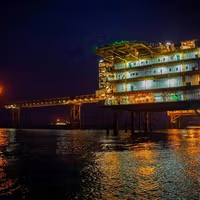
For more than a decade, Tehran has invested heavily in the Jask oil terminal, a project designed to shift part of its crude exports to the Gulf of Oman and create an alternative export route outside the Persian Gulf in times of crisis. Yet the data suggests the terminal has so far played only a marginal role in Iran’s export system.
According to Kpler data, Iran loaded an average of about 1.84 million barrels per day (bpd) of crude during the first 25 days of March. The contribution of the Jask terminal remained minimal.
Average loadings from Jask stood at roughly 81,000 bpd during this period—less than 5% of Iran’s total crude exports.
Historical patterns suggest this limitation may be structural. Iran first initiated exports from Jask in October 2024 amid heightened military tensions with Israel. Even then, volumes remained modest at around 77,000 bpd. In March 2025, exports from the terminal averaged roughly 54,000 bpd.
This is despite the fact that Jask is connected to Iran’s main oil-producing regions through a pipeline stretching nearly 1,000 kilometers, an infrastructure investment intended to enable significant export capacity outside the Persian Gulf.
In practice, Iran’s dependence on Kharg Island remains overwhelming.
Kpler data indicates that more than 84% of Iran’s oil exports in March were loaded from Kharg, while Jask accounted for just 4.4%. Another roughly 10% originated from the Soroush and South Pars terminals in the Persian Gulf.
Such concentration creates a clear strategic vulnerability: any disruption at Kharg could severely cripple Iran’s oil exports.
The question has gained renewed relevance as the war between Iran and the United States and Israel has intensified. The Strait of Hormuz—through which roughly a fifth of global oil trade passes—has become a central point of tension, with Tehran periodically restricting maritime traffic.
At the same time, reports have emerged of expanding US military operations in the region, including contingency planning involving strategic islands near the Strait of Hormuz that could be used to control access to the waterway.
In such a scenario, Iran’s continued reliance on export infrastructure concentrated around Kharg would leave its oil trade exposed to disruption.
Overall, the export data underscores a fundamental reality: despite years of investment, Iran has not succeeded in meaningfully reducing its dependence on the Strait of Hormuz—or, more critically, on the Kharg export hub.
In a volatile regional environment, that dependence represents a significant structural weakness.