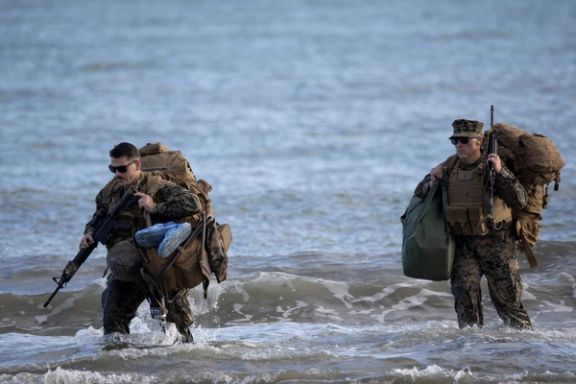
US Marines disembark from a U.S. Navy Landing Craft Utility (LCU) during amphibious operations in Arroyo, Puerto Rico, December 9, 2025
Some Tehran commentators say any US attempt to seize Iranian islands in the Persian Gulf could play directly into the IRGC’s long-standing strategy of capturing American troops for leverage.
Much of the commentary in Iranian media and political circles frames such a scenario as an opportunity rather than a risk for Tehran, arguing that deploying US forces on Iranian territory would expose them to capture by the Islamic Revolutionary Guard Corps (IRGC) and potentially inflict a political humiliation on Washington.
The idea has deep roots in Iran’s political rhetoric. Mohsen Rezai, the former IRGC commander who once floated the proposal of capturing US troops and demanding large sums for their release, now serves as a senior military adviser to Iran’s new Supreme Leader, Mojtaba Khamenei.
Former IRGC commander Hossein Kanani Moghaddam said last week that one scenario allegedly considered by the United States involved focusing on Iran’s southern islands and attempting to seize them to gain control over Persian Gulf oil routes.
“If Trump were to deploy air and naval forces along with Delta Force commandos in a ground operation, the battlefield would shift entirely in our favor,” Kanani Moghaddam said. “By killing or capturing American soldiers, we could raise the level of US losses to a point where they would quickly regret their actions.”
He added that such losses could trigger a political backlash in Washington and even lead to impeachment proceedings against President Donald Trump.
The prospect of an occupation of an Iranian island has also been linked in Iranian commentary to the broader diplomatic standoff between Tehran and Washington.
Despite Trump’s references to “constructive negotiations,” Iranian officials argue that US military threats undermine any possibility of diplomacy.
On March 25, Foreign Ministry spokesman Esmail Baghaei said Iran had already experienced “two catastrophic examples” of trusting US diplomacy. “Over the past nine months, the United States has attacked Iran twice in the middle of negotiations,” he said. “This was a betrayal of diplomacy.”
In a March 23 interview with the Iranian outlet Fararu, Jalal Sadatian, Iran’s former chief diplomat in London, said Trump could not simultaneously threaten military action against Iranian territory while expecting Tehran to accept ceasefire proposals.
Sadatian also warned that Iranian retaliation could expand beyond direct confrontation with US forces. He pointed to the IRGC’s earlier warnings that electricity-generation facilities and desalination plants in regional countries could be targeted if Iran’s own critical infrastructure were attacked.
According to Sadatian, Tehran had long warned that any attack on Iran would trigger a broader regional war. He argued that Washington underestimated Iran’s willingness and ability to strike US bases across the region.
Masoud Pezeshkian appointed Mohammad Bagher Zolghadr as secretary of Iran’s Supreme National Security Council under direct pressure from senior commanders of the Islamic Revolutionary Guard Corps, including newly installed IRGC chief Ahmad Vahidi, according to informed sources.
The sources, who spoke on condition of anonymity due to the sensitivity of the matter, said the appointment was imposed on Pezeshkian and other members of the council amid intensifying internal struggles within the Islamic Republic’s new leadership and as part of the IRGC’s effort to consolidate full control over power.
According to the sources, following the killing of Ali Larijani—and with no visible sign of Mojtaba Khamenei participating in decision-making—the IRGC selected Zolghadr as the new secretary of the Supreme National Security Council.
Despite opposition from some remaining senior officials and Pezeshkian’s own dissatisfaction, the Guards compelled the president to issue the appointment decree.
Mehdi Tabatabaei, deputy for communications and information at Pezeshkian’s office, confirmed the appointment on Tuesday in a post on X, writing: “With the opinion and approval of the esteemed leader of the Islamic Revolution, and by decree of President Masoud Pezeshkian, Mohammad Bagher Zolghadr has been appointed secretary of the Supreme National Security Council.”
Sources told Iran International that the move reflects the diminishing role of Pezeshkian’s government and other power centers within the Islamic Republic’s highest security decision-making body.
It also highlights the IRGC’s expanding dominance over the country’s power structure, particularly over the Supreme National Security Council.
Mohammad Bagher Ghaziani, better known as Mohammad Bagher Zolghadr, currently also serves as secretary of the Expediency Council. In 2021 he replaced Mohsen Rezaei in that position by decree of Sadegh Amoli Larijani.
Following the killing of Mohammad Pakpour, Ahmad Vahidi was introduced as commander-in-chief of the IRGC, although no formal appointment decree signed by Mojtaba Khamenei—the Islamic Republic’s new leader and commander-in-chief—has been made public.
Vahidi Shahcheraghi, known as Ahmad Vahidi, had previously been appointed deputy commander of the IRGC by former Supreme Leader Ali Khamenei on December 27, 2025, replacing Ali Fadavi. After Hossein Salami was killed during the 12-day war, Ali Khamenei had named Mohammad Pakpour as IRGC commander-in-chief.
Despite the absence of any publicly released decree signed by Mojtaba Khamenei, Vahidi has now been introduced as commander-in-chief of the IRGC.
At the same time, Mohsen Rezaei, a former IRGC commander, has reportedly been appointed as Mojtaba Khamenei’s military adviser under a decree attributed to the new leader.
Since Mojtaba Khamenei was introduced as the Islamic Republic’s third supreme leader, he has not appeared in public, and only a few written messages attributed to him have been released.
US President Donald Trump and senior members of his administration—including Vice President J.D. Vance and Defense Secretary Pete Hegseth—have said Mojtaba Khamenei is alive but seriously wounded. They have also emphasized that there is no sign of him actively exercising authority in the Islamic Republic.
Senior Israeli officials, including Prime Minister Benjamin Netanyahu, have likewise reported that Mojtaba Khamenei was injured and warned that there is no guarantee he will survive.
Iran’s economy is no longer merely experiencing high inflation; it is exhibiting the structural symptoms of a nation losing faith in its own currency and facing a shift in its monetary regime.
Over the past year, a pattern has emerged across markets, policy decisions and price behavior pointing to the early stages of de facto dollarization.
In April 2025, when a “five-dollar pizza” shop opened in Tehran’s affluent Niavaran neighborhood, many dismissed the fixed dollar price as a marketing gimmick. At the time, one pizza cost roughly 5 million rials, with inflation reportedly above 40%.
Less than a year later, on the eve of the current war, the same pizza was priced at 8.6 million rials, while officials acknowledged inflation exceeding 70%. What initially appeared symbolic began to look practical.
The shift was not confined to niche businesses and high-end stores. Informal dollar transactions, once largely limited to luxury goods or services aimed at foreign customers, steadily expanded.
In the months leading up to the 12-day war, despite the departure of many foreign nationals, dollar-pegged property sales and rentals increased noticeably. While upscale properties led the trend, mid-range apartments also entered the market with dollar-based pricing.
By the end of 2025, the US dollar had climbed to 1,430,000 rials, up from 800,000 in January of the same year. The volatility hit the automotive market hard. With car production concentrated among three major state-linked manufacturers and supply unable to meet demand, the price of second-hand cars in rial terms outpaced the increase in the dollar exchange rate.
Media headlines read, “The dollar is in the driver’s seat,” and traders increasingly priced vehicles in dollars. In December, automobile market expert Abdollah Babaei warned that if current trends continued, car transactions would effectively become dollarized.
Economists began warning of a structural shift. Former Tehran Stock Exchange chief Hossein Abdeh Tabrizi cautioned that Iran "will enter the stage of dollarization" if 60% inflation and government overspending continued.
he statement went viral, and many echoed the growing concern that “Iran’s economy is on a dangerous path,” with the rial losing its function both as a store of value and as a unit of account.
Government policy after the 12-day war reinforced these anxieties.
The administration’s 2026–2027 budget introduced three pivotal shifts. First, gasoline subsidies moved from a liter-based rationing system to cash transfers. Second, an inflation coefficient was added to the pricing formula of Iran’s key commodity anchor. Third, the preferential exchange rate was abruptly removed in December, converting the government’s largest dollar commitment into rial-based direct subsidies.
Perhaps most striking was the historic decline in oil revenue’s share of the budget—from about 32% in 2025–2026 to just 5% in 2026–2027, the lowest level since the 1960s.
To compensate, taxes were increased by more than 60%. Across these measures, the common denominator was clear: the state systematically reduced its foreign-currency and commodity obligations, converting them into rial-based commitments. The administration that campaigned on taming inflation now appeared increasingly reliant on inflationary financing to navigate wartime pressures.
In February, before the outbreak of the second war, average inflation for basic necessities reached triple digits, estimated between 105% and 115%. Reacting to these concerns, the administration pushed to remove four zeros from the rial, presenting it as a technical reform to simplify calculations.
In reality, redenomination in a high-inflation environment is an expensive cosmetic surgery on a patient on his deathbed—an adjustment that quickly loses meaning as prices continue to rise.
During the second war, market closures, the suspension of price discovery in the exchange market, and reduced demand slowed money circulation and provided short-term inflationary relief. At the same time, large banks halted operations, increasing demand for physical cash.
The Central Bank responded by issuing a 10-million-rial banknote—raising the highest denomination one hundredfold from 100,000 rials—a step it had resisted for years.
But such pauses rarely eliminate underlying pressures. When markets fully reopen and normal trading resumes, deferred demand for foreign currency is likely to return. A similar pattern followed the 12 day war, when pent-up demand translated into a rapid adjustment in prices once restrictions eased.
Even under conservative assumptions, inflation could move decisively into triple-digit territory if monetary expansion continues. At that point, the shift toward dollar pricing would no longer be limited to select sectors. It would spread more systematically across contracts, wages and savings behavior.
Dollarization rarely begins with legislation; it begins with economic self-preservation. It starts with a pizza menu, moves to apartment contracts and car listings, and eventually reshapes fiscal expectations.
If post-war reopening triggers another inflationary wave, the timeline may not be measured in years but in quarters. Under such conditions, the transition toward de facto dollarization would become increasingly difficult to reverse.
A foundational figure of the Islamic Revolutionary Guard Corps, Mohammad Bagher Zolghadr’s rise signals not a shift, but a moment of clarity — the same hardline system, now accelerating and more visible than ever.
The longtime hardliner is the new chief of the Supreme National Security Council to replace his slain predecessor Ali Larijani, state television said Tuesday.
Zolghadr is not a new figure emerging in a moment of crisis, but a product of the Islamic Republic’s original revolutionary security networks. A man whose career spans armed militancy, senior command within the Islamic Revolutionary Guard Corps (IRGC) and influential roles across Iran’s political and judicial institutions.
“He is one of the last remnants of the radical revolutionaries that armed themselves against the Pahlavi monarchy,” historian Shahram Kholdi told Iran International.
A former deputy commander of the IRGC, Zolghadr belongs to the generation that helped transform the Guards into the backbone of the Islamic Republic not only as a military force, but as a political and economic power center. Over decades, the IRGC expanded its reach across the state, embedding itself in key institutions from the interior ministry to the judiciary.
Kholdi traces Zolghadr back to the early networks that evolved into the Quds Force — the IRGC’s elite unit responsible for managing Iran’s proxy militias and projecting power across the Middle East placing him alongside the system later commanded by Qassem Soleimani, the architect of Iran’s regional strategy.
His appointment following the killing of Larijani underscores what many analysts see as an accelerating trend: the consolidation of power by hardline military figures. What has been a gradual shift over decades appears to have intensified amid the current conflict, with the Guards tightening their grip over both national security and political decision-making.
The Quds Force, the IRGC’s external arm, has been at the center of Iran’s regional power projection, training and directing militias from Iraq to Syria, where it helped sustain Bashar al-Assad’s war in a conflict marked by widespread civilian suffering.
“He is part of the three to four thousand families that have been forming the power core of the Islamic Republic,” Kholdi said.
Zolghadr’s rise does not mark a departure from that system, but a continuation of it, reflecting the enduring dominance of a tightly knit network of insiders drawn from the Islamic Republic’s revolutionary and security institutions.
His role in internal repression also stretches back decades. During the 1999 student protests — a pivotal moment in the regime’s violent suppression of dissent— Zolghadr was among a group of senior IRGC commanders who signed a sharply worded letter to then-reformist President Mohammad Khatami. The message warned that if the government failed to decisively crush the unrest, the Guards would act on their own. The episode is widely seen as a turning point, marking a more overt willingness by the IRGC to intervene directly in politics and, for many Iranians, cementing the reform movement’s ultimate failure.
His political trajectory has long aligned with Iran’s most hardline currents. He played a role in the rise of former hardline president Mahmoud Ahmadinejad and later acknowledged that conservative factions had carried out coordinated efforts to secure that victory. In office, he adopted a confrontational posture toward the United States, warning that Iran would respond to any attack with overwhelming missile strikes.
During the Iran-Iraq War, he led units he fought in cross-border operations, which is experience that would help shape the regime’s enduring emphasis on asymmetrical warfare.
According to Kholdi, Zolghadr was among those who helped design that doctrine alongside figures like Qassem Soleimani — building a decentralized system capable of operating even under sustained attack.
“They created this asymmetrical hierarchy where units can act independently… and continue operating even if leadership is cut off,” Kholdi said.
That system is now visible in Iran’s military posture, with dispersed missile and drone capabilities across the region.
Kholdi also points to Zolghadr’s deep institutional knowledge as a key factor in his significance today.
“The fact that he hasn’t been eliminated is bad news — he is one of the main people who knows a lot about how this system works,” he said, adding that Zolghadr likely has insight into sensitive areas including the country’s nuclear program.
For ordinary Iranians, his rise is much the same as his predecessor Ali Larijani, who was eliminated in an Israeli airstrike overnight on March 16 in Tehran.
“No, he is much the same,” Kholdi said when asked whether Zolghadr differs from figures like Larijani.
His appointment underscores a consistent reality: power in the Islamic Republic remains concentrated within a small circle of entrenched insiders — many of whom have been at the center of the system since its earliest days.
Remarks by Donald Trump suggesting backchannel contacts with a figure inside Iran’s government have stirred intense political debate in Tehran.
The controversy intensified after reports by Israel’s Channel 11 and Politico suggested that Parliament Speaker Mohammad-Bagher Ghalibaf could be the “pragmatic partner” potentially engaging with the Trump administration.
According to the Politico report, “at least some White House officials see him as someone who could lead Iran and negotiate in a next phase of conflict with the Trump administration.” However, the report added that the White House “is not yet ready to bet on a single figure” and is exploring multiple options.
The mere suggestion that a sitting Iranian parliament speaker could be engaged—formally or informally—with Washington carries significant implications within Iran’s political system, where any perception of independent diplomatic outreach can trigger backlash, particularly during periods of heightened tension.
Iran’s Revolutionary Guards (IRGC)-linked media outlets have strongly rejected claims of secret negotiations.
Fars News Agency described the reports as a “psychological operation,” asserting that the narrative was designed with three goals: “character assassination of Ghalibaf, incitement toward possible physical targeting, and sowing division in the country.”
Similarly, Tasnim News Agency called the reports a “complex enemy design to create the perception of internal tension,” arguing that it aimed to distract political forces from the ongoing conflict.
Even political figures outside Ghalibaf’s immediate camp have echoed concerns about psychological warfare.
Mohammad-Javad Azari-Jahromi, telecommunications minister under President Hassan Rouhani, wrote on X that Trump’s contradictory statements—and media suggestions that Ghalibaf could be conducting secret talks—are intended to “create division within the government and among military forces.”
Hesameddin Ashena, a former media adviser to Rouhani, also warned of “character assassination,” describing the amplification of such claims as effectively “aligning with the enemy.”
Iranian officials have acknowledged indirect communications with Washington through intermediaries. Foreign Minister Abbas Araghchi and spokesman Esmail Baghaei said countries such as Egypt, Turkey, and Pakistan have been exchanging messages between the two sides in recent days in an effort to reduce tensions.
At the same time, Iranian officials stressed that Tehran’s core positions remain unchanged.
These include its stance on the potential closure of the Strait of Hormuz—a position that has contributed to escalating rhetoric, including reported threats by Trump to target Iran’s energy infrastructure and impose a short deadline.
An Iranian official told Al Jazeera that Washington has so far refused to meet Tehran’s key conditions for negotiations: “payment of war reparations and acknowledgment of aggression against Iranian territory.”
Meanwhile, reports from Reuters and The Wall Street Journal suggest that potential talks to end the conflict could take place in Pakistan or Turkey, possibly involving figures such as Steve Witkoff, Jared Kushner, and Vice President J. D. Vance in the coming days.
Despite official denials, the issue has gained traction on social media—particularly among Iranians abroad, given severe internet restrictions inside Iran since the war began.
Thousands of responses to Ghalibaf’s denial of secret talks with Washington on X framed the issue in terms of suspicion and alleged betrayal.
Some users pointed to his absence from certain recent public events, while others noted that his name had not appeared in US bounty lists targeting Iranian officials, interpreting this as suspicious though without evidence.
Others revived longstanding allegations of financial corruption and nepotism raised by hardline factions such as the Paydari Front and supporters of Saeed Jalili—claims that have circulated in Iran’s political rivalries for years.
Mohammad Bagher Ghalibaf may soon be called a pragmatist. That would be a mistake.
The Rebrand Begins
The pattern is familiar. When Ali Larijani was killed in an Israeli strike last week, some Western coverage quickly reached for the usual labels: practical, moderate, easier to work with than the other men around him. Ghalibaf may now be next. He is now the most senior surviving figure in the Islamic Republic with deep IRGC roots. That puts him in a dangerous and important position. He could become the next major assassination target. He could also be sold as a channel to the West in a system that increasingly looks like an IRGC republic.
At the very moment that reports are emerging of further U.S. military steps around Iran, there are also reports that JD Vance may soon meet senior regime figures. Ghalibaf may be one of them. We do not know whether those reports are true, whether any such contact will take place, or who exactly would be involved. No name has been officially confirmed. But if such a meeting does happen, it may prove clarifying. Vance belongs to the isolationist wing of the Trump administration. A meeting with Ghalibaf or another senior regime figure would give Vance a direct look at who actually holds power in Iran and the kind of men the administration would be dealing with. That could matter if the war deepens and the isolationist wing has to judge the regime more directly.
As I argued in an earlier piece, ambiguity about potential contacts is already doing political work, unsettling senior officials in Iran as they wonder who may be talking to Washington. This piece makes a different point. The same ambiguity can also create openings for the wrong kind of figure to be misread as a moderate or a usable channel.
But Ghalibaf is not a moderate. He is not a hidden reformer. He is not a practical man trapped inside an ideological state. He is a hardliner, corrupt to the bone, who has spent years trying to look like something else.
Ghalibaf has always been ambitious. He once cast himself as the Islamic Republic’s version of a modernising strongman, even using the language of an “Islamic Reza Khan.” He wanted the presidency and, for years, carried himself like Iran’s next president. He ran in four presidential elections after 2005. Around him, that ambition produced a political project: to present Ghalibaf not as just another insider, but as the man who could impose order after Khamenei.
That image was built not only for domestic politics. It was built for foreign eyes too.
How the image was built
Inside the system, Ghalibaf is a hardliner and a loyal product of the regime. Outside that circle, especially in private meetings and foreign-facing conversations, he has long tried to present himself as more modern, more practical, more disciplined, and less ideological than the Islamic Republic’s usual faces. He has tried to market himself as the man who could keep the system in place while making it easier for the outside world to deal with.
By mid-2024, that effort was already visible. On June 10, IranWire reported that people presenting themselves as Ghalibaf’s advisers had spent the previous two weeks approaching European and American diplomats with a clear message: Iran would need a strongman after Khamenei, and that strongman should be Ghalibaf. A European diplomat quoted in the report said they were presenting him as the only figure with the authority and connections to contain factional conflict, restore order, improve Iran’s foreign relations, and “cleanse” the regime of radical elements. The diplomat added that academics and think tank figures in Europe and the United States were also involved, suggesting a broader effort to persuade Western officials that Ghalibaf was not merely a candidate, but a future leader they should start accepting now.
My own sources point in the same direction. One source who was in the room told me that, in a meeting with European politicians in a European capital a few years before the IranWire report, Ghalibaf was plainly marketing himself as the kind of Islamic Republic figure the West could do business with after Khamenei. He was not presenting himself as an opponent of the regime. He was presenting himself as a more polished custodian of it: strong enough to control the system at home, but measured enough to speak to foreign capitals abroad.
There was another reason this belief took root. People familiar with the matter say Ghalibaf saw his absence from U.S. sanctions lists as a form of distinction, as if Washington treated him differently from other senior figures in the Islamic Republic. According to those familiar with the issue, the explanation was technical and legal rather than political, particularly because of his role as speaker of parliament. Even so, the coincidence seems to have had a real political effect. It fed his belief that he was seen abroad as a more acceptable and more usable figure than others in the system.
According to sources inside Iran, this also made parts of the regime suspicious of him. Some in the intelligence apparatus viewed his unsanctioned status with distrust and asked why a man of his seniority had escaped measures imposed on others. His ability to travel to the West only added to that unease. Ghalibaf is a pilot and, according to these sources, has at times flown aircraft himself, including on trips to London to keep his pilot credentials current. That too strengthened the sense among some insiders that he occupied an unusual place in the regime’s external profile.
The Record Behind the Image
But the image collapses the moment one looks at the record.
Ghalibaf is not a reformer held back by the system. He is one of its purest products. He rose through the Revolutionary Guards, the police, the municipality, and the institutions that sustain power in the Islamic Republic. His name is tied not only to hardline politics but also to repression, corruption, and elite hypocrisy.
For many Iranians, his role in repression has made him one of the most hated faces of the Islamic Republic. He is linked not only to the student crackdowns but also to the coercive institutions that kept the system alive through fear and force.
His corruption record is just as important. His years as mayor of Tehran are tied to some of the best-known scandals of that period, including the “astronomical properties” affair and the wider Yas Holding and Isa Sharifi case. These were not minor accusations at the edge of his career. They became part of the political meaning of his name.
The family scandals tell the same story. “Sismoni-gate” was politically damaging not because it was the gravest case against him, but because it exposed the hypocrisy of the ruling class. While the regime preached sacrifice and resistance, members of Ghalibaf’s family were seen shopping in Turkey for baby goods. Later came the embarrassment over his son’s attempt to secure permanent residence in Canada. These episodes confirmed a familiar pattern: the men who speak in the language of endurance often arrange private exits for their own families.
Why the West Should Resist the Script
That is why the current moment matters.
As war and decapitation strikes have thinned the Islamic Republic’s upper ranks, Ghalibaf has moved closer to the centre of power. Reports have suggested that he may have been involved in contacts with Washington. He has publicly denied that. He called the reports fake news and rejected any suggestion that negotiations had taken place.
But the deeper point is not whether he is lying or whether the reports are true in full. The deeper point is that his name surfaced so quickly at all. Whether Ghalibaf is really involved is almost secondary. He is exactly the kind of figure around whom such speculation gathers: a hardliner who has spent years trying to present himself as more practical, more modern, and more internationally legible than the rest of the ruling class. That makes him a natural target for rumour, whether or not he is the actual channel.
And that is the danger.
In moments of crisis, some in the West begin looking again for a hard man they can call practical. Faced with chaos in Tehran, they search for someone tough enough to control the machine but polished enough to sound like a statesman. Ghalibaf has spent years preparing for that role. He has tried to look like the man who could preserve the system while making it more manageable for outsiders.
But he is not a post-Khamenei solution. He is a distilled product of the Khamenei system.
Before anyone in the West starts calling him a pragmatist, it is worth remembering what he really is.
He is one of the clearest expressions of the Islamic Republic, and one of its most hated figures in the eyes of the Iranian public. That public is not a bystander here. Less than three months ago, Iranians gave more than 30,000 lives in resistance to the same oppressive system that Ghalibaf stands at the heart of. Anyone thinking of dealing with him should remember that.
And that is the point to make now, before the rebranding begins.