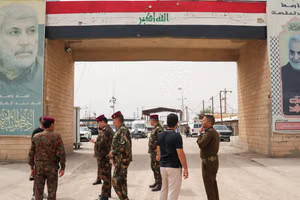
On Thursday, Iraqi forces closed Sheikh Saleh, a crossing in Iran's western Kermanshah province, the Mehr news agency reported, citing the governor of Salas-e Babajani county. He said Baghdad had acted on a central government order to shut "unofficial" crossings with neighboring countries.
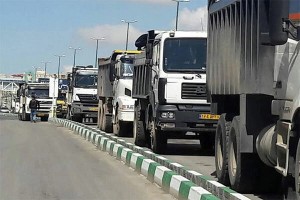
About 300 trucks loaded with goods and building materials were stranded, Kermanshah's customs chief said, and would be rerouted through other crossings.
The same day, Iraq's border forces closed the Bashta crossing with Iran and the al-Waleed crossing with Syria, both run until now by the Kurdistan Regional Government, Reuters reported, citing Iraqi state media.
There were unconfirmed reports that a third crossing, Shoushmi, in Kermanshah's Paveh county, had also been shut. Kermanshah's customs chief said he had received no official notice of it.
'Only two'
Washington asked for this. On November 8, Iraqi Foreign Minister Fuad Hussein said the US Treasury had formally asked Baghdad to close all its crossings with Iran except two, one in the Kurdistan region and one elsewhere in Iraq.
"There are many official and unofficial crossings with Iran, and closing them all is difficult and affects our economy," he told Al Jazeera.
Trade between the two countries is worth $15 billion to $18 billion a year, he said, including about $4 billion in Iranian gas.
The day before, US Central Command had set up Task Force Iron Gate, a unit of about 20 military and civilian staff in Florida, to disrupt the movement of weapons, dual-use technology, sanctioned goods and illicit revenue across Iran's land borders and the Caspian Sea.
Without US personnel at the crossings, it relies on neighboring governments, chiefly Iraq, Turkey and Pakistan, to do the closing.
Open, shut, open again
Iraq and Iran share a border of about 1,600 kilometers, with nine official crossings and many unofficial ones. Over the past six weeks, Baghdad has closed and reopened them one by one, usually citing technical reasons.
On October 21, Iraq closed Chazabeh, known in Iraq as Sheeb, between Iran's Khuzestan province and Iraq's Maysan, citing inadequate preparations.
An adviser to Prime Minister Ali al-Zaidi said Iran had "deliberately undermined Iraq's security," with people linked to it crossing without permits.
Truckers and traders in Maysan protested over rising prices, and the provincial council chairman, who threatened civil disobedience, was briefly detained. Chazabeh reopened on November 10.
On November 13, Iraq closed Somar, known in Iraq as Mandali, between Kermanshah and Iraq's Diyala province, for what it called maintenance before the rainy season. It is still closed.
On November 26, Sheikh Saleh and Bashta followed.
Major crossings such as Mehran, which carries millions of Iranian pilgrims to Karbala each year, remain open.
Why the border matters to Tehran
With its ports under US naval blockade since July and seaborne oil exports all but stopped, Iran depends more than ever on land routes for imports, exports and cash.
Iraq is one of Iran's largest export markets, its biggest buyer of gas and electricity, and a long-standing route around sanctions, through fuel smuggling, currency trading and companies fronting for Iranian interests.
Pro-Iran factions in Baghdad have pushed back. The Badr Organization's bloc in parliament condemned what it called American interference in Iraq's border policy and demanded the crossings reopen, and the Asaib Ahl al-Haq bloc asked why the government's technical explanations differed from the foreign minister's account.
The Revolutionary Guards dismissed Iron Gate, saying Tehran had made arrangements to keep trading with its neighbors.
The pressure comes from more than one direction. Iraq's oil revenues still pass through an account at the Federal Reserve Bank of New York, an arrangement dating from the 2003 US-led invasion, and Washington warned Baghdad this year that it could cut off access to them if Iraq did not reduce Tehran's influence in its government, Reuters reported.
US officials also discussed with Zaidi the idea of Iraq leaving OPEC, Reuters reported. The prime minister raised it with his cabinet, but the oil ministry opposed it and proposed seeking a higher production quota instead. The US government said the issue had not been raised in high-level talks.
A standoff with Erbil
The closures in the Kurdistan region are also part of a separate fight. On Tuesday, Zaidi ordered federal authorities to take over all crossings run by the Kurdistan Regional Government, and the federal oil ministry to take over oil fields held by Kurdish security forces in Diyala, Kirkuk, Salahuddin and Nineveh provinces.
After the Kurdistan Regional Government objected, Iraq's Federal Supreme Court ruled on Wednesday that Baghdad could deploy federal forces along all international borders, including in the region.
Thousands of people protested in the Kurdistan region on Thursday, while supporters of the prime minister rallied in Mosul.
The moves came a week after Zaidi sent troops into Jurf al-Sakhar, a stronghold of the Iran-backed militia Kataib Hezbollah, over an oil smuggling network.
Not all of Baghdad's moves answer to Washington. The operations against smuggling, the push into Jurf al-Sakhar and the takeover of the Kurdistan region's crossings and oil fields also concentrate power in the central government, a goal that overlaps with US demands but is not the same thing.
Both standoffs turn on control of oil, borders and the money that flows across them, and both put Zaidi, who came to power after Washington opposed the return of Nouri al-Maliki, a longtime ally of Tehran, at odds with powerful forces at home.
How far Baghdad can go
Iraq cannot easily cut its ties with Iran. It depends on Iranian gas and electricity, particularly in summer, and Iran-aligned factions sit in parliament, in the governing coalition and in the Popular Mobilization Forces, the state-funded umbrella of armed groups. Moving against them too fast risks unrest at home.
Even Iranian media now describe a shift. Baghdad "appears to be redefining its relations with Tehran," the Iranian news site Rouydad24 wrote on Thursday, in a course that is "less a separation than an effort to increase Iraq's bargaining power with both sides."
Tehran says it can ride out the squeeze. Iran's diplomats, especially in neighboring countries, were working "around the clock" to meet the country's needs and keep trade routes open, Foreign Minister Abbas Araghchi said in the northeastern city of Mashhad.
"The goal is for the enemies to know that besieging Iran is not possible, and that they cannot besiege our country," he said.