Obama says 'unnecessary' Iran war has left Tehran in a stronger position
Former US President Barack Obama accused President Donald Trump of launching an unnecessary war with Iran that had left Tehran in a stronger strategic position, killed American troops and pushed up prices.
Speaking at a campaign rally in Michigan on Saturday, Obama challenged the administration’s claims of victory, saying the conflict had exposed US allies and bases to attacks while giving Iran greater control over shipping through the Strait of Hormuz.
“The current president chose to make a series of bad decisions,” Obama said. “The most important of which was he decided to start an unnecessary war nobody asked for and nobody voted for.”
He contrasted Trump’s decision to go to war with his own administration’s nuclear diplomacy, saying Iran did not possess nuclear weapons and that the 2015 agreement reached during his presidency had curbed its nuclear program.
“I didn’t have to fire a missile. I engaged in diplomacy,” Obama said.
Questioning what the military campaign had achieved, Obama said seven months had passed since the war began and six since the administration declared victory.
“Seven months later, how’s that war going?” he asked.
“Our allies and bases have been attacked,” Obama said.
He argued that Iran’s ability to disrupt the Strait of Hormuz, a critical route for global oil shipments, had strengthened its strategic position.
“Iran now has veto power over the Strait of Hormuz,” he said. “So they’re in a stronger strategic position now than before the war started.”
He blamed the administration’s decision to launch the war for rising oil and diesel prices and broader increases in living costs.
Iranians say they are paying more for slow, unreliable and heavily restricted internet after mobile operators raised data prices by up to 40%, with some reporting that their allowances run out unusually quickly.
Messages sent to Iran International described mounting frustration over the cost of staying connected, from families worried about paying for online classes to users struggling to send even a text message.
“All we have left of life in Iran is passing the time on our phones, and they are taking that away too,” one reader from Baharestan said.
Mobile operators Hamrah-e Aval and Irancell increased their data package prices by up to 40% early on Friday, October 23, according to state media.
One reader said a weekly four-gigabyte package had risen from 330,000 rials ($0.12) to 450,000 rials ($0.17). Another said a monthly six-gigabyte package that cost 530,000 rials ($0.20) three days earlier now cost 740,000 rials ($0.28).
The pressure comes as Iran’s official minimum wage stands at about 166.3 million rials per month, equivalent to roughly $62 at the unofficial-market exchange rate.
Others questioned why prices were rising again after earlier increases before and during the war.
“Didn’t they raise internet prices two months before the 40-day war? Didn’t they raise package prices again during the war, taking advantage of the blackout?” one reader asked, referring to the US-led war that began on February 28. “So what is this latest increase for?”
The higher charges have brought no improvement in service, according to accounts from users across the country.
A reader in the northern province of Mazandaran described Hamrah-e Aval’s connection as moving “at a snail’s pace,” saying Wi-Fi connections in many areas also cut out, even when accessing domestic messaging apps.
In Iranshahr, in southeastern Iran, another reader reported severely degraded ADSL service followed by a complete outage from 8 p.m. on Friday. Another said sending a text message on Telegram was difficult, let alone a photograph or video.
Iran International reported on Friday that users in Semnan, Shiraz, Tabriz, Kerman, Tehran and Tonekabon had complained of sharply slower connections, malfunctioning tools used to bypass internet filtering and difficulty accessing social media.
The Telecommunications Company of Iran has previously attributed some disruptions to “upgrading and optimizing technical infrastructure.”
The complaints come against a backdrop of extensive restrictions on internet access. Freedom House’s 2026 report gave Iran an internet freedom score of nine out of 100, down from 13.
The organization said Iran’s tiered internet system had made access to the global internet difficult and expensive, leaving much of the population restricted to a domestic network controlled by the authorities.
All global social media platforms, from X and Telegram to Facebook, Instagram, TikTok and YouTube, are banned in Iran.
Several readers also accused operators of “stealing data,” saying their allowances were depleted far faster than their usage would explain.
“I topped up my data package two days ago. Today, only 600 megabytes of my six gigabytes are left, even though we don’t have a decent connection,” one reader said.
Another said a six-gigabyte package bought for 570,000 rials ($0.21) had run out within two days despite limited use, and now cost 730,000 rials ($0.27) to replace.
Cost of education
For families, the increases have also raised concerns about the cost of education if gas shortages force schools to move classes online.
One reader said a one-gigabyte Hamrah-e Aval package cost 330,000 rials ($0.12), including tax. “With things like this, how are we supposed to buy data for online classes?”
Another said repeated price increases had left them unable to afford internet access at all.
“We live in a country with vast oil and gas resources,” another reader said, “but we earn in rials and spend in dollars.”
Nazanin Sharifian, also known as Devora Sharifian Bachar, an Iran-born Knesset candidate for Gadi Eisenkot’s Yashar party, during an interview with Iran International (October 2026)
Nazanin Sharifian, an Iran-born former Mossad officer running for Israel’s parliament with Gadi Eisenkot’s Yashar party, told Iran International that Israel should step up military and economic pressure on the Islamic Republic’s leaders and work to end their rule.
“We must do everything we can to bring down the leaders of the Islamic Republic, so this regime is gone and the people of Iran are free,” she told Iran International’s Babak Eshaghi.
Sharifian, a Persian speaker who was born in Iran in 1982 and lived there until she was seven, is a candidate for the Knesset in Tuesday’s election. If Yashar joins the next coalition, she could hold a role in government.
‘The last hope of Iran’
Sharifian called the Islamic Republic Israel’s greatest enemy and an enemy of Iranians as well. Iran’s wealth, she said, goes to Hezbollah and the Houthis instead of to the people it belongs to.
Asked what Yashar’s policy toward Tehran would be, she said it would continue the course set by Prime Minister Benjamin Netanyahu, Eisenkot’s main rival.
“We must intensify this pressure on the leaders of the Islamic Republic,” she said. “We do not want to put pressure on the people of Iran. The people of Iran are the last hope of Iran.”
She called for every available means to be used to end the Islamic Republic’s rule. “I have great faith in the people of Iran,” she said.
Her emphasis on pressure differs from her party leader’s. Eisenkot, a former military chief, said this month that the Islamic Republic’s fall is necessary but cannot be achieved by military action, and that it must come from within Iranian society.
From Tehran to the Mossad
Sharifian was born into a Jewish family. After the 1979 revolution, some relatives left for the United States and Israel, but her father, who ran businesses in Tehran and Isfahan, refused at first to leave. The family fled when she was seven.
In Israel she served in the army, then in the Shin Bet internal security service and the Mossad, Israel’s foreign intelligence agency. Her Persian, she said, was one reason she was moved to the Mossad. She has since taught Persian and Middle East strategy to hundreds of Israeli students.
“I am very proud that my being is Iranian,” she said. Representing Iranians in Israel would be a great honor, she said, adding: “I expect to speak Persian in the Israeli parliament in the future.”
She hopes to bring more people of Iranian origin into Israel’s state institutions, she said, and that one day Iran will be returned to its people.
Workers prepare ballot boxes for distribution, at the Israeli Central Elections Commission warehouse, ahead of Israel's national election, in Shoham, Israel, October 14, 2026.
In 1987, with Khomeini still calling for Israel’s destruction, Israel’s defense minister called Iran its best friend. Today every candidate for prime minister wants the Islamic Republic gone. Israel’s leaders have changed their minds about Iran’s rulers, but seldom disagreed.
That is the thread through 47 years of Israeli policy toward the Islamic Republic, and it runs straight into next Tuesday’s election. Whoever wins, the goal will be the same. What changes is how hard, how openly and with whom Israel pursues it.
The Shah’s friend
Before 1979, Iran was Israel’s most important partner in the region. Under David Ben-Gurion’s “periphery doctrine,” Israel courted non-Arab neighbors to outflank hostile Arab states, and the Shah’s Iran was the prize.
Tehran recognized Israel de facto in 1950, sold it oil through a jointly owned pipeline, and let its intelligence services work with Israel’s Mossad. Israeli engineers, farmers and arms dealers worked across Iran. The relationship was discreet, profitable and close.
The revolution ended it overnight. Islamic Republic's founder Rouhollah Khomeini cut ties, and Israel’s mission in Tehran was handed to the Palestine Liberation Organization.
The enemy of my enemy
Israel’s first leaders after 1979 did not try to bring the new order down. They sold it weapons.
When Iraq invaded Iran in 1980, Menachem Begin’s government shipped arms to Tehran, and Israeli sales ran to an estimated $500 million between 1981 and 1983, according to Tel Aviv University’s Jaffe Institute. Saddam Hussein was the threat, and Iran was the counterweight. In 1985 and 1986, under Shimon Peres, Israel was the go-between in the Iran-Contra affair, passing American missiles to Tehran.
Yitzhak Rabin, then defense minister, explained the logic in October 1987. “Iran is Israel’s best friend and we do not intend to change our position in relation to Tehran, because Khomeini’s regime will not last forever,” he said. The expectation that the Islamic Republic would fall was already there. Israel simply did not think at the time that it was its job to hasten it.
The threat is named
Rabin was also the one who turned. Back as prime minister in 1992, he received the first intelligence reports on an Iranian nuclear program and concluded, aides recalled, that only a nuclear Iran could pose an existential threat Israel could not answer. Part of his case for peace with the Palestinians and Jordan was to clear the near front before facing the far one.
Ariel Sharon took the same view further. In November 2002, as the United States prepared to invade Iraq, he told The Times of London that Iran should be put under pressure “the day after” Baghdad fell, calling it a center of world terror.
As prime minister he carried aerial photographs of Iranian sites to George W. Bush and said Israel “cannot accept” a nuclear Iran. Ehud Olmert, his successor, kept the military option on the table while, according to later reporting, the first cyberattacks on Iran’s centrifuges were set in motion with Washington.
None of them spoke of regime change. Their target was the bomb.
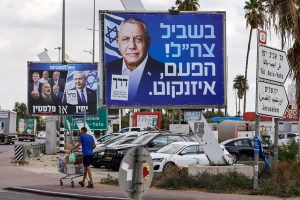
A drone view of an election billboard by Benjamin Netanyahu's Likud Party depicting Iran's Supreme Leader Mojtaba Khamenei, New York City Mayor Zohran Mamdani, Turkish President Tayyip Erdogan and Hezbollah chief Naim Qassem and a text in Hebrew that reads "They Want Netanyahu to Lose, Don't let them Win", in Tel Aviv, Israel August 17, 2026
The man who talked to Iranians
Benjamin Netanyahu made Iran his signature cause. Across 15 years in office before 2021, he drew a cartoon bomb at the United Nations, addressed the US Congress against the 2015 nuclear deal, and displayed an archive of Iranian nuclear documents his agents had smuggled out of Tehran.
He also began speaking past the government to the people. He recorded messages to Iranians, offering water technology during the drought and insisting that Israel’s quarrel was “not with the Iranian people.”
The message was new: the problem is not Iran, it is the people who rule it.
The head of the octopus
Naftali Bennett, prime minister in 2021 and 2022, turned that view into a doctrine. Israel, he argued, had spent decades fighting the arms of the octopus, Hezbollah and Hamas, while leaving the head untouched.
He said he launched about 30 operations against the Islamic Republic with the Mossad and other agencies, not all of them military, and predicted it would collapse like the Soviet Union.
Yair Lapid, who succeeded him for six months, spent his term lobbying against a revived nuclear deal.
Former prime ministers Naftali Bennett and Yair Lapid attend an event for their B'Yachad party, ahead of Israel’s national election, in Haifa, Israel, October 21, 2026.
Saying it out loud
Since returning to power at the end of 2022, Netanyahu has moved from hoping to aiming. In June 2025, as Israeli jets struck Iran in the 12-day war, he told Iranians that “as we achieve our objective, we are also clearing the path for you to achieve your freedom.”
The war that began on February 28 this year, fought with the United States, killed former Supreme Leader Ali Khamenei. Last week Netanyahu went further than any Israeli leader before him: “This regime must fall and I will topple it.”
What the candidates say
Netanyahu, leading Likud, has made bringing down the Islamic Republic his campaign’s primary objective and says he has told the security services to work toward it. He has also said he opposes a preemptive strike before the vote.
Gadi Eisenkot, the former military chief whose Yashar party is Likud’s main rival, says the Islamic Republic’s fall is necessary but cannot be achieved by force. “This must come from within the Iranian people,” he said, and he would strike again only if Tehran raced for a bomb.
Bennett and Lapid, running together on the Together list, want to hit harder, not softer. Bennett says attacks by Tehran’s allies should be answered on Iranian soil. Lapid has called for striking Iran’s energy infrastructure, including the Kharg Island oil terminal.
Avigdor Lieberman of Yisrael Beiteinu has long called for overthrowing the Islamic Republic and says past efforts fell short. Itamar Ben-Gvir of the far-right Jewish Power backs military operations until Israel’s goals are met. Mansour Abbas, whose Ra’am party draws Arab Israeli voters, has set out no position on Iran.
From Rabin’s prediction that Khomeini’s rule would not last to Netanyahu’s promise to end it himself, the conclusion has barely moved. What Israelis will choose on Tuesday is not whether to want the Islamic Republic gone, but how loudly to say it and how much to risk to get there.
Two men speak on Jaffa Street, one of the main shopping streets, ahead of the Israeli parliamentary election in Jerusalem, October 22, 2026.
Armed Baluch groups in Iran’s southeast are adding one more strain on the Islamic Republic’s security forces just as war has stretched them thinnest, with 18 attacks in the 18 days to October 10, more than in any full month this year.
At least 63 armed incidents were documented across Sistan and Baluchestan and neighboring Kerman province between March 31 and October 10, leaving at least 94 people dead and 33 injured, according to the rights group HRANA. The attacks have grown more complex as well as more frequent: coordinated ambushes, roadside bombs and heavier weapons.
The question is whether a decades-old insurgency, long contained by force, can become a wider problem for a state fighting on other fronts.
A coalition with bigger aims
Several Baluch armed organizations joined forces in December 2025 under the People’s Fighters Front. The coalition includes Jaish al-Adl, which Iran and the United States both list as a terrorist organization.
The front has increasingly framed its goal as ending the Islamic Republic’s rule rather than winning concessions for the Baluch. Whether it can draw support beyond the southeast is unproven.
Its timing is not accidental. Iran’s security services are absorbing the consequences of war with the United States and Israel while still needing the forces they rely on to suppress dissent at home.
Rahim Bandoui, an Iranian-Baluch human rights activist and senior member of the Balochistan People’s Party, said the conflict itself is nothing new.
Speaking on Iran International’s Eye for Iran podcast, he traced it to decades of repression, arguing that Tehran has long treated peaceful political activity and armed resistance in the province as the same security threat.
What has changed, he said, is the state’s position. A government weakened by war presents armed groups with an opening they did not have before.
What the attacks can and cannot do
If the attacks keep growing, Tehran will have to send more personnel and resources to the southeast at a time when its security forces are already stretched. Those forces have contained unrest there before through military operations, mass arrests and lethal force. A sustained insurgency adds a cost on top of the war.
That cost could be felt elsewhere. Every unit tied down in Sistan and Baluchestan is one not available against protests or other opposition in the rest of the country.
The limits are real, though. There is no evidence the coalition can take and hold territory or threaten the central government’s control. Its political ambitions face a further obstacle across the border: Baluch armed groups in Pakistan differ considerably from their Iranian counterparts in ideology and aims, so a unified cross-border movement is unlikely without substantial change on both sides.
The grievances underneath
The insurgency sits on grievances that successive crackdowns have failed to address.
Sistan and Baluchestan, home to a mostly Sunni Baluch population, is among Iran’s poorest provinces despite its position on the Pakistani and Afghan borders and its natural resources. Residents face discrimination, few jobs and poor access to schools, clinics and other basic services.
Tens of thousands of people in the province have no official identity documents, Sabah Baluch, a human rights advocate with Iran House, told the podcast, which shuts them out of basic services and legal rights. For some families that has meant generations without formal schooling or work.
Hardship pushes residents into dangerous informal work, above all carrying fuel across the border, where they risk being shot by security forces or burning to death in vehicle fires.
The province has also seen some of the Islamic Republic’s deadliest violence against dissent. On September 30, 2022, during the nationwide protests that followed the death of Mahsa Amini, security forces killed at least 87 people in Zahedan, the provincial capital, most of them Baluch worshippers, in what became known as Bloody Friday.
Baluch prisoners are also executed out of all proportion to their numbers. According to Iran Human Rights, they accounted for 20 percent of recorded executions in 2023, 11 percent in 2024 and 9 percent in 2025, from a group that is a small fraction of Iran’s population.
The larger question
For now the Islamic Republic retains the military and security capacity to hold the southeast, and nothing suggests the insurgency can change the balance of power on its own.
The larger question is not whether armed groups can defeat government forces in Sistan and Baluchestan. It is whether a state that has relied on lethal force against its opponents for decades can go on containing several challenges at once while war makes new demands on the forces it uses to do so.
For Iran’s wider opposition, the answer will matter well beyond the southeast.
Turkish Chief of General Staff General Selcuk Bayraktaroglu meets with Saudi Arabia's Chief of General Staff General Fayyadh bin Hamed Al-Ruwaili and Pakistan's Chief of Defence Forces and Chief of Army Staff Field Marshal Asim Munir in Riyadh, Saudi Arabia, September 25, 2026.
Pakistan is mediating between Iran and the United States even as it sends troops to defend Saudi Arabia against attacks by Tehran’s allies, placing Islamabad in the conflicting roles of peace broker and military partner to Iran’s rivals.
On Tuesday, Pakistan's military chief, Field Marshal Asim Munir, met Iranian President Masoud Pezeshkian, Foreign Minister Abbas Araghchi, Parliament Speaker Mohammad Bagher Ghalibaf and security chief Mohsen Rezaei in Tehran.
Munir has also cultivated a close relationship with President Donald Trump, including meetings at the White House.
Islamabad helped broker the June agreement between Washington and Tehran. The truce did not last, but Pakistan has kept its mediation channel open.
Commitment to Saudi Arabia
Pakistan has taken a direct military role in Saudi Arabia's defense.
Reuters reported in May that Islamabad had deployed approximately 8,000 troops, a squadron of fighter jets and air-defense systems to the kingdom under a bilateral agreement. Saudi Arabia financed the deployment, according to Pakistani officials cited by Reuters.
Pakistan’s commitment to Saudi security deepened in August when Pakistan, Saudi Arabia and Turkey signed the Makkah Joint Defense Agreement, treating an attack against one member as an attack against all.
This week, Islamabad announced that Pakistan and Saudi Arabia had completed ratification, while Turkey's remained pending. The partners have also discussed further military mobilization following attacks by Iran-aligned Houthis on Saudi territory.
On Wednesday, Pakistan signed another defense agreement, this time with Turkey, Qatar and Indonesia. The Badr agreement, signed in Doha, offers opportunities for industrial cooperation and defense production.
Together with Makkah, the agreements deepen Pakistan's military, diplomatic and economic ties across countries pursuing different regional agendas.
Pakistan's balancing act
That tension was evident during Munir's Tehran visit. Pakistani government sources told Turkey's state-run Anadolu news agency that the talks focused more on stopping Houthi attacks against Saudi Arabia than on reviving US-Iran negotiations.
Munir pressed Iranian leaders to use their influence over the Houthis, citing Pakistan's commitment to defend the kingdom.
Saudi Arabia and other Persian Gulf states supply much of Pakistan’s energy, while millions of Pakistani workers live in the region. Defense cooperation brings financial support and industrial opportunities, while diplomacy helps protect relations with competing partners.
Pakistan appears to be carving out an unusual role: mediating between Iran and the United States, helping defend Saudi Arabia against the Houthis, and joining new regional defense ventures while retaining direct access to Iranian leaders.
But the same network could become harder to manage if regional tensions escalate. The more security commitments Pakistan assumes, the greater the chance that relationships which currently give Islamabad leverage could eventually force it to choose between them.