• العربية
  • فارسی
BrandBrand
  • Iran Insight
  • Politics
  • Economy
  • Analysis
  • Special Report
  • Opinion
  • Podcast
  • Live TV
  • Iran Insight
  • Politics
  • Economy
  • Analysis
  • Special Report
  • Opinion
  • Podcast
  • Live TV
  • Theme
  • Language
    • العربية
    • فارسی
  • Iran Insight
  • Politics
  • Economy
  • Analysis
  • Special Report
  • Opinion
  • Podcast
  • Live TV
All rights reserved for Volant Media UK Limited
volant media logo

Architect of Guards' missiles becomes Iran's defense minister

Hooman Abedi
Hooman Abedi

Iran International

Oct 18, 2026, 10:54 GMT+1
Iran's new Defense Minister Mehrdad Akhlaghi Ketabchi attends an official meeting, with the Islamic Republic's flag behind him.

Mehrdad Akhlaghi Ketabchi, a sanctioned veteran of Iran's missile industry with ties to the Revolutionary Guards, became defense minister on Sunday, following his predecessor's killing in the war with the United States and Israel.

Akhlaghi secured 237 votes in favor and 15 against in a virtual parliamentary session attended by 277 lawmakers.

He replaces Aziz Nasirzadeh, who was killed on February 28 during the opening day of joint US-Israeli strikes on Iran. The ministry had since been overseen by acting minister Majid Ebn al-Reza.

Unlike several previous defense ministers who rose through military command positions, Akhlaghi built his career inside Iran's weapons manufacturing establishment, overseeing industrial organizations involved in missile production, aerospace technologies and military procurement.

His name has appeared on international sanctions lists since 2007, reflecting his longstanding involvement in institutions central to Iran's ballistic missile program.

From engineering to missile production

Born on September 10, 1958, in Rasht, northern Iran, Akhlaghi studied chemical engineering at Amirkabir University of Technology before earning a master's degree in strategic management from Malek Ashtar University of Technology, an institution affiliated with the Defense Ministry.

He entered Iran's defense industries in the early 1980s and spent more than four decades in technical, industrial and managerial positions, according to Iranian state-linked media.

Much of his career has involved solid-fuel missile propulsion systems and the management of industrial facilities associated with ballistic missile development.

Solid-fuel propulsion allows missiles to remain stored for extended periods and reduces preparation time before launch, making it a significant component of Iran's missile capabilities.

Akhlaghi previously headed the Shahid Bagheri Industrial Group, a subsidiary of the Aerospace Industries Organization involved in Iran's ballistic missile program.

In November 2014, then-Defense Minister Hossein Dehghan appointed him managing director of the Aerospace Industries Organization, replacing Mehdi Farahi.

100%
Iran's new Defense Minister Mehrdad Akhlaghi Ketabchi (right) is welcomed by acting Defense Minister Majid Ebn al-Reza during a meeting with senior military officials.

He later became head of the Defense Industries Organization, which produces conventional weapons and supplies military equipment to Iran's armed forces.

Akhlaghi's role in the Fateh-110 missile project

Akhlaghi's close relationship with Hassan Tehrani Moghaddam, a founder of the Revolutionary Guards' missile program, was central to his involvement in developing Iran's missile industry.

Akhlaghi worked closely with Hassan Tehrani Moghaddam, widely known as the father of Iran's ballistic missile program. Tehrani Moghaddam oversaw the development of the Revolutionary Guards' missile arsenal before he was killed in a November 2011 explosion at a military facility near Tehran.

Iran's IRGC-linked Tasnim news agency, citing The Eternal Man, a biography by Masoumeh Sepehri, reported that Akhlaghi approved $10 million in equipment purchases and production facilities for the Fateh-110 missile despite uncertainty over whether the project would succeed.

The account, based on an interview with a senior missile designer, describes Akhlaghi's direct involvement in financing infrastructure used to produce missiles for the Revolutionary Guards.

Pezeshkian also referred to Akhlaghi's association with Tehrani Moghaddam during Sunday's parliamentary session, crediting figures such as the two men with developing Iran's military capabilities.

Nearly two decades under international sanctions

Akhlaghi's involvement in Iran's missile industry brought him under international sanctions long before his appointment to the cabinet.

The United Nations Security Council included him in Resolution 1747, adopted on March 24, 2007, identifying him as head of the Shahid Bagheri Industrial Group.

The group had previously been sanctioned over its involvement in Iran's ballistic missile program.

The US Treasury Department also placed Akhlaghi under sanctions in 2008.

US State Department information about his activities identified him as a senior figure in missile-related industrial operations and described his participation in negotiations to purchase equipment for the missile industry.

In 2020, the first Trump administration sanctioned him in connection with his position as director of the Defense Industries Organization.

100%
Iran's new Defense Minister Mehrdad Akhlaghi Ketabchi addresses lawmakers during a virtual parliamentary session.

The European Union has also included Akhlaghi on its sanctions lists, identifying his senior roles within both the Defense Industries Organization and the Aerospace Industries Organization.

Britain imposed sanctions on him in 2023, citing his involvement in activities connected to the development of systems capable of delivering nuclear weapons.

His name was also included in UN sanctions lists following the reimposition of international sanctions in September 2025.

The measures have made Akhlaghi one of the more extensively sanctioned figures to enter Pezeshkian's cabinet, with restrictions linked to his work in institutions involved in missile development and weapons production.

Missile production and air defenses top priorities

Akhlaghi outlined plans to expand weapons production, strengthen air defenses and rebuild military industrial facilities during his parliamentary confirmation session.

His proposed program includes developing new military technologies, improving production efficiency and increasing cooperation with universities and technology companies.

Akhlaghi also proposed shortening the development cycle for certain new defense technologies to a maximum of six months.

The program envisages increasing the share of production outsourced to companies outside the Defense Ministry to 75 percent in the Iranian year beginning in March 2026 and more than 85 percent the following year.

Highly classified weapons production would remain within facilities controlled by the ministry.

Akhlaghi has also identified continued support for armed groups aligned with the Islamic Republic across the region as a ministry priority.

His agenda builds on programs developed under Nasirzadeh, with adjustments intended to address the damage and military requirements arising from the recent wars.

Akhlaghi portrayed Iran's military capabilities as having frustrated US and Israeli objectives during the latest conflict.

"These capabilities have brought the American-Zionist enemy to the point of desperation in the recent war and placed it in a strategic deadlock," Akhlaghi told lawmakers.

His remarks came as the Defense Ministry faces the task of replacing damaged infrastructure and restoring weapons production capacity following months of military confrontation.

Warning to Washington over possible strikes

Akhlaghi also delivered a warning to the United States on the sidelines of Sunday's parliamentary session.

Asked about the possibility of Washington using the GBU-43 bomb, commonly known as the Mother of All Bombs, against Iran, he said the Defense Ministry had prepared measures to respond.

"The US president should be thinking about how to get his forces out of our region alive. If he drops one bomb, he will have to see how many of his troops he will have to take out of the region horizontally (dead)," Akhlaghi told reporters.

The remarks followed warnings by US officials about the possibility of further military action against Iranian facilities.

100%
Iran's new Defense Minister Mehrdad Akhlaghi Ketabchi secured 237 votes in favor and 15 against in parliament's confidence vote.

President Donald Trump has raised the possibility of striking the underground Pickaxe Mountain complex near Natanz, while US Defense Secretary Pete Hegseth has warned of severe military consequences if negotiations with Iran fail.

A sanctioned missile official takes charge after the war

Akhlaghi's appointment follows the war with the United States and Israel, which killed senior Iranian military officials and exposed vulnerabilities in the Islamic Republic's military infrastructure and air defenses.

Pezeshkian told lawmakers that the new minister had the backing of the army, the Revolutionary Guards and other military and security institutions.

The president also referred to Akhlaghi's presence on US sanctions lists and expressed hope that he would remain alive to continue his work.

The decision to appoint an official sanctioned for nearly two decades over his involvement in Iran's ballistic missile program points to the leadership's continued reliance on the same military-industrial establishment that oversaw the development of its missile arsenal.

Akhlaghi now faces the task of rebuilding military production capacity and expanding weapons manufacturing at a time when Iran's missile program remains a major source of confrontation with Washington and European governments.

Most Viewed

Tehran’s diplomatic paralysis leaves Iran caught between deal and escalation
1

Tehran’s diplomatic paralysis leaves Iran caught between deal and escalation

2
PODCAST

Iran cultivated Houthis for years before opening new war front, insider says

3
ONE-ON-ONE

Iran’s rulers face a reckoning with their own people, former US envoy says

4

Iran hangs Iraqi man on Saudi spying charge he denied

5

Iran giving Houthis targeting intelligence for Saudi attacks - WSJ

Spotlight

  • Iran risks losing ground as East-West trade routes expand
    ANALYSIS

    Iran risks losing ground as East-West trade routes expand

  • Tehran’s diplomatic paralysis leaves Iran caught between deal and escalation

    Tehran’s diplomatic paralysis leaves Iran caught between deal and escalation

  • Iran's January crackdown: Snipers at Friday prayer leader's office, dorm

    Iran's January crackdown: Snipers at Friday prayer leader's office, dorm

  • Iran cultivated Houthis for years before opening new war front, insider says
    PODCAST

    Iran cultivated Houthis for years before opening new war front, insider says

  • After the killings, Iran turned on the families of the dead

    After the killings, Iran turned on the families of the dead

  • Iran’s rulers face a reckoning with their own people, former US envoy says
    ONE-ON-ONE

    Iran’s rulers face a reckoning with their own people, former US envoy says

Banner
Banner
Banner
Banner
Banner
  • Leaked IRGC manual shows systematic use of civilian sites as missile cover

    Leaked IRGC manual shows systematic use of civilian sites as missile cover

  • Atlas of Iran missile cities: The hidden network behind Tehran’s missile power

    Atlas of Iran missile cities: The hidden network behind Tehran’s missile power

  • 670 bridges, 380 tunnels: The network that moves Iran's army and its missiles

    670 bridges, 380 tunnels: The network that moves Iran's army and its missiles

•
•
•

More Stories

Iran giving Houthis targeting intelligence for Saudi attacks - WSJ

Oct 17, 2026, 09:52 GMT+1
100%
A poster bearing an image of late Iranian Supreme Leader Ayatollah Ali Khamenei is seen at a rally with Houthi supporters in Sanaa, Yemen, March 6, 2026.

Iranian support has helped Yemen’s Houthis carry out their most potent and sophisticated attacks yet on Saudi Arabia and its Yemeni allies, the Wall Street Journal reported, citing people briefed on intelligence from Saudi Arabia and Yemen’s anti-Houthi alliance.

The assistance includes help targeting drone and missile attacks, as well as training, intelligence and tactical guidance, according to the report. It has also contributed to rapid Houthi territorial gains in Yemen. The group now controls coastline along its side of the Bab al-Mandeb Strait and has attacked Saudi oil tankers, energy facilities and airports.

People briefed on regional intelligence cited by the WSJ said IRGC officers inside Yemen had helped the Houthis deploy missiles and radars threatening the Red Sea and Bab al-Mandeb.

The report said the Houthis used large numbers of fighters backed by missiles and drones during an offensive launched in early September, seizing the Red Sea port city of Mokha and territory around Bab al-Mandeb after catching Saudi-backed Yemeni forces off guard.

A person with forces opposing the Houthis cited by the WSJ said the group showed greater sophistication than in previous fighting, combining infantry assaults with missile and drone attacks, including first-person-view drones guided by fiber-optic wire.

Another anti-Houthi official cited by the newspaper said IRGC officers were on the front lines helping direct drone and missile attacks.

Danny Citrinowicz, a former head of the Iran branch for Israeli defense intelligence, said the operational relationship between Tehran and the Houthis was “very, very strong.”

“Iran has a major interest in the Houthis’ success,” he said, describing the relationship as strategic cooperation rather than a simple patron-client arrangement.

Senior Houthi official Mohammed al-Bukhaiti rejected allegations of Iranian military involvement, saying such claims exaggerated Tehran’s role and ignored the group’s own development of its capabilities.

“Iran does not interfere in Yemeni affairs,” Iranian Foreign Ministry spokesman Esmail Baghaei said last month, describing the Houthis as “entirely independent actors who make their decisions based on their own interests.”

A UN panel of experts found in 2024 that the Houthis had established joint operations rooms in Lebanon and Iraq to coordinate activities.

After the killings, Iran turned on the families of the dead

Oct 16, 2026, 20:57 GMT+1
•
Omid Keshtkar
100%

A bullet is fired once. For the families of those killed in Iran’s Woman, Life, Freedom uprising, the punishment that followed lasted for years: bodies held hostage, false confessions forced on parents, funerals fired upon and killers set free, Amnesty International has found.

Threats, lies, humiliation and prison were the state’s weapons. Families were forced into silence under threat of having graves dug up, of rape and of execution. Many were denied even the right to mourn.

In a detailed report published four years after the uprising, Amnesty documented the killing of at least 377 people by security forces between September 2022 and early 2023, more than half of them in the first two weeks of protests, and said the true toll is far higher. The report also documents what happened next to the families of the dead.

  • Iran used state machinery to crush 2022 uprising, Amnesty says

    Iran used state machinery to crush 2022 uprising, Amnesty says

  • UN says Iran crackdown amounted to crimes against humanity

    UN says Iran crackdown amounted to crimes against humanity

Immediately after each unlawful killing, Amnesty found, the authorities began a campaign of silencing and cruelty against the victim’s family. The body was the first hostage, returned only once the family accepted the state’s false account of the death.

A wide range of institutions took part: the Intelligence Ministry, the police’s crowd-control units, the Revolutionary Guards’ Intelligence Organization, local Basij units, judicial and provincial officials, governors and local Friday prayer leaders.

‘Rioters,’ accidents and drugs

The pattern of forced narratives was almost identical across the country. A death had to be blamed on “rioters,” “counter-revolutionary groups,” “terrorists” or the opposition Mojahedin-e Khalq, or else on suicide, illness, an accident or drug use.

In Divandarreh, in Kordestan province in western Iran, hours after Fuad Ghadimi was killed on September 19, 2022, officials took his father to the state broadcaster and forced him to make false statements on air, threatening to withhold his son’s body and endanger his other children.

Plainclothes agents watched the grave and repeatedly replaced the headstone to remove the word shahid, martyr, which the family had carved on it.

In Kermanshah, Ardalan Ghasemi was shot on November 10 while writing slogans on a wall. An official at the hospital told his family that if they filed a complaint, his body would stay in the morgue for months, and to make the point, showed them the decomposed body of another person.

  • How Iran shielded forces over 2022 protest killings

    How Iran shielded forces over 2022 protest killings

  • How Iran’s 2022 crackdown was coordinated from the top

    How Iran’s 2022 crackdown was coordinated from the top

The family got Ardalan back only after signing a false statement that he had been killed while stealing a car.

The case of Fereshteh Ahmadi in Mahabad, in West Azarbaijan province, is among the most chilling in the report. Half an hour after she died on October 27, four agents dressed as nurses tried to take her body secretly out of the hospital. When the family stopped them, one agent held a gun to her husband’s head and threatened to kill him.

Her brother, Ebrahim Ahmadi, was arrested and held for 28 days in solitary confinement by the Revolutionary Guards’ intelligence arm in Sardasht. Agents offered him double the usual blood money if he would blame Kurdish opposition groups for her death. He refused.

The denial was even more intense when the victims were women and girls, Amnesty found. The UN Independent International Fact-Finding Mission on Iran also concluded that, compared with men, the deaths of women protesters were routinely blamed on alcohol, suicide, ordinary crime, illness, road accidents, family disputes or falls from windows and buildings. The authorities played down women’s deaths to stop them becoming symbols.

  • Mahsa’s dandelion: step by step through Iran's Woman, Life, Freedom

    Mahsa’s dandelion: step by step through Iran's Woman, Life, Freedom

Funerals under fire

Burials became another front for intimidation. Security forces tried to move bodies to undisclosed locations. In Javanrud, in Kermanshah province, the Revolutionary Guards took the body of Ismail Golanbar to their regional Najaf Ashraf base and returned it only on condition that he be buried outside the town.

Kumar Daraftadeh, a 16-year-old boy killed in Piranshahr on October 30, was given an hour for washing and burial; after repeated pleas, his family was allowed to bury him the next day, in a village 25 kilometers away.

Violence against mourners at times exceeded the violence against protesters. At the funeral of Zanyar Abubakri in Mahabad on October 27, hundreds of mourners carried his body above their heads while police special forces fired on them with assault rifles, birdshot and tear gas.

  • 'They shot on sight': Amnesty details 2022 protest killings in Kurdish areas

    'They shot on sight': Amnesty details 2022 protest killings in Kurdish areas

In Bukan, the brother of Shahriar Mohammadi, killed on November 18, described throwing himself onto his brother’s body to stop agents from seizing it. They beat him repeatedly on the head, kicked the body and shot him in the leg with birdshot at close range.

Hospitals, morgues and death certificates

Another layer of repression ran through hospitals, morgues and the coroner’s office. By forcing hasty burials, often within hours, the authorities sidestepped the legal requirement for an autopsy. When autopsies were carried out, families were usually denied the results.

In Sanandaj, the capital of Kordestan province, the coroner told the family of Hooman Abdollahi, shot directly in the heart on December 7, the cause of death only verbally. The family never received a written report or even a burial certificate.

Police seized the ambulance carrying his body and took it to an unknown location, and the family was made to bury him at night with no one else present.

Minoo Majidi, killed in Kermanshah on September 20, had 167 pellets in her body. A forensic expert told her family so, but no written report was ever issued.

Even the language of death certificates was changed to hide the truth. Phrases such as “impact of hard objects” or “hunting pellets” appeared without any indication of their source.

  • Mahsa Amini and the century-long struggle of Iranian women

    Mahsa Amini and the century-long struggle of Iranian women

For Habibollah Fathi, killed by a live round to the head on November 19, a first certificate gave the cause of death as “unknown.” When the family asked for it to be corrected, a second certificate cited heart disease.

The authorities also kept families from seeing their dead. In Sanandaj, relatives of Peyman Monbari, killed on October 8, were made to sign a document stating they had viewed the body, while what they received at the cemetery was a body already washed and shrouded.

Justice denied

Some families, despite everything, tried to seek justice through the courts. Amnesty was able to gather and examine ten such cases from eight provinces.

In four, prosecutors cleared the killers with a single line citing insufficient evidence. Two were referred to military courts to set blood money, without any investigation.

In two more, the authorities themselves admitted that security agents had fired the shots, but sent the cases not to a criminal court but to a military court to determine compensation, and only on condition that the victim be proven innocent.

One case did end in a sentence of qisas, retribution in kind. Mohammad Jamehbozorg was shot in the face in Malard, west of Tehran, after agents raided his home, where he had sheltered protesters.

A court sentenced the agent to death and the Supreme Court upheld the ruling. Then, after direct intervention by Revolutionary Guards commanders and Malard’s Friday prayer leader, the charge was reduced from intentional to unintentional killing, and the killer received three years in prison.

The cases of Sepehr Beiranvand in Khorramabad and Mehran Samak in Bandar Anzali followed the same course: an initial conviction, then the ruling overturned and the case sent back for review. Samak was shot after honking his car horn in solidarity with people celebrating Iran’s World Cup defeat to the United States.

The Bloody Friday case in Zahedan, the capital of Sistan and Baluchestan province, where security forces killed at least 87 people, most of them Baluch worshippers, on September 30, 2022, ended with prison sentences for a few low-ranking officers. All the commanders were acquitted.

The forces of repression were ready to kill and to intimidate. Security agents were trained to cover up the killings and to threaten families, and the judiciary stood ready to clear the killers and protect the forces behind them.

These accounts are an undeniable part of the Islamic Republic’s crimes against humanity: crimes that began in the streets and continued, for months and years afterward, in the suppression of families.

Iran shipped jet fuel to Myanmar despite US blockade - Reuters

Oct 16, 2026, 11:51 GMT+1
100%
An Indian liquefied petroleum gas (LPG) carrier, Shivalik, arrives at Mundra Port via the Strait of Hormuz, amid the US-Israel conflict with Iran, in Gujarat, India, March 16, 2026.

Iran managed to export jet fuel to Myanmar and send several shipments of liquefied petroleum gas out of the region despite a US naval blockade that has largely halted its crude exports, Reuters reported on Friday.

Satellite imagery and analysis by maritime intelligence group SynMax showed a tanker carrying Iranian jet fuel reached Myanmar in September, Reuters said.

Myanmar’s military government did not respond to Reuters’ request for comment on whether it had received the cargo.

The United States imposed targeted sanctions on Myanmar’s jet-fuel sector in 2023, citing military airstrikes on civilians. Myanmar’s military has denied deliberately targeting civilians.

LPG cargoes also passed through

At least eight gas tankers carrying Iranian LPG left the Gulf of Oman since mid-July, according to analysis by United Against Nuclear Iran, which tracks tanker movements using ship and satellite data.

The cargoes totaled an estimated 4.1 million barrels, UANI senior research analyst Jemima Shelley told Reuters.

Four people involved in maritime security and tracking Persian Gulf oil movements told Reuters that Iran had been concealing some cargoes among a growing number of ship-to-ship transfers by other regional producers off Oman.

Some Iranian LPG tankers transferred cargoes near the Omani coastal towns of Shinas and Sohar, while others waited in the Gulf of Oman before continuing their voyages, Shelley said.

Most then sailed toward Malaysia’s Eastern Outer Port Limits for additional ship-to-ship transfers, with China considered the likely ultimate destination, according to UANI’s analysis.

Most Iranian crude exports remain blocked

The shipments remain a fraction of Iran’s previous energy exports and do not appear to represent a broad breakthrough in the blockade.

Shelley said the LPG movements appeared to reflect “more opportunism” than a new Iranian strategy for moving large volumes of oil and petroleum products on smaller ships.

Iranian crude exports fell to zero in September, according to Kpler, marking the first month without a shipment since the analytics firm began tracking Iranian exports in 2013.

Six of the eight LPG tankers identified by UANI, as well as the vessel carrying jet fuel, were under US sanctions for transporting Iranian petroleum or petrochemical products, Reuters said.

US military says blockade remains in force

US Central Command said the blockade remains “ironclad.”

A US military official told Reuters that a ship passing through the area does not necessarily mean it evaded the blockade. US forces assess vessels individually, including by reviewing their documents, and some can be allowed through for humanitarian reasons, the official said.

The official added that being on a US sanctions list does not automatically make a vessel subject to interdiction and that US forces sometimes monitor ships without taking action for operational reasons.

CENTCOM said this week that four commercial vessels had been disabled and 135 ships turned around during the three months since the latest blockade was imposed.

The blockade was first introduced in April, lifted in June following a draft US-Iran understanding and reimposed on July 14 after that arrangement collapsed.

Washington questions shipping data

A US Treasury spokesperson questioned whether tracking data alone could show that vessels had successfully evaded the blockade, noting that ships can spoof locations or operate under false identities.

The spokesperson said such data should be treated cautiously and said Washington’s sanctions campaign and naval blockade were sharply restricting Iran’s access to export revenue.

The Iranian government did not respond to Reuters’ request for comment.

Torbjorn Soltvedt of Verisk Maplecroft told Reuters that worsening economic conditions could push Iran to take greater risks in trying to move petroleum products abroad, particularly jet fuel if domestic aviation restrictions leave Iranian refineries with excess supply.

Iran speaker says government overstepped on anti-terror finance rules

Oct 16, 2026, 11:43 GMT+1
•
Niloufar Goudarzi
100%
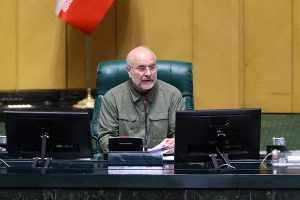
Iranian parliament speaker Mohammad Bagher Ghalibaf (left) and President Masoud Pezeshkian

Iranian Parliament Speaker Mohammad Bagher Ghalibaf says part of the government’s anti-terror financing regulations violates Iranian law, adding that decisions on who is designated as terrorist must remain with the Supreme National Security Council.

In a letter to President Masoud Pezeshkian, Ghalibaf objected to amended government rules that kept national working groups involved in deciding which individuals, groups and organizations should face terrorism-related financial restrictions.

The rules cover measures including freezing or blocking assets.

Ghalibaf said Iranian law gives the Supreme National Security Council responsibility for identifying terrorist individuals, groups and organizations, and that the government could not give that authority to its own working groups.

What did the government change?

The cabinet adopted regulations setting out how terrorism-related financial restrictions should be applied.

They created a national working group to review cases involving people and organizations that could be placed on terrorism-related lists. The group also had a role in decisions that could lead to assets being frozen.

The government later amended the rules so that the working group would be established with the Supreme National Security Council’s approval and operate under its direction.

But the amended rules still allowed the group to make some listing decisions. Ghalibaf said that remained inconsistent with the law because the council itself, rather than a government working group, has the legal authority to determine who Iran considers terrorist.

  • Iran parliament speaker sends anti-terror finance law for implementation

    Iran parliament speaker sends anti-terror finance law for implementation

  • Iran’s president signs law joining UN anti-terror finance convention with conditions

    Iran’s president signs law joining UN anti-terror finance convention with conditions

  • Q&A: All you need to know about Iran's FATF problem

    Q&A: All you need to know about Iran's FATF problem

What does Ghalibaf’s ruling change?

The letter concerns the government regulation used to implement the law, not Iran’s underlying law against terrorist financing.

It also does not address Iran’s membership in international treaties. The issue is narrower: whether the cabinet gave its working groups powers that Iranian law reserves for the Supreme National Security Council.

Ghalibaf issued the finding through Iran’s established system for reviewing cabinet regulations. His letter says the government must correct the disputed provision within the legal deadline and that the part found unlawful will lose effect if it is not corrected.

Why this matters internationally

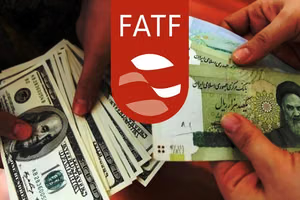
The dispute comes as Iran tries to address shortcomings identified by the Financial Action Task Force, or FATF, the international body that sets standards against money laundering and terrorist financing.

Iran has remained on FATF’s high-risk list since 2020. FATF says Tehran has still not completed most of the action plan it accepted in 2016 and continues to call on other countries to apply financial countermeasures.

Those measures are separate from US sanctions, but both make it harder for Iranian banks and businesses to maintain normal relationships with financial institutions abroad.

One of FATF’s outstanding demands is for Iran to have an effective system for identifying and freezing terrorist assets in line with relevant UN Security Council resolutions.

  • FATF opponents are profiteers of Iran's isolation, economist says

    FATF opponents are profiteers of Iran's isolation, economist says

  • US policy on Iran: can money achieve what sanctions couldn't?

    US policy on Iran: can money achieve what sanctions couldn't?

  • Long-delayed law may ease Iran's way out of financial isolation

    Long-delayed law may ease Iran's way out of financial isolation

Iran has already changed laws and joined two treaties

Iran has spent years changing its financial laws in response to FATF concerns.

It amended its domestic counter-terror financing law in 2018 and its anti-money-laundering law in 2019.

Last year, Iran also completed accession to two UN treaties that had been politically disputed for years: the Palermo Convention against transnational organized crime and the International Convention for the Suppression of the Financing of Terrorism.

Joining those treaties did not mean Iran joined FATF. FATF is a separate organization that judges whether a country’s laws and enforcement meet its standards.

Joining the treaties was not enough for FATF

Iran joined both treaties with reservations, including conditions allowing it to apply them within the framework of its own constitution and domestic laws.

In the case of the Terrorist Financing Convention, Iran also formally said the Supreme National Security Council would determine which individuals, groups and organizations it considers terrorist.

FATF said in June that Iran’s reservations to both treaties were “overly broad” and that its domestic implementation was still not in line with FATF standards. It also said Iran had failed to address the majority of its original action plan.

So Iran can legally be a party to the UN treaties while still falling short of FATF requirements.

The problem at the center of Ghalibaf’s ruling

The latest dispute goes directly to one of those unresolved questions.

Iran needs a system capable of identifying terrorist-linked individuals and organizations and freezing their assets. But under Iran’s own legal framework, Ghalibaf says the decision about who is considered terrorist must be made by the Supreme National Security Council, not delegated to government working groups.

The government must therefore adjust its implementation rules without weakening the financial controls Iran is trying to demonstrate to FATF.

US alert puts Iran’s overseas religious finance networks under scrutiny

Oct 15, 2026, 22:20 GMT+1
100%
Supporters of Iran's Islamic Revolutionary Guard Corps (IRGC) with a banner in central London, UK, June 2022

The US Treasury’s latest warning over Iran’s alleged abuse of religious charities puts renewed attention on religious and charitable organizations outside Iran that have separately faced criminal, regulatory or government scrutiny over financial or institutional links to Tehran.

The Treasury Department’s Financial Crimes Enforcement Network (FinCEN) on Thursday issued an alert asking financial institutions to report potential Iranian government abuse of religious charity networks, including the diversion of khums, a religious levy paid by Shiite Muslims.

Treasury said organizations collecting such payments may act on behalf of prominent Iranian ayatollahs with ties to the government and may use informal financial channels, including hawala networks and cash couriers, to transfer money to Iran or Iran-linked actors.

“Under President Trump’s leadership, Treasury will not allow the Iranian regime to continue its long history of abusing religious institutions to line the pockets of its elites and fund terrorism,” Treasury Secretary Scott Bessent said.

FinCEN identified several red flags, including charities soliciting donations without apparent charitable activity; organizations receiving large donations from unknown sources over a short period before transferring significant sums to other nonprofits; attempts to evade reporting or recordkeeping requirements; and recipients with no clear business relationship to a charity withdrawing its transfers in cash or sending them onward.

The alert also says no single indicator establishes illicit or suspicious activity.

The alert does not identify specific religious centers in the United States or Europe as participants in the conduct described. But US and European authorities have previously investigated organizations with alleged institutional or financial links to the Islamic Republic.

These cases involved different allegations and legal proceedings and should not be treated as equivalent evidence of diverted religious donations.

Khums case in the United States

A US criminal case cited in the alert involved khums payments collected for transfer to Iran without the required US Treasury licenses.

In 2024, Muzzamil Zaidi and Asim Mujtaba Naqvi pleaded guilty to conspiring to violate US sanctions by collecting tens of thousands of dollars for transfer to Iran, including funds collected in the name of then-Supreme Leader Ali Khamenei.

According to the Justice Department, Zaidi received permission in 2018 to collect khums on behalf of several clerics. Zaidi and Naqvi subsequently collected religious payments as well as donations purportedly intended to help victims of the war in Yemen.

Prosecutors said the men arranged for money to reach Iran and Khamenei’s office by using friends, relatives and other associates to carry cash out of the United States. In one instance, 25 travelers on a religious pilgrimage to Iraq carried dollars that were subsequently taken to Iran. The amounts were structured below $10,000 to avoid scrutiny, according to court documents.

FinCEN cited the Zaidi and Naqvi prosecution in Thursday’s alert as an example of illicit transfers involving khums payments.

Alavi Foundation’s long-running US case

The broader question of Tehran-linked financial activity in the United States has also surfaced in the long-running litigation surrounding the Alavi Foundation and the 650 Fifth Avenue office tower in Manhattan.

US prosecutors alleged in the case that entities associated with the property concealed an ownership interest held by Iran’s state-owned Bank Melli. The litigation ultimately ended in a global settlement that the Justice Department announced in March 2026 would provide approximately $318 million to victims of Iran-sponsored terrorism.

Alavi admitted no liability or wrongdoing under the settlement and rejected allegations that it had operated as an agency or instrumentality of the Iranian government. The foundation said all claims against it and its properties were dismissed with prejudice and that it transferred its assets, including its interest in 650 Fifth Avenue, to a newly created, IRS-approved public charity and would cease operations once its affairs were wound down.

Scrutiny in Britain

Britain’s Charity Commission has separately taken regulatory action involving the Islamic Centre of England, a Shiite religious institution in north London.

The Charity Commission opened a statutory inquiry in 2022 over what it described as serious governance concerns. The inquiry followed an official warning related to two events at the center in 2020 that eulogized Qassem Soleimani, the former commander of the IRGC’s Quds Force who was under UK sanctions.

The regulator later appointed an interim manager after finding failures by trustees to comply with their legal duties and protect the charity’s assets.

In May 2025, the Charity Commission said it had found misconduct and/or mismanagement during its ongoing inquiry and ordered governance reforms. During the inquiry, a requirement in the center’s governing document for one trustee to serve as the official UK religious representative of Iran’s supreme leader was removed, and the occupant left the role. The regulator said the change addressed concerns about conflicts of interest and an apparent lack of independence.

The trustees disputed some of the regulator’s findings. The Commission also discharged the interim manager after she implemented specified improvements, leaving further reforms to the trustees.

The Commission said at the time that its statutory inquiry remained ongoing.

Germany shut down Khamenei-linked center

Germany banned the Islamic Centre Hamburg, or IZH, and its affiliated organizations in July 2024, saying the organization pursued Islamist extremist goals.

Germany’s Interior Ministry said IZH acted as a direct representative of Iran’s Supreme Leader and sought to bring about an Islamic revolution in Germany. Authorities searched 53 premises in eight German states, and four Shiite mosques were closed as a result of the ban. then-Interior Minister Nancy Faeser said the measure did not apply to the peaceful practice of Shiite Islam.

German authorities subsequently ordered IZH head Mohammad Hadi Mofatteh to leave the country. Hamburg’s domestic intelligence agency identified him as the official deputy of Iran’s Supreme Leader Ali Khamenei in Germany.

Iran protested the German action and summoned Berlin’s ambassador in Tehran.

A focus on financial pathways

Thursday’s US alert does not allege that all Shiite charities or religious centers are conduits for Tehran. FinCEN explicitly said legitimate charities should have access to financial services and instructed banks to use a risk-based approach rather than treating the sector as inherently suspicious.

Instead, the alert focuses on how religious donations can potentially intersect with sanctions evasion and informal financial networks.

The US khums prosecution documented religious payments collected in the United States and cash carried toward Iran for receipt by the Office of Iran’s Supreme Leader. The cases in Britain and Germany are distinct: British regulators raised governance and independence concerns involving a center whose governing document had required a trustee to serve as the supreme leader’s official UK religious representative, while German authorities said IZH acted as the supreme leader’s direct representative.

FinCEN’s new alert asks financial institutions to look for indicators of potential Iranian government abuse of religious charities, including patterns that could indicate funds are being transferred to Iran or Iran-linked actors through informal financial channels.