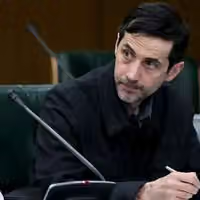
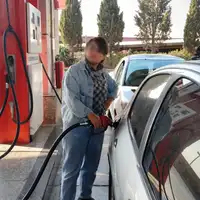
Saeed Golsorkhi, a 31-year-old powerlifter killed outside his family home in Shahroud by Iranian security forces on January 11, 2026, according to sources close to him.
Iranian security forces killed a 31-year-old protester outside his family home two days after he was shot and wounded during demonstrations in Shahroud, northeastern Iran, several sources close to him told Iran International.
Saeed Golsorkhi, an athlete and powerlifter, was shot in the knee during protests on January 9 and taken to hospital, the sources said. Concerned he could be arrested there, Golsorkhi discharged himself and returned home to continue treatment.
Security forces and Revolutionary Guards intelligence agents raided the family home on January 11, assaulted relatives and used pepper spray against Golsorkhi’s mother, according to the sources.
The forces bound Golsorkhi’s hands while his wounded knee was still bleeding and took him outside, the sources said. They blocked both ends of the alley before shooting him at close range in the head and abdomen.
Golsorkhi’s mother and his young niece witnessed the shooting, and he died in his mother’s arms, according to the sources.
Iran International previously reported on January 28 that Revolutionary Guards intelligence agents raided Golsorkhi’s home and shot him dead in front of his mother after he chanted “Death to Khamenei.”
Killings in Shahroud
Golsorkhi’s death forms part of a broader picture of the January crackdown in Shahroud documented by Iran International.
Eyewitnesses previously told that security forces killed at least 200 people in the city on January 8 and 9. The deaths of 22 women were recorded at Bahar Hospital alone, according to those accounts.
Other accounts from Shahroud have described security forces firing directly at protesters and authorities imposing restrictions on the families of those killed.
Iran International previously reported that Hossein Gharib, a 32-year-old athlete from Shahroud, was shot dead by security forces on January 9. His body was released only after his family agreed not to publicize his death and to hold a burial attended by no more than 10 people.
Brother detained, family barred from public mourning
Golsorkhi’s brother, Navid Golsorkhi, was arrested after the killing and held in temporary detention for about a month.
The family was able to retrieve Golsorkhi’s body several days later after agreeing to hold his burial without a gathering or public ceremony. Golsorkhi was buried on January 15 under tight security.
Saeed Golsorkhi, a 31-year-old powerlifter, poses at a gym in an undated image.
Security forces also blocked both ends of the street outside his mother’s home to prevent people from visiting the family to offer condolences, sources close to the family said. The family was not permitted to hold a public memorial.
The restrictions were not limited to Golsorkhi’s relatives. Iran International documented similar measures following the January crackdown, including bodies being returned at night, families being required to hold restricted burials and authorities preventing public mourning ceremonies.
Golsorkhi was a powerlifter and owned a clothing store in Shahroud.
People close to him said he admired the Pahlavi family and had an image of Reza Shah Pahlavi tattooed on his arm.
An Iranian court has sentenced Ali Zarei Doozdarresi, a protester shot by security forces and blinded in one eye during the 2022 protests, to death after he returned from Germany and was arrested upon arrival in Iran, US-based rights outlet HRANA reported.
Branch 23 of the Tehran Revolutionary Court convicted Zarei of “corruption on Earth,” based on alleged acts including extensive political activity, producing false news, propaganda against the establishment, disrupting security and unauthorized entry into and exit from the country, according to HRANA.
The death sentence was communicated to him on August 23, HRANA said.
Zarei, around 27 and from Tehran, was arrested by Intelligence Ministry agents on April 28 after returning to Iran. His case was initially handled by Branch 3 of Tehran Prosecutor’s Office District 33, known as the Security Prosecutor’s Office, before he was transferred to Qezel Hesar Prison in Karaj on June 30.
He is currently being held in Unit 3, Ward 37 of the prison, according to HRANA.
Zarei lost sight in his right eye after being shot during the 2022 Woman, Life, Freedom protests. He was later detained in December 2023 while visiting the graves of protesters killed in the crackdown at Tehran’s Behesht-e Zahra cemetery and spent 33 days in solitary confinement in Evin Prison.
He subsequently left Iran and reached Germany on a humanitarian visa.
While in Germany, Zarei appeared on stage at a February 14 rally in Munich held on the sidelines of the Munich Security Conference alongside exiled Prince Reza Pahlavi who had called for the gathering.
Iranian authorities have increasingly used the death penalty against protesters and political dissidents. Amnesty International has accused authorities of continuing to “weaponize the death penalty to repress dissent,” saying politically motivated death sentences have followed grossly unfair trials.
Last month, Norway-based Iran Human Rights said 29 people arrested in connection with the January 2026 protests had been executed since March 19, in addition to two protesters from the 2022 Woman, Life, Freedom movement. The group said hundreds of protesters were facing the death penalty and warned of an escalation in executions of political prisoners.
The US-based Center for Human Rights in Iran has also said authorities are increasingly using fast-tracked group prosecutions to sentence protesters to death, describing the practice as part of a strategy to punish those who joined protests and deter future dissent.
Young job-seekers in gather to demand more jobs be allocated to local applicants, in southwestern city of Ahvaz, Iran
Iranian security forces on Monday used gunfire and beatings to disperse two protests by young jobseekers in southwestern Iran, as anger over unemployment and alleged discrimination in hiring spills into the streets.
Police opened fire Monday on protesters in Gachsaran who had gathered over hiring practices at the Lishtar refinery project, according to rights groups and footage from the scene.
Human rights group HRANA published a video that appeared to show police firing shots at the gathering. Gunfire can be heard in the footage.
The group said at least one person was injured, while the Iran Human Rights Center and other local and rights groups reported multiple injuries.
Protesters had gathered to denounce what they described as unfair and discriminatory recruitment practices at the refinery project, including the influence of political connections, and demanded greater transparency and priority for qualified local workers.
The dispute has been building for weeks. Young jobseekers from the Garmsiri Boyer-Ahmad region previously demonstrated outside the refinery project and the Gachsaran governor’s office, demanding what they called “justice in hiring” and an end to discrimination against local applicants.
Domestic media reports indicate construction and excavation work at the Gachsaran refinery project in Lishtar was underway in August, while local officials had previously faced demands for greater transparency over recruitment.
The confrontation came alongside another jobs protest in Ahvaz, where security forces used beatings and gunfire to disperse young people protesting hiring practices at the Dabal Khazaei Sugarcane Agro-Industry Company, according to the Karun Human Rights Organization.
The group said it received videos and accounts showing armed forces confronting protesters and opening fire.
It also cited witnesses as saying an officer deliberately injured his own fingers in an attempt to provide grounds for arresting protesters. Iran International could not independently verify that claim.
The protesters say the company operates on around 12,000 hectares of land, much of it belonging to the local area and its residents, but that qualified local applicants have been passed over while workers from outside the region receive priority.
They have called for authorities to disclose how vacancies are advertised, the criteria used to recruit workers and the share of jobs allocated to local applicants.
The two confrontations come as economic grievances over jobs and alleged discrimination increasingly spill into public protest in Iran.
In both cases, young people were demanding jobs and greater transparency over who gets them. In both, their protests were met with violence by security forces.
Iran’s IRGC intelligence arm is recruiting non-Iranian operatives to carry out attacks on ships, waterways and ports in East Asia, including two major Chinese ports, sources familiar with the plans told Iran International.
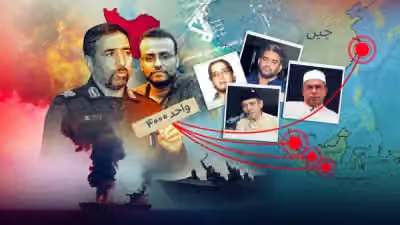
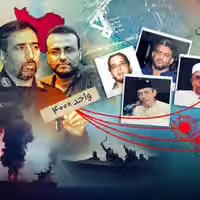
Iran International has obtained information about three alleged recruits and an operation being developed by Unit 4000, the Special Operations Division of the Islamic Revolutionary Guard Corps Intelligence Organization.
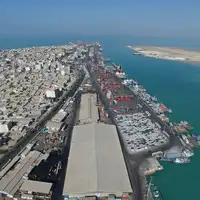
According to the sources, the unit recruited the three individuals through Shiite clerics in Thailand and Indonesia and has begun planning attacks in the Malacca and Bangka straits, as well as at Tanjung Priok Port in Indonesia and the Ningbo-Zhoushan and Shanghai ports in China.
The operations are being overseen by Brigadier General Rahman Moghaddam, commander of Unit 4000, according to Iran International’s sources.
Moghaddam was reported killed in an Israeli strike in Tehran on March 3, during the opening days of the war. Israeli security agencies identified him among senior Iranian intelligence figures killed in Israeli attacks.
Two days later, drones struck Nakhichevan in Azerbaijan in an attack Baku blamed on Iran, although Tehran denied responsibility. CNN later reported that Iranian officials believed the drone attack was retaliation for Moghaddam’s killing, which Tehran suspected had been carried out with Israeli assistance from Azerbaijan.
Iran International has now obtained information indicating that those reports of Moghaddam’s death were incorrect. According to the new information, he survived the strike and is now overseeing what the sources describe as a new phase of Unit 4000’s overseas maritime operations.
Moghaddam, a former deputy coordinator at the Defense Ministry’s Protection and Intelligence Organization, took charge around three years ago of Unit 4000, which has been linked to assassination and sabotage operations targeting opponents of the Islamic Republic and Israeli interests abroad.
Plans to target ships in Indonesian and Chinese waters
Two sources familiar with the IRGC’s activities said Moghaddam is overseeing a new program aimed at expanding Unit 4000’s operations into East Asian waters.
The sources said the unit is considering attacks on commercial, military and privately owned vessels transiting the Malacca Strait, one of the world’s most important shipping routes, as well as the Bangka Strait.
Operatives recruited by the unit have also developed plans targeting Tanjung Priok, Indonesia’s busiest port, and the major Chinese ports of Ningbo-Zhoushan and Shanghai, the sources said.
The plans would represent a significant geographical expansion of Iran’s maritime pressure campaign.
Since the war began on February 28, Iran has sought to restrict shipping through the Strait of Hormuz, while the Iran-backed Houthis in Yemen have disrupted maritime traffic around the Bab al-Mandab and the Red Sea.
In June, Mohsen Rezaei, then a senior adviser to Iran’s supreme leader and now secretary of the Supreme National Security Council, told CNN that Tehran could expand the conflict if the war and US naval blockade continued.
“If the war continues and the naval blockade is not lifted, we will drag the war to the Indian Ocean, the Bab al-Mandab Strait, the Red Sea and the Mediterranean,” Rezaei said.
Around the same period, Quds Force commander Esmail Qaani said a new “security belt” of Iran’s so-called resistance front would extend from the Strait of Hormuz to Bab al-Mandab and from the Persian Gulf to the Red Sea.
Sources identify recruitment links in Thailand and Indonesia
Iran International’s sources said Unit 4000 had been seeking non-Iranian recruits for its East Asian maritime operations, allowing Tehran greater deniability if an operation was exposed.
The recruits were brought to Iran for training before being assigned to operations in East Asia, according to the sources.
For recruitment in Thailand, Moghaddam approached Seyyed Momen Saketicha, a prominent figure in the country’s Shiite community, the sources said.
Saketicha was part of a Thai delegation that travelled to Tehran in 2023 and met Hamas representatives in efforts to secure the release of Thai nationals taken hostage during the October 7 attack on Israel.
The sources described Saketicha as a close associate of prominent Thai Shiite cleric Seyed Sulaiman Husaini, who heads the Al-Mahdi Foundation in Thailand and serves as imam of the Ruhollah Mosque in Nakhon Si Thammarat.
Husaini also has ties to Al-Mustafa International University, an Iran-based institution sanctioned by the US Treasury in 2020 over what Washington described as its role in facilitating recruitment for the IRGC Quds Force.
In 2012, after explosions in Bangkok that Thai and Israeli officials said were part of a plot targeting Israeli diplomats, Husaini blamed Mossad. A Thai court later convicted two Iranian men over the bomb plot. Iran denied involvement.
Focus on Indonesia
The bulk of Unit 4000’s planned East Asian maritime activity is centered on Indonesia, according to Iran International’s sources.
The sources said Moghaddam used two Indonesian clerics to identify potential recruits.
One is Zahir Yahya, chairman of Ahlulbait Indonesia, a national Shiite organization. Iran International’s sources described Yahya as an intermediary who introduced potential operatives to Unit 4000.
The second is Abdullah Saqqaf, whom the sources identified as head of the Amir al-Mu’minin seminary in Bogor and as having links to Al-Mustafa International University.
According to the sources, Saketicha, Yahya and Saqqaf introduced potential recruits to the IRGC, while two Unit 4000 figures — Mohsen Aghazadeh and Vahid Yekeh-Dehqan — were responsible for recruitment and training.
Three alleged recruits identified
Iran International has identified three individuals its sources say were recruited by Unit 4000 for covert maritime operations in East Asia.
The first, Pandu Yudhawinata, is an Indonesian operative who has previously been linked in counterterrorism reporting to Hezbollah and Iranian intelligence.
Yudhawinata was implicated in a failed 1994 Hezbollah plot to bomb the Israeli Embassy in Bangkok. Counterterrorism reporting has said he underwent training in Iran and later worked with Hezbollah networks in Southeast Asia.
Iran International’s sources also linked him to attacks in Sri Lanka.
The sources said Yudhawinata and two other Indonesian nationals, Ardiyanta Mutoha and Mohammad Hossein, travelled to Tehran for training intended to prepare them for covert operations at ports and waterways across East Asia.
The alleged plans come as Washington seeks to increase pressure on Iran’s oil exports while helping move energy shipments through the Strait of Hormuz.
US Treasury Secretary Scott Bessent said last week that the United States had helped move 130 million barrels of oil through the waterway over a two-week period while preventing Iranian exports.
Asia is particularly exposed to any expansion of maritime disruption. The International Energy Agency estimates that around 80% of oil passing through the Strait of Hormuz is destined for Asian markets.
The plans described to Iran International suggest that Unit 4000 may now be seeking to threaten another critical section of the energy and commercial shipping network serving Asia — extending the potential reach of Iran’s maritime campaign from the Middle East into some of the world’s busiest waters.
A Revolutionary Court in Isfahan has sentenced 10 protesters to death and six others to prison terms of up to 25 years over the nationwide demonstrations in the central Iranian city, according to an activist-run Telegram news channel.
Khabaraneha, run by Iranian political activist Mehdi Mahmoudian, said Branch 1 of the Isfahan Revolutionary Court issued the initial verdicts against 16 people detained in connection with the protests that began in late December 2025.
Those sentenced to death are Taraneh Rahimi, Navid Elyasi, Mehrdad Boeri, Abolfazl Dadgostar, Armin Gholami, Mehdi Mansouri, Ahmadreza Saeedi, Mohammadmehdi Asadi, Parsa Jafari and Mehdi Jafari, also known as Mehdi Khosravi.
Romina Rahimi and Milad Boeri were each sentenced to 25 years in prison, while Hamed Mehralian received a 15-year term. Setayesh Saedi, Sajjad Abedi and Ali Boeri were each sentenced to five years, Khabaraneha reported.
In addition, all 16 defendants were sentenced to five years for “assembly and collusion,” five years for “incitement” and one year for “propaganda against the establishment,” according to the report.
The case has become known as the “Isfahan Shohada Square” case and stems from protests in the area during the January uprising.
Khabaraneha said one of the female defendants was assaulted while in detention and filed a complaint over the incident, but that the court issued its verdict without examining the complaint.
Ahmadreza Saeedi also told judges during the trial that he had been tortured during interrogation, the channel reported. Khabaraneha said there had previously been reports of restrictions on lawyers’ access to the case file and of defendants being tortured to extract confessions.
Radio Farda reported in July that the case was connected to the deaths of Abbas Kamrani, a 37-year-old Revolutionary Guards colonel, and another person described in case documents as “homeless.” It said the 16 defendants mostly worked around Shohada Street in Isfahan.
Exiled prince urges international action
The office of Iran’s exiled prince Reza Pahlavi condemned the verdicts on Sunday, calling them “brutal and unjust” and saying they reflected an intensifying crackdown by the Islamic Republic.
Pahlavi’s communications office alleged that defendants had been denied legal representation and subjected to severe torture, including sexual violence against female detainees, to extract forced confessions.
“The world cannot stay silent in the face of these atrocities,” the office said.
The verdicts come amid a wave of death sentences against protesters in Isfahan. In a separate case known as the Alikhani Square case, Iranian authorities have executed five defendants since July.
Ghaem Hosseini was executed on Aug. 20, Abolfazl Sepahi Badjani and Amirhossein Safari Hosseinabadi on July 28, and Golmohammad Mohammadi and Erfan Esfandiari on July 19. The July 28 executions were carried out publicly in Alikhani Square.
Security forces confront protesters during demonstrations in Iran in January 2026.
A Revolutionary Guards veteran who fought in Syria helped command a deadly crackdown on protesters in Shahriar near Tehran, as security forces used coordinated lethal tactics across Tehran province during nationwide protests in January, an Iran International investigation found.
Witnesses and local sources identified Abbas Rasoulifar, a former Guards member with experience fighting alongside forces supporting Bashar al-Assad in Syria, as directing operational groups deployed against protesters in Shahriar.
Parts of this investigative report are based on accounts from witnesses and local sources. The allegations are attributed to those who made them, and their inclusion does not mean that all details have been independently verified by the author.
Witness accounts from Shahriar and other cities around the capital describe security forces firing live ammunition from police stations, mosques and rooftops, deploying snipers and armored vehicles, and dividing urban areas into operational zones.
The accounts point to similarities between some tactics used during the crackdown and methods associated with urban warfare in Syria.
Shahriar religious site emerges as operations hub
The protests began with strikes by shopkeepers in Tehran before spreading rapidly to surrounding cities and much of Tehran province.
Demonstrations peaked on January 8 and 9 following a call by exiled Prince Reza Pahlavi, with a crackdown already underway turning particularly deadly during those two days.
In Shahriar, the locations of reported shootings and security deployments point to the vicinity of the Imamzadeh Esmail shrine as a center for assembling and dispatching forces.
The shrine hosted events associated with Iranian fighters deployed to Syria during the presidency of Ebrahim Raisi, who visited the site several times.
Rasoulifar, the shrine's executive director, emerged as a central figure during Iran International's examination of people connected to the site.
Witness accounts and other findings show that Rasoulifar commanded operational groups during the January crackdown and personally fired a handgun at protesters. Forces under his direction were dispatched across Shahriar from a base near the shrine, according to the investigation.
The base sits in a residential area behind the shrine and next to a boys' high school. Sources said it served as an assembly and preparation point for personnel sent to confront protesters.
From Syria to Shahriar
Rasoulifar, born in 1963, joined the Basij in 1979 and the Revolutionary Guards in 1984, according to published accounts of his background. He has longstanding ties to the Guards and participated in several operations during the Iran-Iraq war.
Abbas Rasoulifar, a Guards member with experience fighting alongside forces supporting Bashar al-Assad in Syria
Javan newspaper, which is affiliated with the Revolutionary Guards, documented Rasoulifar's presence in Syria in 2017 as one of the Iranian personnel called by the Islamic Republic as "defenders of the shrine," a misleading title reserved for the forces that were sent to Syria.
At the time, the Quds Force and allied forces were fighting alongside Assad's forces on several fronts in Syria.
Rasoulifar's deployment establishes his involvement in Iran's military operations in Syria, although the available evidence does not establish precisely which battles or urban operations he participated in.
His name has also surfaced in connection with earlier domestic crackdowns, including in 2009 and the November 2019 protests in Shahriar. Witnesses have also accused him of involvement in the killing of protester Nader Momeni in Shahriar in 2019.
Similar tactics reported across Tehran province
Iran International's examination of witness accounts shows that security operations across several cities in Tehran province shared common features, raising questions about the extent to which the crackdown was centrally coordinated rather than shaped by individual decisions by local units.
In Eslamshahr, police and riot-control forces went on alert in Zarafshan and Bagh-e Feyz on January 7 as strikes began.
As protesters moved toward the Saveh road the following day, police vehicles fired flares, according to witnesses. The accounts indicate that the flares were used to illuminate gatherings and help other units locate protesters.
Witnesses in Vavan, near Eslamshahr, said live ammunition was fired that night from the roof of a mosque and around Khomeini Square. Similar accounts of religious buildings being used as firing positions later emerged elsewhere.
In Parand, in Robat Karim county, witnesses said armed personnel speaking Arabic fired directly at protesters from inside mosques and bases on January 8. Some witnesses identified them as members of Iraq's Popular Mobilization Forces, though Iran International could not independently confirm their identity.
Witnesses also described forces apparently retreating to draw protesters toward Parand's Police Station 18 on January 8 and 9 before firing live ammunition once part of the crowd entered the surrounding area. Witnesses said protesters were killed in the shooting.
Snipers, armored vehicles and power cuts
In Pakdasht, southeast of the capital, security forces deployed a large armored vehicle and firearms against protesters around Mamazand and Allameh Street on January 8, according to witness accounts.
Clashes continued the following day, when witnesses described intense gunfire, including machine-gun fire by Basij and Revolutionary Guards forces.
In Gharchak, electricity around Kalantari Square was cut on the evening of January 8 before shooting began from inside a police station, witnesses said. Snipers positioned on the roof and different floors of a restaurant in Khomeini Square also fired at protesters in the darkness, according to local accounts.
Local sources put the number of people killed there in the dozens.
In Varamin, southeast of Tehran, vehicles equipped with loudspeakers played religious chants at high volume as security forces fired tear gas and live ammunition on January 9, according to witnesses.
Shahr-e Qods, also known as Ghaleh Hassan Khan, south of Tehran, experienced severe internet disruption and a power outage on January 8. Witnesses said snipers positioned on the roof of the Milad commercial complex and armed groups fired at protesters on January 8 and 9.
Some witnesses again identified Arabic-speaking personnel as members of Iraq's Popular Mobilization Forces.
Local accounts said dozens were killed. Among those identified was Ilya Qodsi, who was fatally shot in the head.
Witnesses describe abuse away from protests
Accounts from Pardis and Bumehen, in the east of the capital, describe violence extending beyond shootings at demonstrations.
Mohammadreza Moradgholi, a 19-year-old protester, was detained on the evening of January 8 and taken into a security forces' vehicle, according to one account. The source said that personnel killed him by cutting a blood vessel.
Another account said security forces searched a young man's phone near the Pardis toll station on January 9 and detained him after finding a photograph of Pahlavi.
Personnel severely beat the man and forced him to swallow two pills before leaving him on a street around midnight, according to the account.
Witnesses in the area also described loud religious chants accompanying baton beatings, direct gunfire and tear gas.
Syria experience raises questions over crackdown
Across the cities examined, recurring features included the use of rooftops and elevated positions for gunfire, power cuts, operational zones, live ammunition and coordinated deployments from fixed bases.
Iran International's findings indicate two particular similarities with urban warfare methods used in Syria: dividing cities into operational sectors and assigning units responsibility for controlling designated areas.
Rasoulifar's military background in Syria and his role organizing operational groups in Shahriar provide a direct personnel link between Iran's foreign military campaigns and the January crackdown.
Taken together, witness accounts from cities of Tehran province depict a crackdown in which lethal tactics appeared repeatedly across Tehran's heavily populated outer cities, extending methods of armed urban control to the capital's surrounding belt.