Canada's conservative leader, Iran's exiled prince discuss democratic change in Tehran


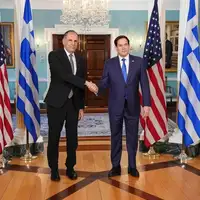
Iran’s exiled Crown Prince Reza Pahlavi and Canadian Conservative leader Pierre Poilievre had a virtual conversation about Western policy toward Iran and support for democratic change in the country, they announced on their social media accounts.
“We discussed the importance of sustained international pressure on the Islamic Republic, maintaining internet access for Iranians, using frozen Iranian regime assets rather than Western taxpayer dollars to support the Iranian people, and ensuring that Iranians themselves determine the future of their country through free elections and a democratic constitutional process,” Poilievre said on X.
"I thanked him for his consistent support for the people of Iran and their human rights and dignity and accepted his invitation to visit Canada again where we will continue our conversation on how to help the Iranian people and free the world of regime holding us all hostage," Pahlavi said on X.





Days before he was killed, Ali Khamenei gave a poem to a translator, a senior cleric says. Iranian outlets published it as his prophecy of his own martyrdom. Then readers ran down the first letters: I am Ali Khamenei, born of Satan.
The account comes from Mohammad-Ali Mousavi Jazayeri, the former Friday prayer leader of Ahvaz and a former member of the Assembly of Experts, in a video that spread across Persian social media this week.
Jazayeri says he heard the story from Abbas Hazbavi, an Arabic-language poet from Khuzestan. By that account, intermediaries told Hazbavi after meeting Khamenei that the leader had urgent business with him, and a call from the office followed.
Hazbavi says he went on the first day of Ramadan, around ten days before Khamenei was killed on February 28, and that the supreme leader handed him a poem and asked him to render it into Arabic. The Khuzestan news site Sobh-e Khouzestan published the interview along with the full Persian text.
Hazbavi was a plausible choice. An established religious poet, he has translated Khomeini's ghazals into Arabic and has publicly recited his own Arabic rendering of Khamenei's verse. The office would have had his number.
The poem reads, on the surface, exactly as its promoters wanted. "Alas, I came late to my purpose," one line runs, "and heard the meaning of martyrdom from the beloved's lips." Another appears to name the month: "If the tyrant has marked my body as his target, in Esfand my soul will set out after the lovers." Khamenei was killed on the ninth day of Esfand (February 28).
The trouble is in the margin. Taking the first letter of each of the poem's 22 hemistiches in order produces a sentence: man Ali Khamenei zadeh-ye Sheytanam. "I am Ali Khamenei, born of Satan."
The device is a classical one. Persian poets have used the acrostic, known in traditional prosody as movashshah, for centuries to conceal a name or a dedication in the opening letters of successive lines. Twenty-two letters forming a grammatical sentence is not coincidence; someone built it deliberately.
Who that was is the question the story leaves open. Iran International cannot verify Jazayeri's account, Hazbavi's, or the poem's authorship, and there is no evidence that Khamenei wrote the poem.
What the establishment's own account supplies is the route the poem travelled: through the supreme leader's office, into a translator's hands, and out into print under Khamenei's name. Every step of that journey is described by his admirers, not his enemies.
It landed among outlets primed to want it. The verses ran on ILNA, Hamshahri and Khabar Online, among others, at a time when Iranian media were combing Khamenei's life for signs he had foreseen his own end.
ILNA's version, headlined "The leader who counted the moments to martyrdom," has since been taken down.
Too late to delete
On Persian social media, where the poem returned to circulation this week with the first letters marked in red, the mood has been close to disbelief.
"Apparently Khamenei ordered a poem he could pass off as his own," one widely shared post said. "The poet delivered, all right. Now the state sites have finally noticed and they're deleting it."
"At first I thought it was a joke," another user wrote. "They've pulled it from a lot of sites, but it's still up on the eulogists' channels."
Others turned to the question of where the poem came from. "So someone inside the leader's own house did this," one post said, speculating about who in Khamenei's circle might have arranged it.
One user drew out the reversal at the heart of the affair: "They wanted to show a miracle, that he foresaw his own martyrdom. The very poem they are using as proof says the opposite: that he was born of Satan."
The appetite the poem fed is well documented. In the weeks after Khamenei's killing, Iranian media ran a steady stream of material presenting him as having anticipated it, including a genuine ghazal of his that Hamshahri Online published under the headline "The ghazal the martyred leader wrote for his own martyrdom."
The flood has been large enough that Khamenei's own Office for the Preservation and Publication of Works has had to issue a denial over a different poem attributed to him after a cleric recited it publicly, saying the attribution and the story around it "are entirely untrue."
Jazayeri's own history gives the episode a final turn. In 1989, when the Assembly of Experts chose Khamenei to succeed Khomeini, it was Jazayeri who proposed that the new leader be addressed as an ayatollah rather than by his actual, lesser clerical rank.
Thirty-seven years later, the same cleric put his name to a poem whose hidden line calls him the son of the devil.
The phrase itself has been used against Khamenei before. In January, the US ambassador to Israel, Mike Huckabee, called him "a true son of Satan" in a post on X.
What is new is where Iranians found it this week: inside a poem his own admirers were circulating as scripture.
A student at Iran's most prestigious technical university has been expelled and banned from all universities for four years over a stuffed rat hung from a campus tree, a toy that carried the nickname protesters gave the late supreme leader.
Sharif University's student affairs office said the ruling against Reza Dalman, a 24-year-old master's student in computer engineering, was final. "The final ruling was communicated to the university for implementation on August 16," the office said.
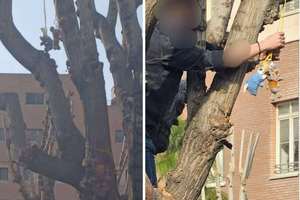
Dalman was arrested on March 19 and released on bail about a month later. Student sources link his case to a stuffed rat that demonstrators hung from a tree during protests at Sharif in late February, before a Basij-affiliated student climbed up and took it down.
The toy was an insult with a name. Critics began calling Ali Khamenei "Moush-Ali," or Rat-Ali, after the late supreme leader largely vanished from public view during the 12-day war with Israel in June 2025, when reports said he had taken shelter in a fortified underground facility.
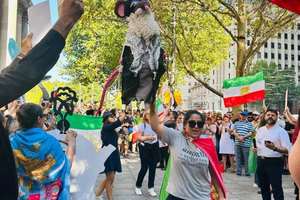
Moush means mouse, or rat. The nickname spread from social media into chants at protests inside Iran and among the diaspora, a way of mocking a leader his opponents said had run for cover.
Dalman published an image of the final decision, stamped "confidential," on his X account. Among the points the university listed against him was that during his defense he showed "no expression of remorse."
The expulsion sits alongside a judicial case against Dalman and a widening series of disciplinary rulings at one of Iran's most prominent universities.
Expulsion orders reach 10
Three more Sharif students have received preliminary expulsion orders, bringing to 10 the number facing such rulings, the United Students group said on Wednesday.
The latest are Ariana Kouchaki, an industrial engineering undergraduate, Ali Alirezaei, a mathematics undergraduate, and Arash Hatami, a physics undergraduate. Kouchaki and Hatami were each barred from studying at any university in Iran for one year, while Alirezaei received a five-year nationwide ban, according to the group.
Seven other Sharif students had already received expulsion orders. Dalman's is the only case finalized by the Ministry of Science; the rest remain preliminary.
Iran executed Ghaem Hosseini, also known as Arian, on Thursday over his involvement in protests in the central city of Isfahan in January, making him the fifth person put to death in a case in which UN experts have raised concerns about the defendants' trials.
Iran's judiciary described Hosseini as a foreign national but did not say which country he was from. A source familiar with the case told Iran International earlier his month that Hosseini was a cousin of Golmohammad Mohammadi, an Afghan national who was previously executed in the same case, indicating Hosseini may also have been Afghan.
The judiciary's media center said Hosseini was executed on Thursday morning after his death sentence was upheld by the Supreme Court. It said he had been convicted of charges including moharebeh, or "waging war against God," and corruption on earth, as well as destruction of property and collusion to act against national security.
Fifth execution in Ali-Khani Square case
Twelve people were sentenced to death in the Ali-Khani Square case, which stems from protests in Isfahan on January 8.
Iranian authorities executed Golmohammad Mohammadi and Erfan Esfandiari on July 19, followed by Amirhossein Safari and Abolfazl Sepahi on July 28. Hosseini's execution on Thursday brings the number of defendants put to death in the case to five.
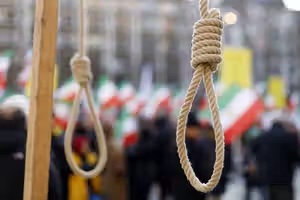
Safari and Sepahi were hanged after an execution scaffold was erected at Ali-Khani Square, the site of the January protests. People gathered near the square overnight amid a heavy deployment of security forces and fears of imminent executions.
Iranian authorities have accused the defendants of involvement in the deaths of four security personnel, as well as arson and vandalism during the protests.
Judiciary says Hosseini took part in violence
Iranian authorities said Hosseini was involved in unrest at Isfahan's Ali-Khani Square on January 8, where four members of the security forces were killed.
The judiciary said Hosseini admitted being present during the unrest and carrying a bladed weapon. It said he wore a jacket, hat and mask and switched off his mobile phone to avoid being identified or tracked.
The judiciary also accused Hosseini of taking part in the burning of the Amir al-Momenin mosque in Isfahan's Malekshahr district on the same night.
The authorities said Hosseini was convicted of drawing a weapon and "creating fear and terror," causing widespread insecurity, acting against national security, destroying public property and colluding to act against national security.
The judiciary said the Supreme Court reviewed Hosseini's appeal and upheld the death sentence before it was carried out on Thursday.
UN experts questioned fairness of trials
Before the July 28 executions, UN human rights experts urged Iranian authorities to halt the executions of the remaining defendants in the Ali-Khani Square case.
"Sentencing 12 people to death in one hearing, in a closed courtroom and without clarity as to each defendant's individual responsibility violates established fair trial standards," the experts said.
The experts, led by Mai Sato, the UN Special Rapporteur on the situation of human rights in Iran, said the defendants, ranging from their late teens to their early twenties, had reportedly faced arbitrary detention, enforced disappearance and, in some cases, ill-treatment.
They also raised concerns that convictions relied heavily on confessions broadcast on Iranian state television, while Revolutionary Court hearings were held behind closed doors and the judgments were not made public.
Other rights groups have also raised concerns over access to independent lawyers and court files in the case.
Executions rise after January protests
Hosseini's execution comes amid a broader rise in the use of the death penalty for national security-related offenses following Iran's January protests.
UN human rights chief Volker Türk said on August 5 that Iran had executed at least 56 people on national security-related charges since March 19, including 27 in cases linked to protests earlier this year.
Türk said more than 100 other people faced similar charges and the possibility of the death penalty. He urged Iranian authorities to halt executions and move toward abolishing capital punishment.
President Donald Trump said Wednesday the Strait of Hormuz was open and the US blockade of Iran had been “100% successful,” as media reports indicated Tehran had lost significant control over traffic through the waterway.
More than 80% of liquid cargo transits through the strait over the past two weeks either used the Omani route or traveled with transponders switched off and likely followed that path, CNN reported, citing Kpler, which tracks ships using transponder and satellite data.
The US military is meanwhile quietly operating a shipping corridor along the Omani side of the strait that is helping move about 10 million barrels of oil a day, Axios reported, citing two US officials.
“It increasingly looks like Iran has at least partially lost control of the strait,” Homayoun Falakshahi, Kpler’s head of crude oil analysis, told CNN.
US organizes traffic along Oman
The US operation has been underway for several weeks, with 15 to 20 tankers entering and leaving the strait each night through a southern channel along Oman’s coast, the two US officials told Axios.
The effort goes beyond moving outbound oil shipments. The US military is helping empty tankers enter the Persian Gulf from the Arabian Sea, travel to ports in the UAE, Bahrain and Kuwait to load oil and then exit through the strait, according to Axios.
A task force run from the US Army’s 82nd Airborne Division headquarters at Fort Bragg coordinates daily inbound and outbound traffic with regional Gulf partners, Axios reported. US fighter jets patrol above the route to intercept Iranian cruise missiles and drones.
“We have been controlling the southern lane of the Strait of Hormuz for two months now. The Islamic Revolutionary Guard Corps can be a nuisance, but they don't control the strait. We do,” a US official with direct knowledge of the operation told Axios.
The growing use of the Omani route has also reduced Iran’s ability to collect tolls from vessels passing through the strait as it did earlier in the war, according to Kpler.
Ali Gholhaki, a political activist close to Iranian parliament speaker and top negotiator Mohammad Bagher Ghalibaf, said in a post on X that the United States had used specialized vessels to clear sharp rocks along the southern, Omani side of the Strait of Hormuz to facilitate traffic through the corridor.
“The quiet transfer of oil by the United States through the southern Strait of Hormuz will reduce the strait’s leverage,” he wrote, adding that if the arrangement continued, Washington would have little incentive to lift its blockade, ease sanctions or release frozen funds.
Trump says blockade is working
Trump said Wednesday the strait remained open and described the US naval blockade of Iran as “100% successful.”
“Right now, the Strait is open. A lot of boats are coming through,” Trump told reporters at the White House.
“The blockade has been 100% successful. No boats have gotten into Iran, but they are getting in for other places,” he said.
US Central Command said Wednesday that US forces had redirected 65 commercial vessels, disabled three and boarded two as part of enforcement of the blockade against Iran.
Iran has nevertheless continued attacking vessels using the waterway, according to CNN. The continued attacks leave control of the strait contested even as recent shipping patterns indicate Tehran has less ability to dictate traffic than it did earlier in the war.
Washington weighs further pressure
The erosion of Iran’s leverage in the Strait of Hormuz comes as Washington considers tightening economic pressure on Tehran further.
Trump said Wednesday the United States was weighing additional sanctions on Iran.
“We have things that we could sanction. We have very draconian sanctions, and we’ll see what happens,” he told reporters.
Treasury Secretary Scott Bessent also signaled tougher measures last week, telling Newsmax that Washington would apply measures against Iran that had “never been seen” in the economic isolation of a country.
Trump also argued that Hormuz could become less important to global energy markets as countries turn to alternative oil supplies and new pipelines.
“People have found other alternatives, which they never thought about: Texas, Alaska, Louisiana, and other places,” he said.
“So I think the Hormuz Strait is not going to be quite as important as it was in the past,” Trump added.
Trump also said Wednesday that Iran could not be allowed to obtain a nuclear weapon.
“Iran cannot have a nuclear weapon. You know why? Because they would use it. We are not gonna let them use it,” he said.
For now, the growing use of the Oman-side route and the US-organized corridor point to a significant erosion of Iran’s leverage over Hormuz, while continued Iranian attacks show that control of the strategic waterway remains contested.
A campaign by pro-establishment religious groups in Iran is asking people to help fund the ritual slaughter of 10,000 sheep as a religious offering for Supreme Leader Mojtaba Khamenei’s health, with each animal priced at 250 million rials, or about $132.
The campaign says it is being carried out with the participation of Heyat-e Gharar, a religious group active on the Iranian messaging platform Eitaa. Donations are being collected through accounts belonging to the Qom-based Hazrat Khadijeh Institute, a religious charity that organizes collective animal sacrifices and meat distribution.
The campaign website describes the initiative as a nazr, a religious vow or offering made for a particular purpose. In this case, it takes the form of qorbani, the ritual slaughter of an animal as an act of religious devotion dedicated to Khamenei’s health.
Donors can cover the full 250 million-rial cost of a sheep, about $132, or contribute smaller amounts collectively. At the advertised price, 10,000 sheep would cost 2.5 trillion rials, or about $1.32 million.
Abdolkarim Abedini, a former representative of the Supreme Leader in Qazvin province and former Friday Prayer leader of Qazvin, has also urged people to participate. In a video, he called for 10,000 sheep to be sacrificed for Khamenei’s health and to ward off what he called the “Zionist-American enemy,” urging people to “hurry” to take part.
Locals question campaign amid economic hardship
The campaign has drawn criticism from Iranians who told Iran International they questioned why the public should fund it amid severe economic pressure and high food prices.
“Why would I sacrifice a sheep for Mojtaba when I haven’t been able to afford lamb myself for years?” one person wrote to Iran International.
A Tehran resident said they had received a text message about the campaign several days earlier.
“A few days ago, we received a text saying they were collecting an offering for the Leader’s health and that we should send money for 10,000 sheep,” the resident told Iran International. “Why should the money come from the people?”
The campaign comes amid continued uncertainty over Khamenei’s health and whereabouts. He was reportedly seriously injured in the Feb. 28 US-Israeli strike that killed his father and predecessor, Ali Khamenei, and has not appeared in public since becoming Supreme Leader.
Khamenei has not delivered a public speech or interview since taking office, and no new authenticated photograph, video or audio recording of him has been released. His public communications have instead consisted of written statements attributed to him.