• العربية
  • فارسی
Brand
  • Iran Insight
  • Politics
  • Economy
  • Analysis
  • Special Report
  • Opinion
  • Podcast
  • Iran Insight
  • Politics
  • Economy
  • Analysis
  • Special Report
  • Opinion
  • Podcast
  • Theme
  • Language
    • العربية
    • فارسی
  • Iran Insight
  • Politics
  • Economy
  • Analysis
  • Special Report
  • Opinion
  • Podcast
All rights reserved for Volant Media UK Limited
volant media logo

Cattle feeding on hospital waste expose risks at Iran landfill

Jul 5, 2026, 09:10 GMT+1
Cattle forage among piles of garbage at a landfill in Talesh, Gilan Province, northern Iran, while a close-up image shows discarded plastic medical waste mixed with refuse.

Cattle have been filmed feeding on hospital waste at a landfill in northern Iran, exposing failures in waste management that risk contaminating livestock, soil and the human food chain, according to a report by Rokna website on Saturday.

The video from the landfill in Talesh shows cattle roaming through piles of refuse, including hospital waste, highlighting the apparent lack of effective segregation, containment and disposal measures for hazardous materials.

Hazardous waste enters food chain

Hospital waste ranks among the most dangerous categories of refuse because it can contain infectious materials, contaminated equipment, sharp objects and hazardous chemicals. Allowing livestock to graze in direct contact with such waste, according to the report, raises concerns that contaminants could spread through meat, milk and other agricultural products consumed by people.

The footage also points to broader shortcomings in landfill management beyond the presence of medical waste. Open dumping without effective isolation, daily cover or barriers preventing animal access leaves waste exposed to livestock, wildlife and the surrounding environment.

Such conditions, Rokna wrote, can contaminate soil, generate polluted leachate that may seep into groundwater, attract disease-carrying insects and animals, and release foul odors and harmful gases. When cattle graze freely in these areas, the potential for biological and chemical contaminants to enter the food chain increases.

The risks, based on the report, are particularly acute in Talesh, where mountains, forests, farmland, residential areas and the Caspian Sea lie in close proximity, allowing pollution to spread more rapidly through interconnected ecosystems.

Environmental and public health concerns

Environmental degradation extends beyond the immediate health risks. Large volumes of uncovered waste can damage natural habitats, reduce land quality and increase the likelihood of contaminants spreading into surrounding soil and water resources, added the report.

The conditions documented by Rokna also suggest failures in basic waste management practices, including separating hazardous medical waste from ordinary refuse, safely treating infectious materials and preventing livestock from entering disposal sites.

Without urgent measures to improve waste segregation, strengthen landfill controls and restrict animal access, the Talesh landfill risks becoming a continuing source of contamination affecting livestock, the environment and public health, the report added.

Most Viewed

Classified warning projected up to 3,000 deaths at Khamenei funeral - Die Welt
1

Classified warning projected up to 3,000 deaths at Khamenei funeral - Die Welt

2

Five more protesters sentenced to death in central Iran

3

Romanian men get combined 20 years over Iran International journalist attack

4
INSIGHT

Iran hardliners warn Hormuz authority slipping to US-backed Omani route

5
ANALYSIS

Behind the funeral: Khamenei’s coffin becomes stage for Iran’s wounded power

Banner
Banner
Banner

Spotlight

  • After the war, Iran’s rulers face their biggest question
    PODCAST

    After the war, Iran’s rulers face their biggest question

  • Behind the funeral: Khamenei’s coffin becomes stage for Iran’s wounded power
    ANALYSIS

    Behind the funeral: Khamenei’s coffin becomes stage for Iran’s wounded power

  • Iran hardliners warn Hormuz authority slipping to US-backed Omani route
    INSIGHT

    Iran hardliners warn Hormuz authority slipping to US-backed Omani route

  • Funeral expenses deepen anger over Ali Khamenei's week-long burial
    VOICES FROM IRAN

    Funeral expenses deepen anger over Ali Khamenei's week-long burial

  • Mojtaba Khamenei’s key word for Iran’s future: a people given a mission
    ANALYSIS

    Mojtaba Khamenei’s key word for Iran’s future: a people given a mission

•
•
•

More Stories

After the war, Iran’s rulers face their biggest question

Jul 4, 2026, 22:20 GMT+1
•
Negar Mojtahedi
After the war, Iran’s rulers face their biggest question
100%
Iranian officials at Ali Khamenei's funeral on July 3, 2026. From left to right: Abbas Araghchi, Sadegh Amoli Larijani, Gholamhossein Mohseni Ejei, Mohammad Bagher Ghalibaf, Masoud Pezeshkian, Mohsen Rezaei

The Iran-US truce has exposed a deeper battle inside Tehran, where public rifts over censorship, negotiations and the system’s future point to a survival debate that could reshape or further destabilize the regime, experts told the Eye for Iran podcast.

In the days since the fighting subsided, Iran's political establishment has offered an unusually public glimpse into divisions that have long remained largely behind closed doors.

State television abruptly cut short a pre-recorded interview with Parliament Speaker Mohammad Bagher Ghalibaf as he discussed the use of blocked Iranian funds abroad, prompting accusations that politically sensitive remarks had been censored. State broadcaster IRIB insisted the interview had always been scheduled to air in two parts.

Elsewhere, hardliners heckled Foreign Minister Abbas Araghchi during a visit to Karbala, chanting "death to the appeaser" and "we don't want pretense" as Tehran pursues negotiations with Washington. Establishment commentators have also begun openly discussing ideas that, until recently, would have been politically difficult to imagine entering the public conversation.

Individually, each episode could be dismissed as another example of factional politics inside the Islamic Republic.

Taken together, however, they point to something more significant.

They suggest the post-war debate inside Tehran is no longer simply about diplomacy, sanctions or military strategy.

It is increasingly about how the Islamic Republic must adapt if it is to preserve power in the wake of one of the greatest shocks in its 47-year history.

"The question isn't whether they're engaging in soul-searching," Alex Vatanka, a senior fellow at the Middle East Institute, told Eye for Iran. "They have to."

For Vatanka, the significance of this moment is not that the Islamic Republic has suddenly embraced reform.

It is that the war appears to have stripped away old assumptions.

"I think there is a lot more clarity today than there was before the war," he said. "The regime knows the old model failed. The question now is what comes next."

He believes survival—not reform—is driving the conversation.

"If you're in the business of surviving, you don't want this to happen to you again," he said. "Maybe this is the moment you change course."

That should not be mistaken for moderation.

"You don't do it because you love the people of Iran," Vatanka said. "You do it because you want to survive."

The debate itself could prove destabilizing.

"When the knives are out within the regime, they go after each other in vicious ways," Vatanka warned, arguing that competition between rival factions could intensify as different camps attempt to shape the Islamic Republic's post-war future.

Behnam Ben Taleblu, senior director of the Iran Program at the Foundation for Defense of Democracies, argues that understanding those debates first requires understanding the nature of the political system itself.

"It is not straight-up Islamic theocracy," he said.

Instead, he described the Islamic Republic as a political project drawing on multiple ideological traditions.

"A traditional Shia marja has basically taken Karl Marx, the Quran and Plato and put it together and created a political system on top of that."

That, Taleblu argues, is why outsiders should be careful not to confuse adaptation with transformation.

"I think it is a real battle within this regime of how best to preserve the prerogatives and the privileges of power while also sacrificing as little as possible on the ideology."

Even if institutions evolve, he says, the guiding principles may not.

"Real transformation comes with behavior. It comes with substance—not style."

Historian Shahram Kholdi remains skeptical that the current debate represents a genuine break with the past.

"Any difference that has existed between any of these people, in my opinion, has always been one of degree rather than in kind," he said. "Tactics are different. Worldviews, strategies, expectations and demands are all the same."

Rather than seeing reform, Kholdi sees a political elite trying to preserve the system after one of its most serious crises.

But he also believes the post-war period could intensify competition among rival centers of power.

"If Ghalibaf and his ilk manage to get the upper hand... the rest of the gang would feel completely insecure, and that intra-conflict then would materialize into a hot conflict within them," he said.

"And that may very well spell their final doom once and for all."

Whether that prediction proves correct remains to be seen.

What is already clear is that the conversation unfolding inside Tehran has moved beyond the immediate consequences of the war.

It has become a debate about the future of the Islamic Republic itself.

In July 2006, Henry Kissinger argued that Iran's leaders would eventually have to decide whether they were governing "a cause or a nation."

Today, that question is no longer being asked only by foreign observers. Increasingly, it appears to be one the Islamic Republic is asking itself.

Iran's new IRGC Navy chief emerges without formal decree: who is Ali Azmaei?

Jul 4, 2026, 20:04 GMT+1
Iran's new IRGC Navy chief emerges without formal decree: who is Ali Azmaei?
100%
New IRGC Navy commander Ali Azmaei (right) and his slain predecessor Alireza Tangsiri

Iranian state media on Saturday published a message from Rear Admiral Ali Azmaei that identified him as commander of the IRGC Navy, marking the first public indication that he has replaced Alireza Tangsiri, who was killed during the war in March.

No formal appointment decree has been published for Azmaei, whose predecessor was killed in an attack on Bandar Abbas on March 26.

Top IRGC appointments are normally announced through decrees issued by the supreme leader, but no such decree has been published by Mojtaba Khamenei who has not been seen in public since he reportedly suffered injuries in the early hours of the war.

In a message issued Saturday for the funeral of Iran’s slain Supreme Leader Ali Khamenei, Azmaei said IRGC naval forces and “guardians of the strategic Strait of Hormuz” would continue Khamenei’s path, adding that “divine revenge” against what he called US and Israeli terrorists was not far off.

Azmaei had commanded the IRGC Navy’s Fifth Naval Region since its formation in 2012 and previously served as deputy commander of the IRGC Navy’s First Naval Region.

He was promoted to brigadier general by Ali Khamenei in April 2022 and has been under US sanctions since 2019. The US has sanctioned him as Ali Ozma’i.

The announcement comes as several senior military posts in the Islamic Republic have changed hands without the publication of formal decrees since Khamenei’s death.

In Iran’s Zagros, villagers fight oak forest fires the state cannot contain

Jul 3, 2026, 14:28 GMT+1
•
Saman Rahmatian
In Iran’s Zagros, villagers fight oak forest fires the state cannot contain
100%
Local residents use improvised tools to fight a wildfire in the Zagros forests.

When flames appeared over the Zagros, local residents again climbed toward the fire with shovels, branches and bottles of water, exposing a recurring failure: Iran’s largest oak landscape is burning faster than the state can protect it.

This time, Taghi Changalvaei was one of those who went.

He entered the fire to help save Khayiz, a protected area in the southern Zagros near Behbahan, in Khuzestan province. He did not return.

For Zagros communities, his death was familiar. For years, local residents and environmental volunteers have been losing friends and relatives to fires that return each summer across the mountains.

Iranian media have reported that since 2020, 27 people have died while trying to control fires in the Zagros.

Most were not professional firefighters. They had no specialized training, no protective clothing and little more than improvised tools.

They went because the forests were burning, and because in many parts of the Zagros, people know that if they do not move first, help may arrive too late.

  • Wildfire burns through southern protected forests in Iran

    Wildfire burns through southern protected forests in Iran

A landscape primed to burn

The Zagros Mountains run for about 1,600 kilometers, from northwestern Iran toward the Persian Gulf. Their oak woodlands cover almost six million hectares, roughly 40 percent of Iran’s forest area, and support millions of rural livelihoods while helping regulate water and prevent soil erosion.

The Persian oak defines this landscape, shaping village economies, water systems and grazing patterns. But the Zagros oak belt has been shrinking for decades under pressure from illegal logging, overgrazing, drought, climate change and poor management.

Each summer, fire turns that decline into an emergency. That pattern was visible again in Khayiz, where a blaze that began on Badil Mountain burned for days through protected forests near Behbahan, exposing shortages of aerial firefighting capacity.

Experts say the fires have become larger, harder to contain and more closely tied to climate stress, fuel buildup and weak management.

  • Iran suspects human cause in northern forest fire, probes land development ties

    Iran suspects human cause in northern forest fire, probes land development ties

Winter and spring rains can cover the slopes with grasses and seasonal plants. By early summer, heat dries that vegetation into fuel load: the combustible layer that lets a spark, a cigarette butt, a campfire or an intentional blaze spread quickly.

One part of the debate concerns grazing. In the past, livestock consumed part of the seasonal vegetation that now dries out in the mountains. From around 2021, authorities pursued efforts to reduce grazing pressure more seriously to help forests and pastures recover from overuse.

  • Public criticism mounts over Iran government’s forest fire response

    Public criticism mounts over Iran government’s forest fire response

  • Iran bans public entry to forest zones as wildfire threat persists

    Iran bans public entry to forest zones as wildfire threat persists

The aim was environmental protection: overgrazing has long damaged Zagros forests, limiting natural regeneration and weakening young oak growth. But some experts argue that reducing livestock presence without alternative vegetation management may have left more dry grass and brush by summer.

That does not make grazing restrictions the cause of the fires. Climate change, drought, oak decline, human negligence, arson, weak fire roads, aircraft shortages, poor coordination and lack of equipment all remain central. Unmanaged vegetation, some experts say, may be one piece of a larger puzzle.

In parts of Spain and the western United States, targeted grazing is used to reduce wildfire fuel loads and maintain firebreaks. For the Zagros, the question is whether the state can protect forests without removing one form of vegetation control and failing to replace it with another.

  • Wind and dry vegetation fuel forest fires in Iran’s Hyrcanian woodlands

    Wind and dry vegetation fuel forest fires in Iran’s Hyrcanian woodlands

Bigger fires, weaker capacity

The statistics point to a worsening burden. In the Iranian year that began in March 2021, about 21,000 hectares of forests across the country burned, according to figures cited in Iranian media. By the year that began in March 2024, that figure had risen to about 27,000 hectares.

By November 2025, Iran had recorded more than 2,300 fires across national land, forests and rangelands, burning about 46,000 hectares. A recent study of the southern Zagros recorded more than 13,000 fire events from 2000 to 2023, with a sharp increase in the most recent years covered by the study.

The year that began in March 2026 has opened with another wave of fires, from Khayiz and Mongasht to the highlands of Lorestan, Fars and Kordestan provinces. Mongasht, a long mountain massif between Khuzestan and Chaharmahal-Bakhtiari, is one of several rugged areas where local residents are often the first responders.

The financial picture has also worsened. On paper, the rial budget of Iran’s Natural Resources and Watershed Management Organization has increased. But once the collapse in the value of Iran’s currency is taken into account, its real resources appear to have fallen sharply.

Calculations based on budget figures cited in Iranian media and market exchange rates suggest the organization’s dollar-denominated budget dropped from roughly $94 million in the Iranian year that began in March 2021 to about $41 million in the year that began in March 2026. Compared with the year that began in March 2016, the decline is estimated at more than 60 percent.

The direction is clear: while the fires have grown, the state’s real capacity to fight them has shrunk.

The consequences are visible on the ground. The fire in Khayiz is now out. But for Changalvaei‘s family, and for the families of others who died trying to save the Zagros, the fire has not ended.

Without changes in policy, funding and firefighting capacity, next summer will bring the same scene again: men with shovels, branches and bottles of water climbing toward the smoke, while fire moves through the oaks and leaves behind ash and names.

Funeral expenses deepen anger over Ali Khamenei's week-long burial

Jul 3, 2026, 12:22 GMT+1
•
Hooman Abedi
Funeral expenses deepen anger over Ali Khamenei's week-long burial
100%
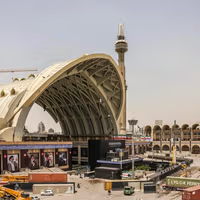
Preparations at Tehran's Grand Prayer Ground, on Thursday, July 2, 2026, where extensive state resources and infrastructure have been deployed ahead of funeral ceremonies for slain Supreme Leader Ali Khamenei.

Funeral spending for former Supreme Leader Ali Khamenei has fueled public anger, with messages to Iran International saying authorities are forcing businesses and state employees to fund ceremonies, provide services or attend events before his burial.

More than four months after Khamenei's death on February 28, authorities say he will be buried on July 9 following five days of ceremonies across Iran and Iraq. Officials have attributed the unusually long delay to wartime conditions and security concerns.

Messages sent to Iran International from people across the country describe what was a broad campaign to mobilize resources for the funeral, even as many Iranians struggle with inflation and declining living standards.

"We work at the terminal, and they told us we are not allowed to sell tickets for three days," one person wrote. "Every shop inside the terminal has also been ordered to close, and they are not even reducing our rent."

Businesses told to shoulder costs

Another message from Semnan said industrial companies had been instructed to finance roadside service stations for mourners.

Tehran Grand Prayer Ground is being prepared on July 2, 2026 for funeral ceremonies of former Supreme Leader Ali Khamenei, with state facilities deployed at significant public expense.
100%
Tehran Grand Prayer Ground is being prepared on July 2, 2026 for funeral ceremonies of former Supreme Leader Ali Khamenei, with state facilities deployed at significant public expense.

"They forced companies in the industrial zone to set up booths and provide soup, tea, juice and dates at their own expense," the person wrote. "This is a government order for all organizations."

Another message said companies in Tehran had been compelled to contribute large sums for the funeral.

"The Islamic Republic and the Revolutionary Guards have forced all companies in Tehran to pay for booths and food for the funeral," the message said. "More than 1,000 billion rials (over $570,000) has been taken from automobile manufacturers, while workers are struggling to make ends meet."

People identifying themselves as employees of Iran's Civil Registration Organization also said staff had been offered incentives to attend the ceremonies.

"Today we were each given 20 kilograms of rice so we would participate in the ceremony," a citizen said. "But we are going to northern Iran instead (for fun)."

The reported pressure comes as the average monthly income is around $150, according to independent estimates, well below a poverty line estimated at roughly $350 for a family, leaving many households struggling to meet basic needs.

Economic hardship fuels backlash

Several also criticized the cost of the funeral during a period of economic hardship.

"People are being destroyed by poverty and inflation, while those in power are spending the nation's wealth on the funeral," one person wrote.

Another said bread prices had been raised before the ceremonies, but they are distributing free bread.

"They increased bread prices just before the funeral," the message read. "Now they want to hand out free bread along the procession routes so more people will attend."

A large number of messages urged people to wear bright-colored clothing instead of black during the official mourning period, saying they would mark the occasion by celebrating rather than mourning. Several also described Khamenei's burial as symbolizing the eventual end of the Islamic Republic.

Iran has announced funeral processions beginning in Tehran before continuing through Qom, Iraqi cities of Najaf and Karbala ahead of Khamenei's burial in Mashhad on July 9.

An interior view of Tehran's Grand Prayer Ground on July 2, 2026 shows black mourning decorations and seating arrangements prepared for funeral ceremonies of slain Supreme Leader Ali Khamenei.
100%
An interior view of Tehran's Grand Prayer Ground on July 2, 2026 shows black mourning decorations and seating arrangements prepared for funeral ceremonies of slain Supreme Leader Ali Khamenei.

Images published by state media on Friday showed foreign delegations attending a ceremony in Tehran where the coffins of Khamenei and members of his family were on display.

Authorities have also announced heightened security measures, including temporary airspace restrictions over Tehran and Mashhad during the ceremonies.

Counterfeit drugs kill 7,000 people annually in Iran

Jul 3, 2026, 10:24 GMT+1
Counterfeit drugs kill 7,000 people annually in Iran
100%
File photo shows an addict woman smoking a cigarette while gathered with others in an outdoor area in Iran.

Counterfeit and adulterated illicit drugs kill around 7,000 people in Iran each year, a senior anti-narcotics official said on Thursday, warning that dangerous impurities in illegal drugs have become a major public health concern.

The comments, published by the Iranian Students' News Agency (ISNA), came as officials highlighted the growing presence of new psychoactive substances that they say are not covered by Iran's current anti-drug legislation.

"Seven thousand people die every year because of consuming counterfeit narcotics," Amirhossein Yavari, deputy for prevention and treatment at Iran's Drug Control Headquarters, said.

"These deaths occur because of impurities and dangerous compounds found in illicit narcotics and psychotropic substances, and accurate public awareness can play an important role in reducing the harm."

  • Shortage of opium syrup threatens addiction treatment in Iran

    Shortage of opium syrup threatens addiction treatment in Iran

Contaminants and hazardous additives in illegal narcotics and psychotropic substances have made them increasingly dangerous, Yavari said.

File photo shows a man using drugs with the assistance of another man.
100%
File photo shows a man using drugs with the assistance of another man.

Iran has one of the world’s most serious drug-use problems, driven by its proximity to Afghanistan and the long-standing availability of opium and heroin.

Official and expert estimates vary, but Iran is generally believed to have around 2.8 million regular drug users, while broader estimates including occasional users can reach 4 million or more.

Last week, Soleiman Abbasi, Director General of Treatment at Iran's Drug Control Headquarters, warned of the rapid spread of synthetic narcotics and new psychoactive substances in Iran, announcing that the number of people with substance use disorders in the country has reached approximately 3.8 million.

Opium remains the most common drug, though heroin, methamphetamine and synthetic drugs have also become major concerns.

Hundreds of substances outside legal framework

In separate comments, Mohammad Tarahomi, legal and parliamentary affairs director at Iran's Drug Control Headquarters, said around 409 narcotic, psychotropic and new psychoactive substances identified in Iran are not included in the country's official list of controlled drugs.

Updating the list is one of the most urgent priorities in proposed amendments to Iran's anti-drug law because it has not been revised since 2011, Tarahomi said.

"In the past we generally classified drugs into three main groups: narcotics, psychotropic substances and stimulants," Tarahomi added. "Today, not only in Iran but around the world, we are facing a phenomenon known as new psychoactive substances."

  • Shortages of addiction medicines raise fears of relapse in Iran

    Shortages of addiction medicines raise fears of relapse in Iran

Many of the newer compounds, he said, have more severe effects than traditional narcotics or previously known synthetic drugs and differ in how they affect users.

A study using Iran’s Forensic Medicine Organization data by Lancaster University of the United Kingdom recorded 11,944 drug-related deaths between March 2022 and March 2024, with the average age of death around 37 and men accounting for the overwhelming majority.

Older official data showed about 3,000 drug-abuse deaths a year, suggesting the annual toll has risen sharply in recent years.

File photo shows two people with substance use disorders preparing drugs together in an outdoor area in Iran.
100%
File photo shows two people with substance use disorders preparing drugs together in an outdoor area in Iran.

Not all of the substances are entirely new, Tarahomi added. Some, including so-called magic mushrooms, have existed for years but have become subject to tighter restrictions as evidence of their medical and social consequences has grown.

Most newly identified substances, however, are synthetic chemicals created by combining existing compounds to produce drugs with different effects.

Tarahomi said some new psychoactive substances can have even more severe consequences than established narcotics and stimulants, citing cases in which methamphetamine-induced psychosis has led users to lose touch with reality and commit violent crimes.

Manufacturers, he added, can rapidly create new substances by making minor chemical changes, making quicker legal updates essential to keep pace with the evolving drug market.