Three of Khamenei's sons appear at funeral, Mojtaba absent


Three of Ali Khamenei's sons—Mostafa, Masoud and Meysam Hosseini Khamenei—appeared on Sunday to say prayers over their father's body. Mojtaba Khamenei, who became Iran's third supreme leader after his father's death, was still absent. It was the first public appearance by Khamenei's sons since he was killed in late February.



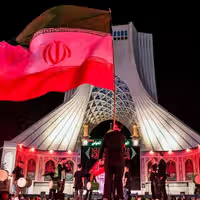
A hardline media figure said on X that President Masoud Pezeshkian and Parliament Speaker Mohammad Bagher Ghalibaf played a role in a chain of events that led to the killing of Ali Khamenei.
In a four-point statement, Amir Hossein Jafari said the two officials carried out what he called “economic surgery,” which he said contributed to a crisis in January that later escalated into war and the killing of Khamenei. He added that they later held talks with “the killer” and attended the funeral, where they mourned the late leader.
A hardline Iranian influencer said on Saturday on X that the display of large numbers of red flags at a mourning gathering for Ali Khamenei reflected a call for revenge over his killing.
"The multitude of red flags for Khamenei in the crowd of millions of devotees of Imam Khamenei shows that the demand for blood vengeance is at the top of all the requests of these noble, brave, and faithful people," the post said.
Iranian MP Ali Khezrian said on Saturday the public “cry for revenge” against what he described as US and Israeli “state terrorism” showed that the ceremony for the late Supreme Leader in Tehran was not only a religious and emotional gathering.
"The cry for vengeance from the people of Iran against what he described as the overt terrorism of the US government and the Zionist regime demonstrated that the farewell and funeral ceremony for the Commander of the Martyrs of the Revolution at Tehran’s Mosalla was not merely a ritual or emotional event, but a clarion call to awaken those mesmerized by the world's material powers," he posted on X.
Iran’s ambassador to China said on Saturday that Tehran plans to introduce new fees for ships transiting the Strait of Hormuz, while indicating that “friendly” countries would receive special treatment, CBS reported.
Speaking at the World Peace Forum in Beijing, Abdolreza Rahmani Fazli said Iran is working with Oman on “new arrangements” for the strategic waterway, including service fees for passage, supervision of shipping, and environmental oversight.
Fazli said Iran would “definitely charge service fees,” though he insisted the measure should not be described as a “toll,” and added that preferential treatment would be considered for countries that “stood by us during hard times.”
Hamidreza Moghadamfar, media and cultural adviser to the commander of Iran’s Islamic Revolutionary Guard Corps, said on Saturday on official media “retribution” has no connection to negotiations, describing it as a “duty” and a “historical obligation” for all Iranians.
“Qisas (retribution) has nothing to do with negotiations. Retribution is an obligation and a duty upon us; it is a historic demand. All of us have a duty—the military and the people alike, young and old. This retribution is a historic matter and a duty for everyone," Moghadamfar said.
"As for the United States and Israel, since the beginning of the Revolution—47 years now—even if the 12-day war and this recent war had not happened or were not the last one, we fundamentally cannot make peace with the United States. These negotiations and understandings are not related to peace or friendship with the US Our relationship with the United States and Israel, and our opposition to them, is existential in nature," he added.