Iran MPs call for missiles capable of reaching White House
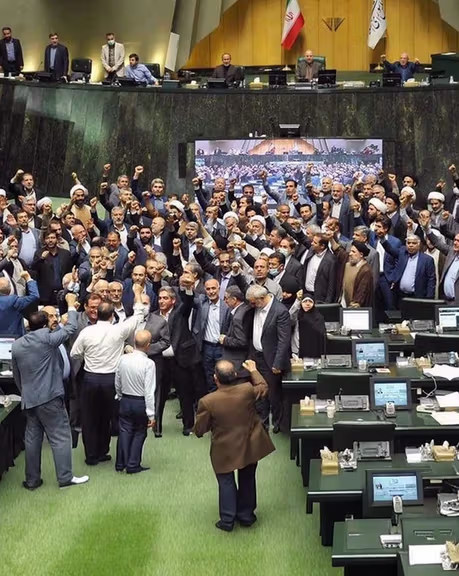

A group of Iranian lawmakers called for the range of Iran's missiles to be increased to reach the White House, in a letter to Mojtaba Khamenei calling for "revenge for the blood" of Iran's former supreme leader Ali Khamenei and commanders of Iran's Revolutionary Guards.
"We will support our military forces and defense industries until the day the range of our missiles reaches the office of Khamenei's killers," the lawmakers said in the statement.
The signatory lawmakers also called for the status of the Strait of Hormuz to become irreversible from its pre-war condition, the rejection of any negotiations over nuclear capabilities, full compensation for the material and moral damages of the war, the withdrawal of US forces from the region and punishment of the "aggressors in such a way that the possibility of repeated attacks is eliminated."




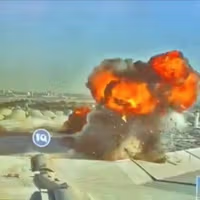

The Gulf Cooperation Council (GCC) condemned what it called Iran's "ongoing aggression" against member states Kuwait and Bahrain, saying attacks on civilian objects amounted to a "dangerous and unprecedented escalation."
Jasem Mohamed Albudaiwi, the GCC secretary-general, said the attacks "reflect the Iranian regime's insistence on pursuing rejected hostile policies targeting the security, stability and sovereignty" of GCC member states.
Kuwait's defense ministry said on Wednesday its armed forces had engaged 13 ballistic missiles and 17 drones from Iran, with debris falling over several residential areas.
"This Iranian criminal aggression resulted in the targeting of civilian and vital facilities, including Kuwait International Airport, leading to the death of an Indian expatriate and injuries to several individuals, in addition to significant material damage," ministry spokesman Colonel Saud Abdulaziz Al-Otaibi said.
The ministry extended condolences to the family of the deceased and wished the injured a speedy recovery.
US President Donald Trump said on Wednesday the United States did not need troops on the ground against Iran, saying bombing had destroyed much of its military.
“We don't need boots on the ground,” Trump said in an interview with Pod Force One released on Wednesday.
“We wiped out much of their military with just bombing,” he said. “We didn't put everybody on the ground. You don't want to do that.”
Trump said the situation was “rapidly evolving” and moving in a positive direction.
“They're not going to have a nuclear weapon and lots of other good things are going to happen,” he said.
Iranians in several cities described wages being consumed by rent, food and healthcare costs, according to messages received by Iran International on Wednesday.
A government employee in Dorud, in western Lorestan province, said a monthly salary of 20 million tomans, about $115 at the current rate, no longer covered basic needs.
“Half of this wage goes to rent, and the other half goes to medicine and doctors,” the message said. “Nothing is left for food and clothing.”
Another message said a salary below 50 million tomans, about $287, could no longer support a family of four, while one person said only three million tomans, about $17, remained from their monthly pay by the end of the month.
“With this situation, we have to fill ourselves with bread and water,” the message said.
Iranians in several cities described wages being consumed by rent, food and healthcare costs, according to messages received by Iran International on Wednesday.
A government employee in Dorud, in western Lorestan province, said a monthly salary of 20 million tomans, about $115 at the current rate, no longer covered basic needs.
“Half of this wage goes to rent, and the other half goes to medicine and doctors,” the message said. “Nothing is left for food and clothing.”
Another message said a salary below 50 million tomans, about $287, could no longer support a family of four, while one person said only three million tomans, about $17, remained from their monthly pay by the end of the month.
“With this situation, we have to fill ourselves with bread and water,” the message said.
Healthcare costs were also cited as a growing burden. A 51-year-old resident of Isfahan said an orthopedic visit cost one million tomans, about $6, and two prescribed scans would have cost four million tomans, about $23, each.
“I did not have the money, so I gave up,” the resident said.
Another message said medicine had become scarce and sharply more expensive, while insurance covered almost none of the costs of visits, treatment or tests. A monthly prescription that previously cost 200,000 tomans, about $1, had risen to 1.35 million tomans, about $8, the message said.
A separate message from Isfahan said most autism centers in the city had raised fees by 80%, leaving them far less crowded.
Others pointed to daily goods becoming unaffordable, citing a simple ice cream at 80,000 tomans, about 46 cents, and a 1.5-liter bottle of water at 35,000 tomans, about 20 cents.
“This is no longer inflation,” one message from Shahreza said. “It is swelling and bruising.”