Trump says US will end Iran war ‘very quickly’


US President Donald Trump told lawmakers at the White House on Tuesday that the United States would “end the war very quickly” with Iran and repeated that Tehran would never be allowed to obtain nuclear weapons.
His comments also came hours after the Senate advanced a measure seeking to limit his authority to continue military strikes on Iran without congressional approval.
The president has in recent days alternated between signaling openness to negotiations and warning that the United States may launch “another big hit” against Iran if talks fail.



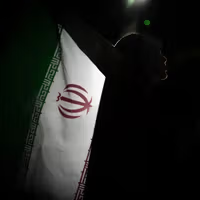



ran’s mission to the United Nations accused Washington of using the UN Security Council to spread “lies, false accusations and disinformation” against Tehran and its nuclear program.
In a sharply worded statement posted on X, the mission said “the only country in history to have used nuclear weapons” was violating international law through maritime blockades and support for Israeli military actions across the region.
“The culprit and the thief are now playing the role of prosecutor and judge,” the Iranian mission said, accusing Washington of trying to whitewash its own actions.
Rafael Grossi, the Director General of the International Atomic Energy Agency, told the UN Security Council that the situation at the Barakah nuclear power plant in the UAE remains “of grave concern” following Sunday’s drone strike.
While radiation levels remain normal and offsite power has been restored, Grossi warned that attacks on nuclear facilities devoted to peaceful purposes are “unacceptable” and carry undeniable risks for people and the environment.
Grossi said he had reiterated to the Security Council the need to uphold the “seven indispensable pillars” of nuclear safety and security.
The competing narratives surrounding the latest US-Iran standoff have become so stark that even basic questions—who is deterring whom, who wants talks and who fears escalation—now produce entirely different answers depending on which capital is speaking.
On Tuesday, Trump again underscored the volatility of the standoff, saying the United States “may have to give them another big hit” and claiming Tehran was “begging” for a deal.
Khabar Online journalist Mohammad Aref Moezzi described the current dynamic as a familiar “neither war nor peace” scenario: sustained pressure and confrontation without a clear decision to escalate into full conflict or pursue a comprehensive agreement.
Both sides, he argued, still believe they can force concessions without paying the cost of war.
Read the full article here.
Iranian Foreign Minister Abbas Araghchi pointed to a US congressional report detailing American aircraft losses during the war with Iran, saying it confirmed Tehran’s ability to inflict serious damage on US forces.
“Months after initiation of war on Iran, US Congress acknowledges loss of dozens of aircraft worth billions,” Araghchi wrote on X.
“Our powerful Armed Forces are confirmed as first to strike down a touted F-35,” he added, warning that any future conflict would feature “many more surprises.”
A recent congressional assessment, compiled from Pentagon, CENTCOM and media reports, listed 42 US military aircraft as lost, damaged or destroyed during the conflict, with estimated losses of around $2.6 billion.
The US Senate advanced a measure that would require congressional approval for continued military strikes on Iran, reflecting mounting concern in Washington over the trajectory of the conflict.
The move follows several failed attempts in both the Senate and House to limit President Donald Trump’s authority to continue military operations against Iran without explicit congressional authorization.
Senators approved a motion to discharge the resolution from committee in a 50 to 47 vote. Four Republicans broke ranks to vote with Democrats while Democratic Sen. John Fetterman opposed the measure.