Iran elected NPT Review conference vice president despite nuclear violations
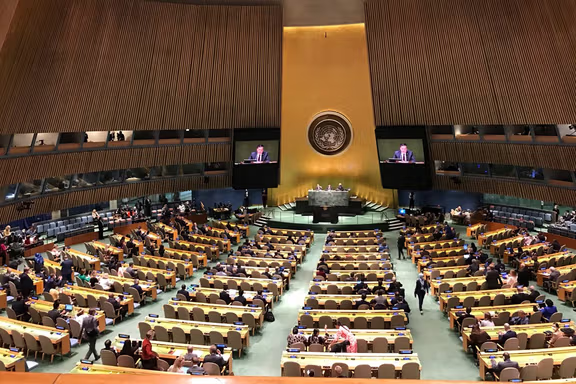
Iran has been elected as a vice president of the ongoing NPT Review Conference in New York, the country’s mission to the UN said, even though the country is in violation of the Nuclear Non-Proliferation Treaty, according to the UN nuclear watchdog.
Last year, the 35-member board of the International Atomic Energy Agency (IAEA), adopted a resolution declaring that Iran is in breach of its non-proliferation obligations for the first time since 2005.
The IAEA said at the time Iran had consistently failed to provide information about undeclared nuclear material and activities at multiple locations.
The Iran Mission to the UN in Vienna said on Monday the appointment reflects what it described as Iran’s role and advocacy for a world free of nuclear weapons.
More than 80 countries issued a joint statement led by Bahrain ahead of a meeting of the United Nations Security Council, condemning Iran’s actions in the region and disruptions to international shipping.
The statement voiced support for Resolution 2817 which condemned Iran's "egregious attacks" on its Arab neighbors. The statement also criticized what it described as actions by the Islamic Republic that threaten freedom of navigation, stressing that the principle must not be undermined under any circumstances.
Signatories rejected any attempts to restrict the passage of vessels or impose tolls, calling such measures a violation of international law, particularly the United Nations Convention on the Law of the Sea.
The statement also warned of the global consequences of Iran’s actions, saying they have disrupted maritime transport, driven up costs, and sent shockwaves through energy markets and supply chains.
It added that the impact has been especially severe for vulnerable countries, including those facing food insecurity.
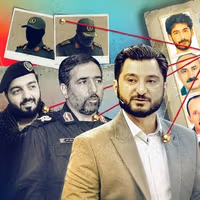
New intelligence obtained by Iran International reveals the identities of operatives in an IRGC-linked espionage and assassination network, including a foreign cleric trained in Qom who allegedly coordinated attacks targeting Israeli and Western interests.
A European intelligence source provided Iran International with new details about the IRGC-linked espionage, sabotage and assassination network operating across several countries.
According to the source, the activities were overseen by an officer in the covert unit identified as Alireza Mohammadi, who allegedly operated under the alias Meghdad Hassani.
The source said Mohammadi recruited and directed individuals tasked with intelligence gathering, surveillance and reconnaissance against targets in Israel as well as US military installations in other countries.
Alireza Mohammadi
According to information obtained by Iran International, one operative allegedly working under Mohammadi’s supervision is Elshad Hajiyev, a 37-year-old citizen of a neighboring country also known as Akram Haji-Zadeh.
Haji-Zadeh is said to have studied as a cleric at Al-Mustafa International University in Qom, an institution sanctioned by the US Treasury in 2020 for being "used as a recruitment platform by the IRGC-QF for intelligence collection and operations, including recruitment for the IRGC-QF-led foreign militias."
Elshad Hajiyev, a 37-year-old cleric also known as Akram Haji-Zadeh
The European intelligence source told Iran International that Haji-Zadeh played a leading role in a cell recently dismantled in a neighboring country. Mossad has separately announced that it dismantled what it described as an Iranian-linked network in one of Iran’s neighboring states.
According to the source, the network’s alleged targets included an oil pipeline, a synagogue, the Israeli embassy and prominent members of the Jewish community. In April 2024, Haji-Zadeh appeared twice as a guest on the television program Helal, broadcast on Iran’s Channel One and produced in cooperation with Al-Mustafa.
Israeli and Western intelligence officials have in recent years alleged that members or affiliates of Al-Mustafa have been involved in covert operations in countries including Senegal, Uganda and elsewhere in Africa.
A wider campaign against Unit 4000
The alleged disruption of the network comes amid what appears to be an escalating Israeli campaign against IRGC intelligence and sabotage units over the past six weeks.
These groups were reportedly overseen by Majid Khademi, head of IRGC Intelligence, who was killed on April 6 in what Israeli officials described as a targeted strike.
Last week, Mossad, Shin Bet and the Israeli military said they had killed Rahman Moghaddam, head of the Special Operations Department of the IRGC Intelligence Organization—known as Unit 4000—along with two other members of the unit in the early days of strikes on Iran.
Rahman Moghaddam
A source inside Iran told Iran International that Moghaddam—previously deputy coordinator of intelligence protection at Iran’s Ministry of Defense—was killed around midday on March 3 in a strike on a residential tower in Tehran’s Kowsar Complex on Artesh Boulevard.
Another senior figure, Mohsen Souri, who Israeli officials say was involved in training local cells outside Iran, was also reportedly killed.
Mossad and Shin Bet said they located his safe house and killed him along with other IRGC members in what they described as a precise intelligence operation. On March 30, Iranian state media outlets IRNA and Tasnim published footage of his funeral in Karaj without mentioning his alleged role.
Another alleged Unit 4000 operative, Mehdi Yekeh-Dehghan—known as “Doctor”—was also reportedly killed in a separate operation. Israeli officials say he was responsible for operations in Turkey and for transferring suicide drones to Cyprus.
According to intelligence cited by prosecutors in Turkey, Yekeh-Dehghan and another Iranian officer, Najaf Rostami, were linked to a network accused of planning surveillance and possible attacks on the US airbase at Incirlik.
On January 29, Turkish authorities arrested six people accused of spying for Iranian intelligence. One of them, Ashkan Jalali, was accused of attempting to smuggle armed drones to Cyprus through his companies.
In recent years, Israel has repeatedly claimed to have disrupted IRGC and Quds Force plots abroad through intelligence operations and targeted killings.
If confirmed, the latest allegations would suggest Israel’s recent campaign has extended beyond missile sites and military commanders into the covert infrastructure Iran has built overseas over years.
New intelligence obtained by Iran International reveals the identities of operatives in an IRGC-linked espionage and assassination network, including a foreign cleric trained in Qom who allegedly coordinated attacks targeting Israeli and Western interests.
A European intelligence source provided Iran International with new details about the IRGC-linked espionage, sabotage and assassination network operating across several countries.
According to the source, the activities were overseen by an officer in the covert unit identified as Alireza Mohammadi, who allegedly operated under the alias Meghdad Hassani.
The source said Mohammadi recruited and directed individuals tasked with intelligence gathering, surveillance and reconnaissance against targets in Israel as well as US military installations in other countries.
Iran’s Foreign Minister Abbas Araghchi accused the United States of slowing diplomacy through “unreasonable demands,” shifting positions and threats, saying Tehran will decide on the path forward during talks with Vladimir Putin in Saint Petersburg on Monday.
"The continuation of the United States’ harmful practices—particularly its insistence on unreasonable demands, frequent shifts in positions, threatening rhetoric, and repeated breaches of commitments—has slowed progress in diplomacy," he was quoted as saying in a readout released by Iran's foreign ministry.
"The Islamic Republic of Iran, taking into account past experiences—especially two instances of military aggression against Iran during diplomatic negotiations, attacks on its peaceful nuclear facilities, the United States’ reliance on sanctions and economic pressure, and the continued harassment of Iranian commercial vessels at sea—will make an appropriate decision regarding the current diplomatic process," he said in the meeting.
A group of lawmakers aligned with hardline politician Saeed Jalili declined to sign a parliamentary statement backing Iran’s negotiating team led by Speaker Mohammad Bagher Ghalibaf, despite broad support from 261 other MPs.
The statement expressed confidence in the negotiating delegation. However, several prominent hardline figures—including Mahmoud Nabavian, Mohammad Taghi Naqadali, Morteza Aghatehrani, Amirhossein Sabeti, Hamid Rasaei, Ruhollah Izadkhah and Meysam Zohourian—did not sign the statement.
Nabavian was one of the members of the Iranian delegation led by Ghalibaf who attended the first round of Islamabad talks with the United States.
The statement warned that “the enemy” is seeking to create divisions between the state, society and diplomatic institutions during what it described as a new phase of conflict.
It also urged political and social actors to avoid speculation based on “rumors and incomplete information,” cautioning against contributing to what it called the enemy’s “cognitive warfare.”
Lawmakers who signed the statement expressed full support for the negotiating team, particularly Ghalibaf, saying they trust the delegation as it enters what they described as a “new battlefield” against adversaries.