Iran's top lawmaker threatens to send Kurdish rebels to 'dustbin of history'
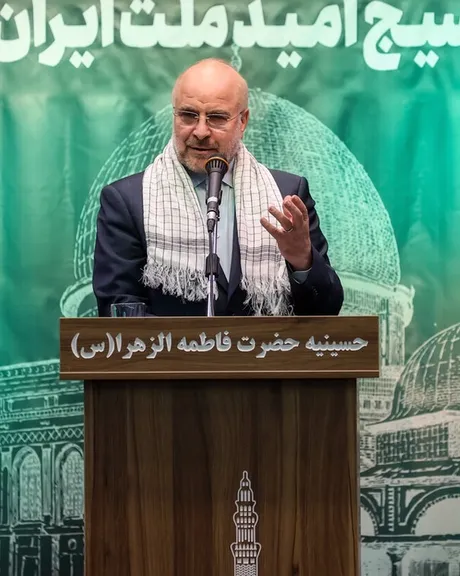
“America wants to gamble with all its assets to defend the criminal Israeli regime! Anyone with common sense would not enter this killing ground," Iran's parliament speaker Mohammad-Bagher Ghalibaf said in a post on X.
"Worthless separatists—if they raise their heads and make the slightest misstep—will once again be sent to the dustbin of history," he said in an apparent reference to Iran's Kurds who are reportedly preparing for a ground operation against the Islamic Republic.




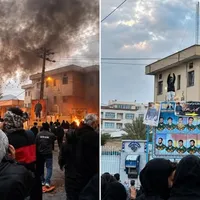




Human rights groups and families of detainees warn that wartime conditions inside Iranian prisons could trigger another tragedy like the June strike on Tehran’s Evin prison.
Activists say the situation inside prisons has become increasingly chaotic. While some non-political detainees have reportedly been released on bail and many staff have reportedly left their posts for safer locations, authorities have refused to grant furlough to political prisoners or people detained during recent protests or accept bail.
The volunteer lawyers’ website Dadban also warned that periods of intense political or military tension in Iran often lead to harsher treatment of political prisoners.
“In the Islamic Republic, during times of severe political or military tension, the risk of intensified repression and even retaliation against political prisoners increases,” the group said. In such circumstances, detainees may face greater restrictions, violence or additional pressure.
Warnings of a humanitarian crisis
Several human rights organizations — including the Committee for the Freedom of Political Prisoners and a foundation linked to imprisoned Nobel Peace Prize laureate Narges Mohammadi— have warned of an impending humanitarian crisis in Iranian prisons.
In their statements, the groups said administrative order inside Evin has effectively collapsed, guards have abandoned their posts and cell doors have been locked, leaving prisoners confined inside.
According to these reports, food distribution and medical care have largely been suspended, while the prison shop — a key source of food and drinking water for inmates — has also closed.
In some cases, activists say, political prisoners have been transferred to unknown locations without informing their families. Family members of detainees say they have been given little information about the prisoners’ fate.
Reports from rights groups and relatives who have managed to contact inmates suggest that Iran’s special police unit (NOPO) has taken control of Evin prison.
The wife of political prisoner Mostafa Mohammad-Hassan wrote on social media that authorities plan to transfer political prisoners and foreign nationals held in Evin to a prison in the city of Qom.
Fears of another Evin tragedy
Reza Khandan, a political prisoner in Evin and the husband of prominent human rights lawyer Nasrin Sotoudeh, has also raised the alarm in a letter to Iran’s judiciary chief, Gholamhossein Mohseni-Ejei.
Khandan warned that authorities had ignored repeated warnings from prisoners, as they did during the 12-day war in June when an Israeli missile attack on Evin prison destroyed parts of the complex and killed dozens of prisoners, visiting relatives and prison staff.
“This time no excuse will be acceptable,” Khandan wrote. “The direct responsibility for the lives of prisoners lies with the judiciary and the prison organization — prisoners who are still mourning their cellmates and families who mourn their loved ones.”
After the June attack, political prisoners were reportedly placed in shackles and temporarily transferred to other facilities, including Tehran Greater Prison (Fashafouyeh), Qezel Hesar prison and Qarchak women’s prison.
Conditions worsening in other prisons
Activists say the situation is deteriorating in other prisons as well.
Dadban reported worsening conditions at Qarchak women’s prison, south of Tehran — widely considered one of Iran’s harshest detention facilities.
According to the report, medical staff, administrative workers and guards have left their posts, leaving prison operations in disarray. Water shortages, already common at the facility, have worsened, and the prison shop is no longer operating.
At The Tehran Greater Prison blast waves from nearby explosions on March 2 reportedly shattered windows and damaged several walls. While no casualty figures have been confirmed, reports say prison guards beat inmates and fired tear gas inside the facility.
“My brother is in Tehran Greater Prison. For four days they have had neither water nor food,” a viewer wrote in a message to Iran International. “Officials have even welded the prison doors shut and the facility is now under the control of the Revolutionary Guards,” he added.
Similar incidents have been reported elsewhere. Kurdish news outlet Kurdpa said anti-riot guards attacked prisoners in Mahabad prison after inmates protested being held in dangerous wartime conditions following a strike on a nearby Revolutionary Guards (IRGC) base.
According to the report, guards fired tear gas, injuring at least two prisoners. Food rations were reduced to one meal a day, and phone calls were restricted, according to the report.
Israeli Prime Minister Benjamin Netanyahu set the goal of assassinating Iran’s supreme leader Ali Khamenei in November, and protests inside Iran later accelerated Israeli and US planning for the strike, Defense Minister Israel Katz said in an interview.
“Already in November, we held discussions with the prime minister in a very small forum. The prime minister set the objective: to eliminate Khamenei,” Katz said in remarks aired by Israel’s Channel 12 television.
Katz said the operation had initially been planned for around mid-2026 and that Israel first prepared to carry it out alone before discussions began with US President Donald Trump.
He added that protests that erupted across Iran late last year accelerated considerations in the US and Israel about striking Iran, amid concerns the pressure on the Iranian government could prompt a preemptive missile attack on Israel or US forces in the region.
The United States has suspended operations at its embassy in Kuwait, the State Department said in a statement on Thursday.
“While there have been no reported injuries to US personnel, the safety of Americans abroad remains the highest priority of the US Department of State,” the statement said.
“US citizens in Kuwait should depart the country, if they can do so safely, using commercial or other available transportation options,” the statement added.
Iran’s Foreign Minister Abbas Araghchi said Tehran is prepared to confront a potential US ground invasion and is not afraid of American troops entering the country.
Asked in an interview with NBC News whether he feared a US ground invasion, Araghchi replied: “No, we are waiting for them.”
“We are ready for this war,” he added.
An Israeli military spokesperson said on Thursday Iran could build up an arsenal of up to 8000 ballistic missiles by 2027 if it continued rebuilding its missile program following the June 2025 war.
Speaking in an online press conference for Persian-language media outlets abroad, the spokesperson said Israel observed that Tehran had resumed rebuilding its missile production systems after the June 2025 conflict and continued pursuing its nuclear program.
According to the spokesperson, Iran had around 3000 missiles before the June 2025 war, many of which were used or destroyed during that conflict.
“By Saturday, when Operation Lion's Roar began, it had managed to rebuild 2500 missiles through renewed and mass production.”
“If this trend had continued, the regime could have reached 8000 ballistic missiles by 2027.”
Israel and the United States launched coordinated strikes across Iran on February 28 under what Israel calls Operation Lion’s Roar, targeting military and strategic sites.
The airstrikes killed nearly 40 high-ranking Iranian officials including Supreme Leader Ali Khamenei in the first 24 hours, and continue to destroy Iran's military capabilities, according to the Israeli military.
Two-thirds of Iran launchers destroyed
The spokesperson said Israeli forces had struck hundreds of targets inside Iran since the start of the current war.
“So far we have attacked 700 regime targets,” he said. “300 launchers out of Iran’s total 450 missile launch platforms have been disabled or destroyed.”
He said the Israeli Air Force had flown more than 7000 operational hours during the campaign and that Israeli forces had also carried out strikes in Lebanon.
“At the same time as the operation in Iran, we destroyed more than 320 Hezbollah terrorist infrastructures in Lebanon.”
According to the spokesperson, Israel has mobilized 110000 reservists and will continue its operations until threats against the country are eliminated.
Why Iran war was necessary
The spokesperson said Israel launched its current military campaign to counter what he described as long-term threats posed by the Islamic Republic, which had sought Israel’s destruction for decades.
“The overall and fundamental objective of Israel’s operation is to strike the terrorist targets of the Islamic Republic regime and especially to remove serious and operational threats that have been carried out against Israel over the long term,” the spokesperson said.
“The Islamic Republic has for 47 years dreamed of the destruction of Israel and has repeatedly stated in its own media at various times that the destruction of Israel is at the top of its political, security and ideological objectives. For this reason it was necessary to begin this operation.”
“In just the past year they transferred about $900 million or even up to $1 billion to their proxy groups in the region such as Hezbollah and the Houthis.”
Civilian casualties
Asked about reports of an airstrike on an elementary and preschool complex in Minab, southern Iran where over 160 people were killed, the spokesman denied any Israeli involvement, saying "the Israeli army had no operation in the Minab area and it was not within its operational zone."
“I'm not accusing anyone, but in many cases such as the Ukrainian airplane shootdown in 2020 we have seen that the regime itself made a mistake but accused others.”
The spokesperson added: “I express my sympathy and condolences to the people of that region. It is painful when one sees those scenes. No war can be pleasant or without casualties.”
The spokesman said Israel uses precision-guided munitions and issues evacuation warnings before strikes. “Israel only targets strategic objectives and uses the most precise precision-guided munitions so that only the intended area is struck."
“We are the only army in the world that issues evacuation warnings before attacks to prevent civilian casualties. In contrast, Iran cuts the internet so people cannot access those warnings.”
He also referred to the Israeli casualties in Iran's missile strikes, saying, “In Iranian missile attacks on residential and civilian areas so far, 12 Israeli civilians have been killed and more than 370 have been wounded."