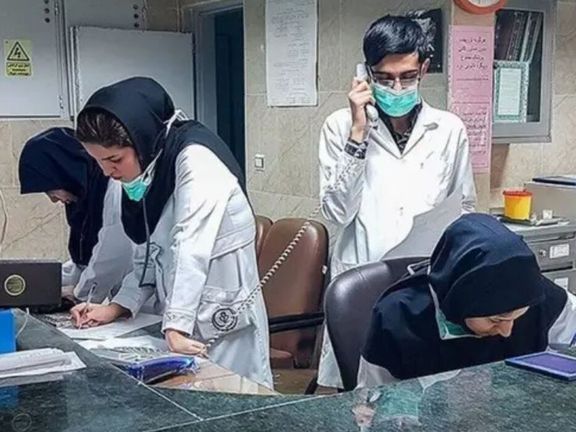
Medical staff in a Tehran hospital, undated file photo
Physicians working with Iranian protesters are warning that hospitals and medical care in Iran may be increasingly used as tools of repression, as doctors are arrested or threatened for treating the wounded and injured demonstrators are denied care.
The effort to compile a database of detained healthcare workers is led by the AIDA Health Alliance (AHA), named after Aida Rostami, a 36-year-old Tehran physician who treated protesters in secret during the 2022 protests, went missing after a hospital shift, and was later found dead bearing signs of torture.
Doctors involved with AHA say they have so far identified at least 40 detained healthcare workers across multiple provinces, including doctors, nurses, medical students, technicians and volunteer first responders. They say the figure is likely incomplete.
“Hospitals are no longer safe places,” said Homa Fathi, one of the doctors involved in documenting the cases. “If a doctor treats a protester, questions security forces or refuses to discharge a patient prematurely, that doctor becomes a target.”
Doctors working on the documentation say the crackdown has pushed medical care underground, forcing physicians to choose between their professional oath and their personal safety.
Some have established makeshift home clinics to treat gunshot and pellet wounds. Others report being followed, threatened or warned to stop providing care altogether.
The Norway-based rights group Hengaw reported this week that an Iranian surgeon, Alireza Golchini, had been charged with moharebeh, or waging war against God—a charge that carries the death penalty.
Golchini was later released on bail following international pressure, including a statement by the U.S. State Departmentcalling for his release alongside what it described as “all the brave doctors who have helped their fellow countrymen.”
Doctors following his case say it has not been closed and is not an outlier, but part of a broader effort to dismantle medical networks that support protesters.
Fathi described a hospital in southwest Iran where an elderly woman suffering from hundreds of pellet wounds to her face, back and legs was forced out of care to free beds for members of the Islamic Revolutionary Guard Corps.
In other cases, she said, security forces fired tear gas inside emergency departments to clear wards, while doctors who confronted plainclothes agents photographing injured patients were later arrested.
She also cited an incident in which a medical intern was shot inside a hospital after protesting the presence of security forces. In one of the most disturbing accounts, she described unconscious patients being placed among the dead.
Another physician, Panteha Rezaeian, described cases in which doctors were followed to prevent home treatment, homes were raided, and physicians were warned to stop speaking publicly or face detention.
“We are seeing people attempt to remove bullets themselves or treat serious injuries at home,” Rezaeian said. “Some of them die days later, not because their injuries were unsurvivable, but because they were too afraid to seek help.”
Rezaeian warned that the denial of medical care had become “a secondary killing mechanism,” as injured demonstrators avoid hospitals out of fear of arrest or execution, risking death from untreated wounds, infections and internal injuries.
Doctors involved in the documentation effort say the pattern has intensified since January, with arrests accelerating after the latest wave of nationwide protests.
They warn that the systematic targeting of healthcare workers is intended not only to punish doctors, but to deter the injured from seeking care at all.
“This is not just about arresting doctors,” Rezaeian said. “It is about making people afraid to survive.”
You can watch the full interview of Eye for Iran on YouTube or listen on any podcast platform of your choosing.
Australian Senator Raff Ciccone, Chair of the Parliamentary Joint Committee on Intelligence and Security and a co-sponsor of a bipartisan Senate motion condemning Iran’s crackdown on protests, said Australia was standing firmly with the people of Iran.
The Australian Senate on Thursday approved the motion, which cited killings, mass arrests and internet blackouts imposed on civilians during protests that began in late December. It also acknowledged the distress of Iranian-Australians unable to contact relatives in Iran.
In an interview with Iran International, Ciccone said the vote sent a clear message of unity across Australia’s political spectrum.
“Earlier today in the Australian Senate, myself and a number of other senators across the political spectrum came together in a sign of unity and national bipartisanship to send a very strong message that Australia and the Australian Senate stands very closely with the people of Iran,” he said.
The motion called on the Albanese government to work with international partners, including the United Nations, to support independent investigations into human rights violations, press for accountability, expand targeted sanctions and push for an end to violence and communications restrictions.
Ciccone’s comments followed new Australian sanctions imposed earlier this week on 20 individuals and three entities linked to Iran’s security apparatus.
“Since 28 December last year, the Iranian regime has responded to peaceful protests with extraordinary and horrifying violence against its own people,” Ciccone said, adding that authorities had tried to conceal the crackdown through internet and telecommunications blackouts.
He said his office had received hundreds of calls and emails from members of the Iranian-Australian community worried about family and friends.
“Members of the Australian Iranian community have watched these events unfold with profound anguish,” he said.
Ciccone urged Iranian authorities to halt attacks on civilians and said Australia would not stay silent.
“The attacks that are occurring on citizens has to stop, has to stop immediately,” he said. “Australia is very much by your side.”
A group of scholars in Iranian studies issued a public statement expressing solidarity with people in Iran, describing the protests as a defining historical moment and warning that silence or misplaced neutrality carries consequences.
“The current uprising marks a defining historical moment - one in which silence, equivocation, or misplaced neutrality carries consequences,” the scholars said in a collective statement released on Thursday.
The statement said academics who work on Iran benefit professionally from their research and therefore bear a responsibility to acknowledge the realities facing Iranians. It pointed to widespread state violence, including killings, imprisonment, torture, enforced disappearances and executions, alongside broader repression through surveillance, internet shutdowns, economic pressure and restricted access to medical care.
Universities have become central sites of repression, the statement said, with students, faculty members and researchers arrested, dismissed, forced into exile or killed for political expression. Campuses have been militarized and academic life hollowed out through intimidation and purges, it added.
The scholars rejected narratives portraying the protests as driven by foreign actors, calling such claims a core element of state propaganda that erases Iranian political agency.
“We further reject the repeated circulation - explicit or implicit - of narratives about foreign orchestration, outside agitators, or foreign boots on the ground for which the government has not provided any provable evidence,” the statement said.
The scholars also criticized what they described as an excessive focus on data disputes while documentation of events inside Iran is actively suppressed.
At the same time, they said they do not advocate war or external control over Iran’s future, emphasizing opposition to authoritarian violence without endorsing foreign intervention.
Calling for ethical clarity within their field, the signatories urged colleagues to stand publicly with protesters, avoid reproducing official narratives, center the voices of Iranians demanding change and prioritize documentation of lived experience. They also called for the immediate release of political prisoners and an end to executions.
Canada condemned the killing of protesters and use of violence by Iranian authorities after a video shared by Iran International showed an armored vehicle operated by Iranian security force running over demonstrators in Ardabil, northwest of Iran.
The video shows the incident taking place at Yahyavi Square during protests on January 8 and 9. At least one woman is believed to have been killed and three others injured.
“Canada strongly condemns the killing of protestors, the use of violence, arbitrary arrests, and intimidation tactics by the Iranian regime against its own people,” Canada’s foreign ministry said in a written response to Iran International.
The ministry added that Canada “will continue to hold Iran accountable for its violations of human rights,” citing measures taken over the past two years to maintain pressure on Tehran and its allies.
It noted that Canada listed the Islamic Revolutionary Guard Corps as a terrorist organization in June 2024.
Canada has further designated Iran as a foreign state supporter of terrorism, a designation the government reconfirmed in December 2025, it said.
Last month, Iran International reported that more than 36,500 Iranians were killed by security forces during the January 8-9 crackdown on nationwide protests, making it the deadliest two-day protest massacre in history.
On January 15, Canada said that one of its citizens has died in Iran at the hands of Iranian authorities, according to a statement by the country’s foreign minister.
“Our consular officials are in contact with the victim’s family in Canada and my deepest condolences are with them at this time,” Canadian foreign minister Anita Anand said in a post on X.
“Peaceful protests by the Iranian people - asking that their voices be heard in the face of the Iranian regime’s repression and ongoing human rights violations - has led the regime to flagrantly disregard human life,” she added.
A coalition of human rights organizations and civil society groups has called on member states of the Organization for the Prohibition of Chemical Weapons (OPCW) to take collective action over Iran’s alleged use of prohibited chemical substances against civilians.
In a statement dated February 4, the groups said eyewitness testimony, medical evaluations and independent reporting indicate that Iranian security forces deployed non-standard chemical agents during protest crackdowns.
“Victims report symptoms far exceeding ordinary tear gas exposure, including respiratory distress, neurological impairment, cardiovascular instability, persistent headaches, dizziness, and long-term systemic dysfunction,” the statement said.
The coalition said Iranian medical professionals who treated the affected individuals observed consistent clinical patterns that they described as indicative of exposure to unlawful chemical substances.
The statement did not identify the specific agents involved.
The appeal comes after an unprecedentedly violent crackdown on protests across Iran on January 8 and 9, in which thousands were killed and many more wounded.
The signatories—including Nobel Peace Prize laureate Shirin Ebadi—urged OPCW member states to invoke mechanisms under Article IX of the Chemical Weapons Convention, beginning with a formal request for clarification from Tehran.
They called for authorizing a challenge inspection and the deployment of an independent expert mission to conduct on-site inspections if Iran’s response were deemed inadequate.
The groups also urged the publication of a public factual report detailing findings and levels of cooperation, and coordinated diplomatic, legal and financial consequences including referral to United Nations bodies should Tehran deny or obstruct the process.
“Continued delay enables further harm, the destruction of evidence, and impunity,” the signatories warned, adding that any use of chemical agents against civilians would constitute “a grave violation of international law.”
Iranian authorities have previously denied using prohibited chemical substances against civilians.
The OPCW has not publicly commented on the latest claims.
Human rights advocates in Canada are urging the country’s national police to gather evidence on Canadians linked to Iran’s repression apparatus after thousands of protesters were killed in January.
The call is directed at the Royal Canadian Mounted Police (RCMP) and centers on what is known as a “structural investigation,” an evidence-gathering process that could help lay the groundwork for future prosecutions of individuals linked to crimes against humanity.
“We know that there are a number of IRGC officials in Canada, and also a very large Iranian diaspora with substantial evidence they can provide to the RCMP,” said Brandon Silver, an international human rights lawyer and founding director of policy and projects at the Raoul Wallenberg Centre for Human Rights.
“The RCMP can initiate what’s called a structural investigation into crimes against humanity,”
The push comes amid mounting demands for accountability after Iran International’s Editorial Board confirmed that more than 36,500 Iranians were killed by security forces during the January 8–9 crackdown, the deadliest two-day protest massacre in history.
Advocates say Canada must ensure perpetrators cannot find refuge abroad — and that Iranian Canadians have a direct avenue to report evidence.
Nazanin Afshin-Jam, a member of the Iranian Justice Collective, said structural investigations would give Iranian Canadians a concrete pathway to come forward and begin the accountability process.
Calls from Parliament Hill
The renewed push followed a day of meetings and testimony in Ottawa, where Afshin-Jam appeared before the House of Commons Subcommittee on International Human Rights.
“Yesterday I was invited to testify before the subcommittee on international human rights to give an update on the human rights situation in Iran and to also provide some recommendations,” she said.
Afshin-Jam said the aim was to press Canada to move beyond statements of condemnation toward tangible action.
Pressure on the IRGC
Silver also urged Ottawa to expand sanctions against senior officials directing the repression.
“Sanction the architects of this repression, starting with the Ayatollah,” he said.
He argued that Canada should coordinate closely with allies as international pressure mounts on the Islamic Revolutionary Guard Corps.
Afshin-Jam said Canada has already taken significant steps in the past — including listing the IRGC and closing its embassy in Tehran — and should again lead among Western democracies.
Advocates said they were encouraged by signs of cross-party engagement in Parliament but stressed that the next step must be follow-through: evidence collection, sanctions enforcement, and coordinated international action.