Defiance met with massacre: Iran’s biggest protest wave in generations
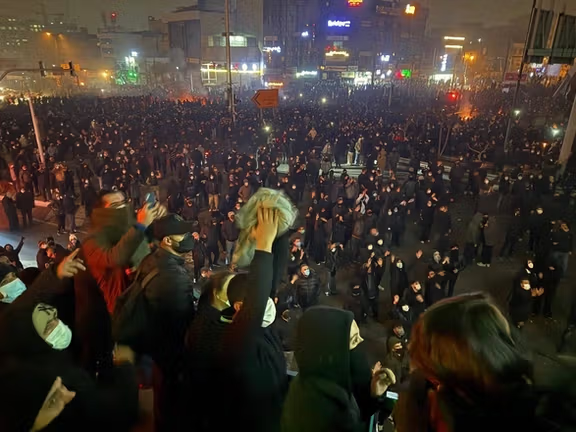
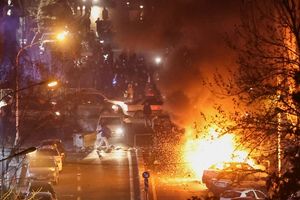
Photo from Iran's 2026 protests
As Iran remains in a near-total communications blackout, three people in different cities described what they said were the biggest protests since 1979—followed by a crackdown so severe it left many seething with anger and hollowed out by anguish.
The accounts, shared in short voice messages over encrypted apps between 13 and 15 January, come from two people in Tehran—a journalist and a business owner—and an engineer in Isfahan.
All three are political activists who have been present in multiple rounds of protests over the years, giving them a clear basis for comparison and a sharp memory of how earlier protests unfolded.
Each stressed that their impressions were drawn not only from what they personally witnessed, but from conversations with friends, relatives, employees, and colleagues across multiple cities and towns.
All three said the demonstrations on the evening of 8 January dwarfed any other round of protests they had seen or known of. One described the crowds as numbering in the millions nationwide.
A European diplomat, citing intelligence shared with Iran International, said their information indicates that at least 1.5 million people took to the streets in Tehran on Thursday, 8 January.
He said the number was lower on Friday, 9 January, as security forces were heavily present in the streets and, in many cases, began shooting as people started to assemble, killing people en masse.
However, the European diplomat who spoke to the channel believes as many as half a million people were present in Tehran on Friday despite the mass killing.
The number of people in other cities is unclear due to the lack of foreign diplomatic presence outside Tehran—all embassies are in the capital. However, their intelligence estimate is that at least 5 million people participated in nationwide protests on Thursday and Friday.
What set that Thursday night apart, the three eyewitnesses said, was timing.
Protests had already been unfolding for more than a week when exiled prince Reza Pahlavi called for coordinated demonstrations at 8pm on 8 and 9 January. The appeal, they said, did not initiate the unrest but gave it focus—“an amplifying and organizing effect”, as one put it.
Few expected such numbers to turn out, possibly including the authorities themselves. Security forces were present, but initially appeared unprepared for the scale.
•
•
That changed rapidly.
By the following evening, after a speech by supreme leader Ali Khamenei on Friday morning framing the protests as the work of foreign-backed agents, the tone shifted decisively. Security forces were deployed in force well before nightfall. Streets that had filled easily a night earlier were saturated with armed personnel.
“It was a massacre,” the engineer said of the violence that followed—an unprecedented massacre in Iran’s modern history. The business owner added: “Everybody you see knows someone who was killed, injured or is missing.”
Iran International reported this week that at least 12,000 people were killed in the crackdown, a figure leaked to us from Iran’s presidential office and the Supreme National Security Council amid the blackout—a sign that the death toll has grown so vast it has shaken the conscience of people inside the system, pushing them to let the number out.
“This is the same system that helped kill hundreds of thousands of people in Syria to keep Bashar al-Assad in power,” the business owner said. “How many do you think it’s willing to kill for its own survival?”
They described the crackdown continuing well beyond the demonstrations themselves. In several neighborhoods, they said, an informal curfew has taken hold: being outside after dark is enough to risk being stopped, searched or detained.
Thousands are believed to have been arrested. In the days before the protests, many ordinary Iranians posted on Instagram urging others to join demonstrations on Thursday and Friday. Many businesses—including ordinary shopkeepers—also posted videos saying they would close on Thursday and Friday to join the protests.
Many doctors posted basic guidance on how to help the injured, or invited people to contact them if they needed medical help. Now that the internet is down, those posts are still there, and security forces are using them to identify and arrest the people who shared them.
“It’s ongoing,” the journalist said. “They’re knocking on doors now, especially of people who posted Instagram stories just before the 8th, when everyone was pumped up and reckless.”
Even those who stayed home have not been spared.
The engineer said several students he knew who had avoided the protests, but had expressed general sympathy online, had since been summoned and charged.
Witnesses also described widespread slogans and chants in support of Reza Pahlavi, echoing through streets and squares before security forces moved in.
Contrary to Tehran’s narrative, all three insisted, those who took to the streets were not “terrorists” but fed-up ordinary Iranians struggling to make ends meet, looking for a way out of what they feel is irreversible deterioration.
“The economy has been going downhill for almost a decade,” the business owner said. “Before that, there were ups and downs. Now it’s all down—and people believe it will only get worse.” In his factory, the engineer said, most workers joined the protests on both nights. One was seriously injured; another is still missing. Many, he noted, had voted for reformist president Masoud Pezeshkian just a year earlier.
“It shows they’re willing to try anything they think might improve their lives even a tiny bit.”
Messages from outside Iran also helped drive turnout. US President Donald Trump urged Iranians to keep taking to the streets, saying “help is on the way”.
The three said the posts—and other public signals of support—spread quickly through private chats and family networks inside Iran, encouraging people to go out despite the risk. What followed, the three said, was as striking and as sudden as the demonstrations themselves: silence.
“It’s been a cull, not just of bodies, but of souls,” the business owner said. “I can’t see the will to fight right now.” The engineer described an atmosphere of pervasive grief. “The city smells of death,” he said. “As if human ashes have been spread all over Iran.”
None of the three supports foreign military intervention. Yet all said a majority of people they speak to now openly wish for a US attack, seeing no internal path forward. “It’s certainly the prevailing sentiment,” the journalist said.
The engineer described near-universal support for that view among his workers. “It’s sad in every sense of the word,” he said. “Utter and absolute despair.”
For now, under tightened security and a suffocating blackout, the question is what comes next. One of the three warned that the most damaging consequence may be the loss of agency itself—the sense that change, if it comes at all, must arrive from outside.
“I’d say Trump attempting regime change is as likely as Trump making a deal,” the business owner said. “No one knows where this ship is going. For now, most people are too seasick to even look ahead.”
A review of public statements by Iran’s senior officials since late December suggests a marked hardening of tone as protests escalated, a shift that coincided with a sharp intensification of the state’s security response.
The protests began on December 28 amid soaring inflation. It initially drew a more measured response from the government.
But following a surge in demonstrations on January 8, and especially after a Supreme Leader speech the following day, officials reverted to a familiar framing: unrest portrayed as a foreign-backed security threat demanding a forceful response.
In an interview with Al Jazeera broadcast between January 9 and 12, Foreign Minister Abbas Araghchi said protests had been peaceful from December 28 through January 7, but claimed that “armed terrorist elements linked to Israel and the United States” had subsequently turned them violent.
The judiciary soon echoed that framing.
Speaking to bazaar merchants on January 10, Chief Justice Gholamhossein Mohseni Ejei said protesters had initially “demanded the country’s progress,” avoiding direct reference to the violent response.
Three days later, he called for the immediate trial of detainees, and in a January 14 post on X announced plans to televise the trials of what he called the “main culprits” in order to expose their alleged foreign ties.
Around the same time, footage of Ejei interrogating a detainee on state television circulated on social media.
‘No peace, only war’
The rhetorical shift became unmistakable on January 9, when Khamenei delivered a speech that many observers viewed as pivotal. He described protesters as “rioters under foreign influence” and urged security forces to confront them sternly.
President Masoud Pezeshkian, who until then had acknowledged protesters’ grievances and expressed openness to dialogue, followed suit.
“(They are) violent terrorists and rioters brought from abroad to attack mosques and civilians,” he said, urging the public “to stop the terrorists.”
Other senior figures reinforced the message. Security Chief Ali Larijani said on January 11 that forces were “controlling the protests with minimal damage,” despite emerging videos of a bloody crackdown.
“There will be no peace and no ceasefire, only war,” he warned protesters.
‘Conspiracy’
Some civilian officials sought to strike a more conciliatory tone, though without challenging the core narrative. Government spokesperson Fatemeh Mohajerani condemned violence in general terms and said the internet blackout—entering its eighth day on Thursday—was a “temporary measure.”
Parliament Speaker Mohammad Bagher Ghalibaf said on January 13 that “protesting is the people’s legitimate right” and promised to address economic grievances, while also accusing protesters of “seeking violence.”
Military commanders, meanwhile, were more explicit. From January 8 through 14, senior officers repeatedly characterized the unrest as a “conspiracy” orchestrated by Israel and unnamed terrorist groups.
Army Commander Abdolrahim Mousavi praised the Basij domestic enforcement militia and police for “controlling the riots,” warned of possible direct military involvement, and described the protests as “a malicious conspiracy.”
Police Commander Ahmadreza Radan said “the level of confrontation has been raised,” warned that attacks on police stations “will not be tolerated,” and described police conduct as “mild” despite reports of mounting casualties.
Taken together, the statements reflect a rapid convergence among Iran’s political, judicial and security elites around a securitized narrative after January 8—one that recast the protests as an externally driven threat that can only be thwarted with bullets.
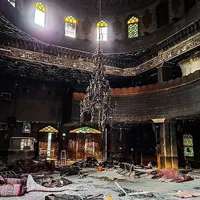
State media in Iran have widely circulated images of damaged mosques and burned Qurans inside, blaming protesters they brand “terrorists” and portraying its deadly crackdown on a protest uprising as a sacred defense of holy places.
Officials assert that dozens of mosques and shrines across the country were deliberately attacked during protests.
Reports by eyewitnesses point to multiple mosques set ablaze in Tehran and Gilan province and in other major cities including Karaj and Isfahan.
In the past week, due to the near-total ongoing internet shutdown, state media have effectively become the primary source of visual material related to alleged damaged during the protests for many Iranians.
Tehran Mayor Alireza Zakani said on Thursday that more than 61 mosques were torched during unrest in the capital. President Masoud Pezeshkian echoed the condemnation on January 12, stating that “Iranian society does not accept those who burn mosques.”
Pezeshkian went further, saying: “They have trained some people inside and outside, brought terrorists into the country from abroad, and they burn mosques.”
State media are widely circulating images of charred interiors and half-burned copies of the Quran in Abu Dhar Mosque in Tehran and CCTV footage from an unnamed mosque in Isfahan that appears to show individuals setting fire to the building and its contents.
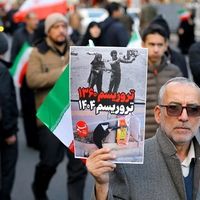
In pro-government rallies, some participants were seen holding half-burned Qurans, and the state TV showed several interviews with them reinforcing the narrative that demonstrators were “terrorists” attacking Islam itself.
Amplification beyond Iran
The images have not remained confined to Iranian media. They have been reshared widely on social platforms by supporters of the Islamic Republic, including some foreign influencers.
Accounts such as “Partisan Girl” (Sirin Girl) and Hamza Adi reposted the images, accusing supporters of Reza Pahlavi of burning the Quran.
Even amid internet restrictions, many pro-government users inside Iran continued to circulate the material online.
The repeated sharing has helped frame the unrest in some Muslim countries such as Pakistan as an attack on religious sanctities rather than a political protest.
Criticism and Fact-Checking
Some opponents of the government argue that the information released is selective and misleading. They say the extensive focus on mosque imagery by outlets such as state broadcaster IRIB aims to discredit protesters and provoke religious sentiment against them.
Iranian fact-checking website Factnameh wrote: “What is being presented is an incomplete and misleading picture of reality, designed to stir religious emotions and mobilize the government’s religious supporters, as well as to inflame Muslim public opinion against protesters in Iran.”
At the same time, some anonymous social media accounts have explicitly encouraged attacks on religious sites. An account posting under the name “Imam Tusi” wrote on X: “People burned Fatemeh Zahra Mosque in Isfahan, too. People should torch all shrines, mosques, and religious seminaries together with the mullahs in them.”
Most mosques and religious employees receive state backing in the Islamic theocracy.
Some opposition figures have implicitly acknowledged mosque burnings.
Darya Safai, an Iranian-born member of the Belgian parliament, wrote on X: “In western Tehran, a great mosque burned. For forty-seven years, its minarets echoed with ‘Allahu Akbar,’ and in that name, Iranian women and men were chained, silenced and broken.”
Yet other observers blamed authorities for the damage,
“They did this themselves to provoke the people—impaling the Quran on spears, setting fires, and destroying the mosque are just the tools of deception used by these hypocrites,” a user posting as Hatam wrote on X, without providing evidence.
Mosques as security hub
Iran has an estimated 75,000 mosques, around two-thirds of which are believed to be largely inactive. Tehran's critics argue that unlike in other Muslim-majority countries, mosques in Iran function not only as religious spaces but also serve as function halls for the state's repressive apparatus, including the Basij militia which quashed protests.
Iranian authorities openly acknowledge this role. On January 9, Revolutionary Guards commander Hossein Yekta called on government supporters via state television to gather in mosques and Basij bases to confront “the enemies of the revolution.”
In August 2024, Iranian media quoted Brigadier General Heydar Baba-Ahmadi, head of the Mosques and Neighborhoods Affairs of Basij militia force, as saying that “79 percent of Basij resistance bases are located in mosques, with another 5 percent in other religious sites.”
During the 2021–2022 protests, CNN reported on networks of secret detention sites, some allegedly located inside mosques. The report asserted that these spaces were used for temporary detention and torture of protesters, run by Basij units based in mosques.
After Iran’s deadliest protest crackdown in decades, authorities have extended their response beyond the streets into morgues, hospitals and family homes, turning the protesters’ bodies into a key tool for suppressing dissent and controlling the narrative.
Iran International has received a large volume of videos, audio testimonies and written accounts describing how the bodies of protesters killed in the latest unrest are being collected, stored and released under strict security conditions.
While a nationwide internet blackout, now about a week, has made independent verification difficult in some cases, Iran International has cross-checked and verified key elements through corroborating footage, eyewitness commentary and the consistency of reports from multiple cities.
According to senior government and security sources speaking to Iran International, the number of protesters killed during the current unrest is believed to be in the thousands, with estimates placing the figure at around 12,000.
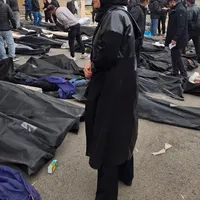
Videos verified by Iran International show the continued transfer of protesters’ bodies to the Kahrizak forensic medicine complex south of Tehran. One verified video, dated Wednesday, shows dozens of bodies laid out inside large warehouse-style halls at the facility. In the same footage, a trailer is seen as security forces unload additional bodies.
Similar videos and reports received from Tehran, Mashhad, Isfahan and Rasht show what appear to be large numbers of bodies stored in forensic facilities and hospitals.
Field reports describe heavily securitized conditions around morgues and hospitals, with access tightly controlled by security forces. Families seeking information about missing relatives have described chaotic scenes, long waits and limited communication.
Pressure on families
Multiple sources told Iran International that families attempting to retrieve the bodies of their relatives face intimidation and pressure from security forces, including plainclothes agents and members of the Islamic Revolutionary Guard Corps.
According to these accounts, security forces have raided the homes of victims’ families and their neighbors, searched mobile phones, verbally abused family members and, in some cases, fired shots at walls during nighttime raids. Hospital conditions have also been described as critical, with families reporting security presence inside medical facilities.
Sources said authorities have informed families that bodies can only be released during the early hours of the morning. Burial ceremonies, they said, are restricted to individual funerals and must be completed by 4 a.m.
Several families reported being warned that if they refuse to comply with these conditions, the bodies of their relatives would be buried collectively, without their consent.
Families mourn as they gather at a facility to collect the bodies of loved ones killed during protests. (January 2026)
Paying for the bullets
One of the most consistent elements across testimonies received by Iran International is the demand for money in exchange for the release of bodies.
According to multiple sources, families are being told they must pay for each bullet used to kill their relatives. The amounts demanded range from 700 million rials to 2.5 billion rials per bullet, depending on the case.
At the current exchange rate of approximately 1,450,000 rials to the US dollar, this translates to roughly $480 to $1,720. The average monthly income of a worker in Iran is less than $100, making such payments unaffordable for many families.
This practice is not new and has been used by Iranian authorities in previous crackdowns. However, they described its application during the current unrest as unusually widespread.
Forced Basij membership
In addition to financial demands, families have reported pressure to consent to their relatives being identified as members of the Basij militia, the paramilitary volunteer force of the Revolutionary Guards.
Rights monitors and sources said families are told that if they agree to a Basij membership card being issued posthumously for their relative, the body may be released without payment.
According to Dadban, a rights monitoring group, authorities in several cities have made free release of bodies conditional on families accepting that their killed relatives be registered as Basij members allegedly killed by protesters.
Rights groups say the practice amounts to forced identity alteration and an effort to inflate official claims of security force casualties, supporting authorities’ assertions that the unrest involved “terrorist elements.”
Hospitals overwhelmed
Audio testimonies sent to Tavaana, a civil society platform, describe hospitals overwhelmed by gunshot victims and bodies, with security forces intervening to prevent bodies from being released or funerals from taking place.
One audio account said security forces raided the homes of families who had managed to retrieve bodies. Another described a nurse who died by suicide after exposure to what was described as an overwhelming number of corpses.
Additional messages from Isfahan described widespread killings, mass arrests and refusal to release bodies. Some accounts said entire neighborhoods had lost at least one resident, with businesses shut down amid fear and anger.
Silencing grief
The restrictions placed on funerals and burials appear designed to prevent public mourning from becoming a focal point for further protest.
Families described being forced to bury their dead quickly, quietly and under surveillance. Some said they were instructed not to speak publicly or share images, while others reported continued monitoring after burial.
For many families, the process has turned private grief into a prolonged ordeal – one shaped by fear, financial coercion and the threat of erasure.
Iranian authorities have blamed foreign enemies, including the United States and Israel, for the unrest and have described the protests as a security threat. They have denied allegations of mass killings.
Three members of the same family were killed after their car came under fire from Iranian security forces in the city of Karaj, west of Tehran, during protests on Jan. 9, Iran International has learned.
The victims were identified as Bijan Mostafavi, a retired education worker, his wife Zahra Bani Amerian, a retired social security employee, and their 19-year-old son, Danial Mostafavi, a university student, a source close to the family said.
According to information received by Iran International, the family was inside their private vehicle when it was hit by heavy gunfire amid unrest in the area.
The couple’s older son, Davoud Mostafavi, was also in the car at the time, but there was no confirmed information about his condition at the time of publication.
Iran International has previously reported that at least 12,000 protesters were killed in Iran, mostly over two nights on Jan. 8 and 9.
Uncertainty over Iran’s direction deepened on Wednesday as unrest at home coincided with mixed signals across the region, with military movements and diplomatic steps raising the risk of a broader conflict.
US officials said Washington began withdrawing some personnel from military facilities in the region, describing the move as a precaution as tensions rose.
The drawdowns came as the United States weighed its response to unrest inside Iran and after repeated warnings from Tehran that any US strike would be met with retaliation against American bases in neighboring countries.
US President Donald Trump struck an ambivalent tone, telling reporters he was monitoring the situation closely and suggesting reports of killings inside Iran were easing. He said he had received what he described as “a very good statement” from Iran, while stopping short of ruling out military action.
Privately, officials and diplomats from several countries said they remained concerned that US intervention was still possible, with some suggesting there was a limited window in which action could occur.
Regional governments, including Qatar, confirmed adjustments tied to heightened tensions, while Britain also reported precautionary measures involving its personnel.
Britain said it had closed its embassy in Tehran, citing security concerns, adding to signs of diplomatic retrenchment as foreign governments reassessed their presence in Iran amid the unrest.
Inside Iran, the leadership has sought to project control in what officials describe as the most serious unrest in decades. Iranian authorities have blamed foreign enemies, particularly Israel and the United States, for fueling violence, while insisting calm has returned after what they describe as a brief but intense period.
In a combative television interview with Fox News, Iranian Foreign Minister Abbas Araghchi rejected allegations that Iranian security forces carried out mass killings of protesters. He said the violence stemmed from clashes with what he called foreign-backed “terrorist elements,” and portrayed the unrest as part of a wider conflict imposed on Iran.
“There was fighting between our security forces and terrorist elements,” Araghchi said, dismissing accounts of widespread repression as misinformation and accusing Israel of trying to draw the United States into war.
Human rights groups outside Iran have reported high casualty figures, while an internet blackout has restricted independent verification on the ground. The information gap has fueled uncertainty, with competing narratives from Iranian officials, foreign governments and activists.
Iran has also intensified contacts with regional states in recent days, officials said. Tehran has urged neighboring countries to prevent any US military action, warning that American bases in the region would be at risk if Iran were attacked. Direct communication between Iranian and US officials remains suspended, they added.
Despite the scale of the unrest and mounting external pressure, Western officials have said Iran’s security apparatus appears intact and the government does not look on the brink of collapse. Iranian state media has broadcast images of funerals and rallies that it presented as evidence of continued public support for the Islamic Republic.