Domestic challenges put survival of Islamic Republic at risk, Khatami says
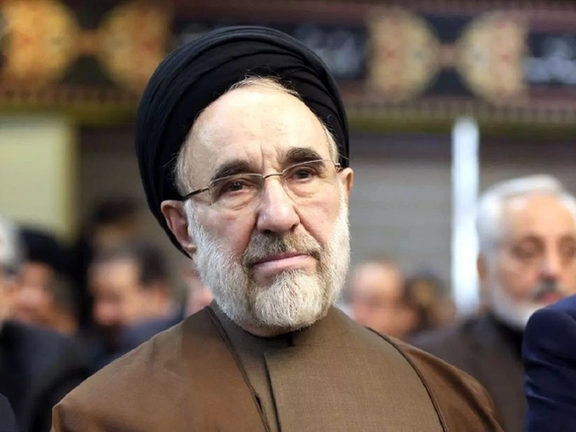
Iran's Former President Mohammad Khatami
Iran's ex-President Mohammad Khatami warned Tehran may collapse or be toppled without urgent reforms, joining other Reformist figures who have sounded the alarm in recent days about popular anger over the ailing economy.
Their calls come as costs of living mount and the country faces huge external pressure in the form of military setbacks and renewed sanctions under Donald Trump.
Referring to a 15-point action plan for greater social and economic freedoms, Khatami warned on Thursday that “Iran is in a critical situation“.
Adopting the plan would ensure "the country does not fall into chaos and conflict, to prevent, in my view, an overthrow, while also avoiding self-overthrow," Khatami said.
The former president from 1997 to 2005, rarely comments so stridently on vital policy matters and is out of favor with Supreme Leader Ali Khamenei - the ultimate decider of foreign and domestic policy.
"If no action is taken to improve people’s lives and strengthen hope for change, we will all suffer,” he added.
Khatami and other Reformists have often been caught between the need for change and the constraints imposed by Iran’s conservative political structure.
Their history of seeking to improve the system only for the Islamic Republic to resort to harsher crackdowns and fail to deliver on promises has stoked criticism.
Khatami, who has long been a de facto leader for Iran’s Reformist camp, also called for a return to the ideals of the 1979 revolution, including republicanism, which he argued had been sidelined by the current political order.
“If we have deviated from this goal, what peaceful and fair measures can be taken to bring all—parties, factions, society, and governance—back to republicanism?” he said.
His remarks reflect an ongoing struggle within Iran’s political elite: how to balance the need for reform with the preservation of the Islamic Republic’s fundamental structure, which has been increasingly threatened by internal and external challenges.
Hassan Khomeini and the struggle for hope
Hassan Khomeini, the grandson of the founder of the Islamic Republic, weighed in on the depressed mood in Iran, expressing concern about the erosion of popular hope.
“The enemies have targeted the people’s hope,” he said in a Thursday speech. “If they kill our hope, we are dead; every nation lives through hope.”
Khomeini has emerged as another figure in the Reformist camp, though he has carefully avoided directly criticizing Khamenei’s policies.
Hassan Khomeini, grandson of the founder of the Islamic Republic Ruhollah Khomeini
“Despair is the plague of human activity ... even in difficult situations, people of faith must not fall into despair,” Khomeini’s said.
Azar Mansouri, another prominent Reformist and head of the Islamic Iran Participation Front, also weighed in on the troubled state of the nation, urging national unity.
Speaking at the party’s 10th Congress, Mansouri called for prudence in the face of Iran’s increasing regional and international isolation, particularly with the second act for a Trump administration that has promised a renewed policy of maximum pressure.
“In the current situation, where regional problems for Iran have increased on one hand, and on the other, someone with a history of anti-Iranian policies and maximum pressure is sitting in the US presidency, it is crucial to understand these increasingly complex and challenging conditions,” Mansouri said.
“A strong and dignified presence on the international stage requires the government to have the solid backing of public satisfaction and support,” Mansouri added.
Her call contrasts with the reality of dwindling voter turnout and increasing disillusionment with the political system.
In the 2017, 2021, 2024 elections, voter turnout plummeted, with the 2024 presidential election seeing one of the lowest turnouts in the history of the Islamic Republic. The sense of disengagement from the electorate is palpable, and many Reformists like Mansouri have failed to confront the root causes of the apathy.
As Iran teeters on the edge of deeper political and economic turmoil, the reformists’ calls for change are framed within a difficult paradox: they are both critics and, detractors would argue, enablers of the system they now warn is endangered.
While figures like Khatami, Khomeini and Mansouri continue to push for reform, they are part of a system that has shown little interest in the transformation they advocate.
Reformists and their history of saving the system
While the Reformists are now sounding alarms about Iran’s future, they have historically played a key role in stabilizing the Islamic Republic amid crises.
Khatami’s own presidency was marked by a push for political freedoms and better relations with the West. However, the real turning point came in the post-2009 period, when the Reformists once again rallied behind the system to prevent it from falling.
In 2013, they threw their support behind Hassan Rouhani in the presidential election, hoping he would bring economic relief and mend ties abroad.
Yet after Rouhani’s election, Iran saw little of the promised change. The nuclear deal, which was heralded as a diplomatic breakthrough, quickly unraveled after Trump pulled out.
Under Rouhani, Iran also faced the worst economic crisis in decades, fueled by US sanctions. The Reformists, instead of challenging the system’s hardline approach, largely supported policies that allowed the establishment to remain in power.
This culminated in the suppression of multiple waves of protest, such as in November 2019, when hundreds were killed by security forces during demonstrations against rising fuel prices.
Iran is currently grappling with an intense economic crisis, as the value of the US dollar has surged past 800,000 rials, exacerbating inflation and eroding the purchasing power of ordinary citizens.
The country is facing severe energy shortages, with power outages and gas supply cuts becoming more frequent, leading to the disruption of business and daily life.
Pollution levels are escalating, intensifying the already dire health challenges.
Meanwhile, skyrocketing prices for basic goods, including food and medicine, are placing immense pressure on households, pushing many to the brink of poverty.
The sons of a former high-ranking Iranian judiciary official have been sentenced to a combined total of over 25 years in prison for their involvement in a financial corruption case.
Amir-Hossein Mosaddegh was sentenced to 17 years and 9 months in prison and fined 8.25 trillion rials (about $10,000) for illegal influence peddling and participation in bribery.
His brother, Mohammad-Sadegh Mosaddegh, received an eight-year prison sentence for abuse of office and involvement in eight counts of money laundering.
Their father Mohammad Mosaddegh Kahanmouei, the former first deputy of the Judiciary, resigned in March, several months after a Telegram channel revealed that his two sons were arrested for massive corruption and money laundering.
Apart from Mosaddegh’s sons, the case involves twenty-one other suspects.
The indictment revealed details of the case, including allegations related to the transfer of the "Shohaday-e Gheytarieh" sports complex to a prominent Tehran constructor.
The sons of the former first deputy allegedly held a 20 percent stake in the deal, equivalent to 1.4 trillion rials, approximately $1.75 million at today’s rates.
Another charge against the brothers involved exerting influence in the case of Mohammad Rostami Safa, a known bank debtor, resulting in their acquisition of 2 trillion rials (about $2.5 million).
The Rostami Safa Group, managed by Mohammad Rostami Safa, has a history of accusations, by the Judiciary itself, of receiving substantial loans since 2003 and failing to repay them.
It is not the first time a judiciary official has been caught up in a corruption scandal. In a similar case, another senior judiciary official, Akbar Tabari, was arrested in 2019 for leading a bribery network and personally accepting multiple bribes. He was sentenced to 31 years in prison.
However, Iran ranks 149 out of 180 countries in the 2023 Corruption Perceptions Index (CPI) by Transparency International, scoring 24 out of 100.
Iranian President Masoud Pezeshkian called for regional and global peace as the country's armed allies around the region continue to weaken.
“We desire friendly relations with the countries of the region and the world, and we are striving to establish peace and security both inside and outside the country,” he said on Thursday during his trip to North Khorasan province.
In a possible bid to publicly align with Khamenei's decades-long policy of arming militias around the region and accelerating the country's nuclear program, he added that Iran's actions were a matter of self-defense.
“We do not intend to invade other countries' territories, nor will we allow anyone to encroach upon our borders or rights. Preserving the integrity of the country is a fundamental principle for us, but at the same time, our focus is on peace and security," he said.
Iran's militias such as Hezbollah in Lebanon and Hamas in Gaza have in recent months suffered huge blows.
Pezeshkian's comments also follow statements in recent days from the new Sunni Islamist leaders of Syria, who have warned Iran to stay out of the country's internal affairs since the fall of President Bashar al-Assad.
Iran had been a heavy presence in the country since 2011, with military bases and personnel across Syria.
Pezeshkian’s call for diplomacy stands in contrast to the Supreme Leader’s persistent rejection of normalization with the West and Israel, suggesting that Iran’s pursuit of peace may remain contingent upon maintaining its ideological and geopolitical conflicts.
President Masoud Pezeshkian (right) sitting next to Supreme Leader Ali Khamenei (left) during a ceremony in Tehran.
In his speech, Pezeshkian also addressed critical domestic issues, acknowledging the impact of mismanagement on the country’s energy crisis.
“Today, we have the largest oil and gas reserves, but consuming three or four times more than Europe has caused us a crisis,” he said, before promising to address the inefficiencies that have led to power and gas shortages.
The government's long-standing narrative, which blames the energy crisis on the people's excessive consumption, has become increasingly ineffective in the face of rising public frustration.
Calls on citizens to conserve energy have become a familiar refrain, yet many Iranians are growing skeptical of these appeals, viewing them as a justification for government inaction rather than a genuine solution.
Iran's energy crisis has deepened in this year, marked by frequent power outages and gas shortages. The country, which holds some of the largest reserves of oil and natural gas in the world, has struggled with inefficient energy consumption, outdated infrastructure, and mismanagement.
A day after the Iranian government announced the lifting of restrictions on WhatsApp and Google Play, media and users erupted in outrage, accusing it of hypocrisy following the release of a 32-point plan to tighten and compartmentalize Internet access.
The lifting of Google Play restrictions changes little, as Iranians in the country remain unable to make purchases on the platform due to international banking limitations imposed by both the Iranian government and US sanctions.
Mehr News Agency, which published portions of the 32-point plan, quoted social media users stating that lifting the ban on WhatsApp and Google Play does little to help thousands of Iranian businesses operating on Instagram and Telegram, which remain inaccessible without the use of filter-breakers, otherwise known as circumvention software. The government’s ultimate plan is to establish more monitoring of users and controlled Internet access.
Hundreds of social media users noted that the declaration by the government did not change anything about its censorship of the Internet as although people can use WhatsApp for messaging, for all other platforms they still need to use VPNs to circumvent the censorship.
Iran began aggressively blocking websites in early 2,000s, even before the rise of social media, citing political and religious reasons. The beginning of blocking websites in Iran dates to 1998 and the reformist government of Mohammad Khatami. With the increased use of home internet in Iran, Ali Khamenei issued the "General Policies about Computer and Information Networks," which was subsequently implemented by the government with the objective of filtering of the Internet and overseeing the activities of Internet service providers (ISPs).
For over two decades, most independent Iranian news and political websites have remained inaccessible. Starting in 2009, Western social media platforms, including Facebook, were also blocked. In response, most Iranians turned to circumvention tools, such as VPNs, to bypass digital censorship.
In 2014, Hassan Rouhani's government launched the "Intelligent Internet Filtering" plan, further restricting Iranians' access to the Internet. After the 2017-2018 protests, Telegram and Instagram were also blocked. During the nationwide internet shutdown in the November 2019 protests, the government escalated its efforts to block websites and applications, aiming to disrupt protest organization, and hinder the mobilization of demonstrators.
Meanwhile, as some pro-government reformist newspapers such as Arman Melli ran headlines like "The filtering has been broken," others, including the reformist daily Etemad, emphasized that this is merely "a first step in a gradual move to lift the filtering" and urged the nation to "wait for the next step."
According to the plan, in the "next step" platforms such as YouTube might be made accessible through an added local layer or shelf that checks the users' identity and monitors what they upload and download.
Conservative newspapers, including Jam-e Jam, which is affiliated with Iran's state television, warned the government that cyberspace must be "governed" with stricter controls.
Prominent economic journalist Maryam Shokrani criticized the move on X, writing: "Are you kidding the people? We always need foreign filter-breakers to access most applications, and then have to turn them off to use Iranian banking and other apps. What has changed now…?"
Akbar Montajabi the editor-in-chief of centrist daily Sazandegi, who has over 11,900 followers, wrote on the same platform: "What has been done is good but insufficient as a first step." He advised the government: "Do not worry about lifting the filtering. Worry about losing the people's trust and your social capital."
Internet security expert Amir Nazemi, who has over 24,000 followers, analyzed the development from a political perspective. Writing on X, he said: "Filtering, slowing down Internet speeds, and cutting off access (as seen during the 2019 protests and afterward) were all tactics implemented with the Supreme Leader's approval. His signature remains on the ratification by the Supreme Council of National Security. With yesterday's decision, Mr. Khamenei has, for the first time, reversed one of his domestic political decisions. This is unprecedented and the only aspect of this development that carries real news value."
Meanwhile, Filterbaan, an account with around 12,000 followers which advocates digital and internet access rights in Iran explained that what has been already done in the first of a three-step plan, and wrote that the plan is not meant to facilitate Internet access. It is rather meant to make it even harder based on the 32-point plan drawn by the Supreme Council of Cyberspace.
Iranian Nobel Peace Prize laureate Narges Mohammadi has drawn parallels between the oppressive system described in Margaret Atwood’s The Handmaid’s Tale and the systemic control of women in Iranian society.
Mohammadi, who has been imprisoned multiple times for her activism and is currently on a medical furlough, appeared in a video conversation with Atwood, facilitated by TIME magazine on December 18.
In the interview, the Iranian activist turned the spotlight on what she described as gender apartheid in Iran and the restriction of women’s autonomy in ways eerily similar to Atwood’s dystopian Gilead.
Margaret Atwood is a renowned Canadian author, poet, and essayist, celebrated for her profound contributions to contemporary literature. Born on November 18, 1939, in Ottawa, Canada, she is best known for her speculative fiction, including The Handmaid's Tale and its sequel, The Testaments.
Her works often explore themes of power, gender, environmentalism, and the complexities of human relationships, blending literary brilliance with sharp social commentary. Atwood's innovative storytelling and unique perspective have earned her numerous awards, including the Booker Prize, which she has won twice.
Mohammadi recounted how she began reading the novel in Evin Prison but was unable to finish it due to restrictions.
She noted how its themes and imagery have resonated deeply with Iranians, especially during the protests sparked by the Woman, Life, Freedom movement.
“Many young Iranians have been watching the Handmaid’s Tale series, and I have also heard that many performances during Iranian protests abroad have incorporated imagery and symbols from the series in solidarity,” Mohammadi said.
Atwood, speaking from New York, expressed her admiration for the courage of Iranian women in the face of systemic repression.
“I was looking at the Woman, Life, Freedom movement when it was at its height. It was remarkable, and I was amazed that they were getting away with it with all that total repression,” she said.
The Canadian author Margaret Atwood gives a speech after receiving the H.C. Andersen Literature Prize 2024 at the concert hall Odeon in Odense, October 27, 2024.
The Iranian activist also reflected on the broader societal changes driven by the movement, highlighting its transformative impact on Iranian culture.
“I see this change as a positive one specifically regarding the issue of forced hijab,” she said. “The change brought about by the Woman, Life, Freedom movement in Iranian society is remarkable. If we had tried to achieve this through traditional methods, such as religious, political, sociological, or women’s rights discussions, it might have taken far longer to reach this level of progress.”
Mohammadi, a journalist and campaigner against the death penalty, was awarded the 2023 Nobel Peace Prize for her unwavering efforts in promoting women’s rights and her relentless fight against oppression in Iran.
As a prominent voice for freedom, Mohammadi has been a leading figure in advocating for the rights of political prisoners and challenging the Iranian government's systemic injustices, including its crackdowns on protests.
Despite enduring multiple arrests, imprisonment, and harassment, her resilience and dedication have inspired millions worldwide. The Nobel Committee recognized her courage and significant role in empowering women in Iran, particularly during the Woman, Life, Freedom movement, which gained momentum following the death of Mahsa Amini in 2022 in police custody for not having proper hijab.
Use of medication to torture inmates
During the Dec. 18 conversation, Mohammadi also shared details about the inhumane treatment of women in Iranian prisons.
“One of the methods used against these women is transferring them to psychiatric hospitals,” she said. “They are given heavy medications intended for those with severe mental illness and injected with powerful drugs and even subjected to electric shocks.”
Atwood connected these accounts to historical practices under authoritarian systems. “This is very Soviet Union. This hospitalization and medication—they used to do that,” she said. “Who knows, they probably still are. And this kind of treatment was not confined to Iran.”
Mohammadi then emphasized the far-reaching consequences of controlling women in society. “When women lose control over fundamental aspects of their lives, such as their clothing, bodies, and choices through anti-women laws, it paves the way for oppressive regimes to take hold,” she said.
Atwood echoed this concern, observing how such dynamics are not confined to one country. “When I wrote it, I thought perhaps this book will become obsolete,” she said. “But the opposite has happened... This kind of total control of women, particularly their reproduction, that is already happening.”
Both women expressed hope that these stories of oppression will eventually become irrelevant. “The Handmaid’s Tale is an eternal work,” Mohammadi said.
“It continues to offer new insights and warnings in different eras.” Atwood said, “If it remains relevant, then it’s because the situation remains unequal and oppressive to women.”
A company affiliated with Iran's Ministry of Agriculture has been found to have imported 60,000 tons of sub-standard rice for national reserves, potentially costing the government millions of Euros.
The rice purchased using a lower exchange rate of US dollar was supposed to be high-quality Indian rice but was discovered to be contaminated with cheaper varieties.
The financial implications of the blunder are significant, sparking investigations and raising critical questions about the oversight and approval processes behind such large-scale imports.
"This rice was not high-quality. When I saw a sample, it was clear that most of it was a different variety," Karim Akhavan, President of the Iranian Rice Importers Association told Tasnim News Agency.
He said the mixture of inferior rice with the intended high-quality variety indicated serious mismanagement.
An analysis of the rice by a German institute confirmed the presence of impurities, though the precise level of contamination remains unclear.
The ministry of agriculture confirmed that the rice had been mixed with cheaper varieties by the foreign seller, but it stopped short of specifying what types of rice were used.
"This is a matter for Jahad Company, which is responsible for the imports," said Ahmad Khani Nozari, the Ministry's Deputy of Commerce as he tried to shift the responsibility away from the ministry.
The financial fallout from the mislabeling is expected to be considerable. The standard cost of rice imports for the ministry is between 1,010 to 1,020 euros per ton, but the contaminated shipment is believed to fall well below this price point.
Given the massive volume of the rice involved, the discrepancy could add up to millions of euros.
The Economic Security Police have launched an investigation into the case, although the full scale of the financial loss is still unclear due to the unspecified percentage of the rice that was mixed.
The timing of the scandal is particularly damaging, coming on the heels of rising food prices in Iran where at least one third of the country is living below the poverty line. Increases in the cost of basic staples like rice and legumes have put additional strain on an already struggling economy.
A pile of rice with stacked bags of rice in the background, in a warehouse in Iran.
Jahad Company, which has long been tasked with importing rice for government reserves, faces mounting scrutiny.
The investigation will now examine who exactly authorized the shipment, and why there was a failure in ensuring the quality of the rice before it was allowed into the country.
While oil exports have surged by 20%, the country's overall economic growth has been sluggish, the economy squeezed by global sanctions.
In the first half of the current fiscal year, Iran's GDP growth was half of last year's rate. The agricultural sector, which has already been underperforming due to droughts and power shortages, has been particularly hard hit.
Despite these challenges, official figures continue to report growth, leading some analysts to question the accuracy and honesty of the data provided by the Central Bank of Iran.
The rice scandal also underscores the growing frustration among ordinary Iranians, feeling the pinch from rising food costs, despite government assurances of stability.
The Government Trading Corporation, tasked with safeguarding the nation's strategic reserves, now faces questions about its oversight of critical imports. The Ministry of Agriculture’s ambiguous stance on the issue—treating it as a business dispute rather than a regulatory failure—has only fueled doubts about the accountability of state-run institutions.