Putin asks restraint from Khamenei as regional tensions escalate
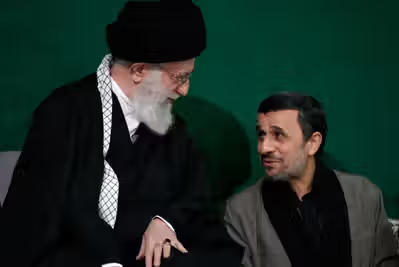
Russian leader Vladimir Putin and Iran's Ali Khamenei meeting in July. 2021
In a diplomatic move, Russian President Vladimir Putin has reportedly urged Iran's Supreme Leader Ali Khamenei to exercise restraint following the assassination of Hamas leader Ismail Haniyeh, allegedly carried out by Israel.
According to two senior Iranian sources cited by Reuters, the plea for moderation was delivered by Sergei Shoigu, a key Putin ally, during a high-level meeting with Iranian officials in Tehran on Monday.
Shoigu's visit, as reported by Russia's state-run RIA news agency, highlighted Moscow's dual approach: condemning the assassination while advocating for a measured response from Iran. "The killing of Haniyeh is a very dangerous assassination," Shoigu allegedly stated.
The sources indicated that Shoigu’s visit was part of Russia's broader strategy to relay to Tehran the necessity of restraint, warning that a reckless response could lead to a major Middle Eastern war.
Iran's request for Russian military support
Despite the Kremlin's cautious approach, Tehran has not shied away from pressing its demands, including the acquisition of Russian-made Sukhoi Su-35 fighter jets. The two Iranian sources, who were privy to the discussions, disclosed to Reuters that this request was reiterated during Shoigu's visit, reflecting Iran's strategic ambitions amidst escalating tensions. Russia itself has lost hundreds of warplanes in its war on Ukraine and would be hard pressed to satisfy Iran's request.
An Israeli insider, who previously served as Commander of the Israel Air Defense Forces from 2015 to 2018, conveyed to Iran International that the current threat of war with Iran is notably different from the situation during Tehran's first direct attack on Israel in April. Brigadier General Zvika Haimovich indicated that Hezbollah is expected to play a pivotal role in Iran's anticipated retaliation this time. He expressed that he could not envision any outcome other than Iran responding to last week's killing, which Tehran has attributed to Israel.
"In the long term, I think we need to focus on the Iranian nuclear, wielding vision and capabilities, and build a strong and stable coalition led by the United States of America and also the Arab Sunni states against Iran," Haimovich stated.
International concerns and potential for conflict
The potential fallout from Iran's retaliation has alarmed international observers. An unnamed Biden administration official, speaking to Reuters, emphasized the risks of a significant regional conflict, stating, "The scale of Iran's and Hezbollah's response will be a key factor in determining the extent of a potential conflict." This sentiment is shared across Western capitals, where there is a palpable fear that Iran's aggressive posturing could spiral out of control, especially if coupled with Hezbollah's actions in Lebanon.
In Tehran, Ali Bagheri Kani, the acting head of the Foreign Ministry, reiterated Iran's stance, asserting that the assassination of Haniyeh was a "violation of international law" and that the Islamic Republic "has the right to take appropriate measures to defend and protect its national security and sovereignty." This rhetoric was echoed by Hezbollah, with a prominent Lebanese source close to the group telling Reuters, "A retaliatory strike is inevitable and diplomacy is no longer a viable option." The source added that while Iran seeks a severe response, it does not intend to spark a full-scale regional war.
In a separate discussion, former CIA director and US CENTCOM Commander David Petraeus, in an exclusive interview with Iran International, suggested that both Iran and Israel are likely to avoid an all-out war due to the catastrophic consequences it could entail for both nations.
“I think [the Iranians] have to respond,” Petraeus told Iran International's Marzia Hussaini, “this is an enormous blow to Iran's honor… It's a huge intelligence failure and… a security failure. So, they have to respond. But I don't think that Iran wants to get into a real direct back and forth war with Israel… And frankly, I don't think Israel wants to get in a real full-on war with Hezbollah or with Iran," he explained.
Israeli and US preparations for potential escalation
In response to these developments, Israel has been ramping up its military preparedness. Israeli Defense Minister Yoav Gallant warned that the nation must be ready for all scenarios, including "a swift transition to offense" should Iran or Hezbollah launch attacks.
According to sources familiar with recent Israeli assessments, the country's response to any aggression will be calibrated based on the damage incurred rather than the scale of the attack.
Meanwhile, US intelligence has briefed President Joe Biden and Vice President Kamala Harris on potential scenarios, including possible waves of attacks from Hezbollah and other Iranian proxies. Axios reported that the intelligence community believes Iran and Hezbollah's response is still a "work in progress," with both actors undecided on the exact nature of their retaliation.
Rising tensions and regional dynamics
The regional dynamics are further complicated by recent events. A Tuesday NOTAM (Notice to Airmen) posted on the US Federal Aviation Administration warned pilots that there is a risk of gun firing activities in western Iran on August 7 and 8. It has set the danger zone up to an altitude of 12,000 feet above mean sea level.
Concurrently, Israeli warplanes conducted a series of aggressive maneuvers over Beirut, breaking the sound barrier and causing widespread panic just before a scheduled speech by Hezbollah chief Sayyed Hassan Nasrallah. The IDF has also confirmed airstrikes in southern Lebanon, targeting Hezbollah's infrastructure, as reported by Hebrew media. Lebanese media say at least four people were killed in the strikes in southern Lebanon.
As noted by a senior US official focused on Middle Eastern affairs, "We are doing everything we can to dissuade all parties from going to a place they can’t get back from," urging other regional and European states to exert more influence to de-escalate tensions. A Qatari official also echoed this sentiment, indicating that Doha is in constant communication with Tehran to reduce the likelihood of a conflict.
Iran's uranium enrichment machines called centrifuges
The latest report from the US Office of the Director of National Intelligence accuses Iran of becoming ever bolder in boasting about its nuclear weapons as the chances of a return to the JCPOA nuclear deal look to be fading away.
"There has been a notable increase this year in Iranian public statements about nuclear weapons, suggesting the topic is becoming less taboo,” the report stated.
In May, Iranian MP Ahmad Bakhshayesh Ardestani said openly that Iran might already possess a nuclear weapon. It followed closely on the heels of remarks by Kamal Kharrazi, senior foreign policy advisor to Supreme Leader Ali Khamenei, who had said that Tehran will change its nuclear doctrine if its archenemy Israel were to attack its atomic facilities.
For years, the Islamic Republic has insisted that its nuclear program is entirely peaceful, despite enriching uranium to 60-percent purity, which can only have a weaponization purpose.
"Since 2020, Iran has repeatedly stated that it is no longer constrained by any Joint Comprehensive Plan of Action (JCPOA) limits, expanded its nuclear program, reduced International Atomic Energy Agency (IAEA) monitoring, and undertaken activities that better position it to produce a nuclear device, if it chooses to do so,” the US intelligence report noted.
However, it comes in stark contrast to the report released just last year in which it wrote that “Iran is not currently undertaking the key nuclear weapons-development activities that would be necessary to produce a testable nuclear device”.
That assessment rang hollow after it was revealed recently by the UN’s nuclear chief, Raphael Grossi, that Iran is “weeks not months” away from a nuclear weapon.
The latest report, under the Iran’s Nuclear Weapons Capability and Terrorism Monitoring Act of 2022, acknowledges the imminent threat the program poses as Iran continues to increase the size of its uranium stockpile, its enrichment capacity, and development, manufacturing, and operation of advanced centrifuges.
“Tehran has the infrastructure and experience to quickly produce weapons-grade uranium, at multiple facilities, if it chooses to do so,” the report noted.
The country’s nuclear capabilities have become a bargaining chip on the global stage, noted the report, which states that “Iran uses its nuclear program for negotiation leverage and to respond to perceived international pressure,” which has included hostage diplomacy with nations including Sweden and the US.
In line with UN inspectors, the report warns that “Iran probably will consider installing more advanced centrifuges, further increasing its enriched uranium stockpile, or enriching uranium up to 90 percent in response to additional sanctions, attacks, or censure against its nuclear program,” as global sanctions fail to stem the tide of armament.
It notes that Iran has the largest inventory of ballistic missiles in the region and the government continues to emphasize improving the accuracy, lethality, and reliability of these systems.
As the program continues, the unclassified report notes that “Iran probably is incorporating lessons learned from its missile and unmanned aerial vehicle attack against Israel in April”.
The first ever direct attack from Iran to Israel saw over 350 missiles and drones fired towards Israel, most of which were intercepted by Israel and a US-led coalition. It was in retaliation for an alleged Israeli strike on the Iranian consulate in Damascus in which two IRGC commanders were killed along with several other senior personnel.
But the intelligence suggests Iran’s armament development continues to gain pace in spite of global sanctions not only for Iran's nuclear program but for human rights abuses at home and its support of Russia's war on Ukraine. Iran has been supplying suicide drones to Russia used on civilian targets.
“Iran’s work on space-launch vehicles—including its Simorgh—probably would shorten the timeline to produce an intercontinental ballistic missile, if it decided to develop one, because the systems use similar technologies,” the report stated.
In yet another move in its war on women's freedom of choice, Iranian authorities have introduced the Tuba Plan to promote and enforce the country's mandatory hijab laws amid widespread defiance.
In a report on Sunday, the ‘reformist’ newspaper Shargh revealed it will be rolled out in three phases, culminating in the training of 1,500 "missionaries" tasked with promoting "the culture of chastity and hijab" with a particular focus on schools and education centers.
Citing Mohammad Hosseinzadeh, director general of Culture and Islamic Guidance of Khorasan Razavi province, Shargh reported that the project is mainly aimed at teenagers and youth with 400 individuals registered to become its missionaries.
"Our goal is to promote an Iranian-Islamic culture, of which the hijab is one of its examples,” Hosseinzadeh said.
When asked about whether the individuals taking part in the course would also be involved in the Nour Plan , an initiative that began in April this year to enforce mandatory hijab laws, Hosseinzadeh said it had not been finalized.
“I don't have any information about whether or not people will be allowed to participate in Nour Plan or Headquarters for Enjoining the Good and Forbidding the Evil after completing this course, but our field of activity is advertisement and promotion," he said.
However, Shargh highlighted that the Tuba Plan's ultimate goal seems to be staffing the hijab division within the Headquarters for Enjoining the Good and Forbidding the Evil, a government institution that shapes and enforces Iran's morality laws.
Led by Seyyed Mohammed Saleh Hashemi Golpayegani, the institute also referred to as the Headquarters for the Promotion of Virtue and Prevention of Vice was sanctioned in January 2023 by the European Union for being “responsible for serious human rights violations in Iran.”
Last week, Naimeh Islamlou, director of Kheybar Institute announced the commencement of registration for the Touba National Project in Karaj, near the country’s capital in Tehran.
She stated that the free "hijab and chastity promotion” training course will run for 60 hours, training people at three levels and awarding them a “reputable” degree upon completion.
Shargh noted that according to Kheybar Institute’s website, their main role appears to be in staffing and implementation of chastity and hijab projects for Headquarters for Enjoining the Good and Forbidding the Evil.
A unit within Kheybar Institute which they refer to as the 'Fatemi Mujahedan' appears to be aligned with the Tuba Plan, as pointed out by Shargh.
Kheybar Institute's 'Fatemi Mujahedan' Unit logo
According to the institute's website, the unit runs training courses for hijab promoters at three levels, with 124 courses conducted so far, involving participants from all over the country.
To train, individuals must visit the "Chastity Virtual Specialized University." The so-called university is described as "a training barracks and an ammunition depot for cultural officers of the frontline of chastity and hijab."
One of the registration officials in these courses told Shargh: "We have been holding training programs in the field of chastity and hijab at three levels for nearly 20 years. We took Plan Tuba to the Ministry of Culture and Guidance and got their support so that applicants who want to participate in these courses can have a free training course without spending money."
The registrar, whose name was not mentioned in the Shargh report, said there is no guarantees of employment for those enrolling, "but if they reach level three, they can work in schools, and if they earn, they will be paid with a gift or a gift card."
The official Tuba Plan poster
Ehsan Ahangar, director general of the Ministry of Guidance in Mazandaran Province, announced on July 28 that the Tuba Plan will indeed be focusing on public spaces and schools.
"After completing the course and receiving their certificate, participants will be deployed to promote hijab and chastity, particularly in neighborhoods and schools, which are our main target communities," Ahangar said.
For over four decades, the Islamic Republic has tried to impose mandatory hijab laws on Iranian women through various projects and its crackdown on women who defy its stifling rules continues.
Following the nationwide Women, Life, Freedom uprising sparked by the death of Mahsa Amini in morality police custody in September 2022 for an alleged hijab violation, women's protests against the Islamic Republic’s oppressive laws have become one of the most significant challenges facing the authorities.
Despite the government's violent suppression, which saw hundreds killed by state security amid the 2022 protests, many Iranian women have continued to defy and resist the Islamic Republic’s hijab laws, appearing unveiled in public places over the past two years.
These acts of civil disobedience however come at a heavy price. Women risk severe penalties and even their lives in the fight for freedom and equality as the battle against what the UN termed "gender apartheid" continues.
Unveiled women have been banned from public spaces, education, workplaces, and even jailed amid the government's fight in the face of nationwide hijab rejection.
An Iranian ballistic missile shot down over Israel in April
As Iranian officials continue to issue threats of missile retaliation against Israel for the killing of Ismail Haniyeh, a conservative newspaper on Tuesday suggested that a more effective response would be to create insecurity within Israel.
Khorasan Daily, a traditionally conservative newspaper distinct from hardliners, argued that while a missile response was appropriate in April when Iran retaliated against Israel’s air strike on its embassy compound in Damascus, the nature of this recent attack is different. The paper suggested that Iran’s proxies should now focus on launching attacks in Tel Aviv to create insecurity, and that the ‘Resistance Front’ should move away from relying solely on missile deterrence.
What's even more intriguing is the newspaper's stance that any response to Israel should not be launched from Iranian territory.
Although few government-controlled media outlets or authorized commentators inside Iran have acknowledged that Tehran’s April attack failed to inflict any damage on Israel, the Iranian public is generally well aware of this fact. Online, jokes frequently mock the IRGC’s missiles and their exaggerated claims. Some have even nicknamed the missiles “flying water heaters,” humorously suggesting they need frequent welding before use.
Arguing that Iran’s missile strategy cannot offer good answers any longer, Khorasan newspaper said, "The region and the Axis of Resistance are now obligated to deliver an appropriate response to the Israeli regime.” The newspaper immediately added that a response at this time must be prioritized, “but with several considerations: first, it should not involve missile or drone operations; second, it should not be carried out from Iranian soil."
It's difficult to determine whether the newspaper was expressing its own opinion or publishing the article under the direction of state authorities or a particular political faction. However, the call for Iran to avoid direct involvement, especially while the top leadership advocates for a response, is noteworthy.
This sentiment is reflected in overall Iranian public opinion, as seen in social media posts: Why should Iran continue to pursue a costly confrontation with Israel and potentially the United States? Many also view a potential war as a threat to the regime's very survival—a possibility that has not gone unnoticed by the Islamic Republic leaders.
Khorasan Daily also argued that Iran’s missile and drone attack in April was successful in demonstrating that Iranian weapons could reach Israel. However, the newspaper suggested that repeating the same operation would not yield additional benefits. Instead, it urged the leaders of Iran’s proxy groups to adopt new tactics and strategies to harm Israel.
The suggestion to make Tel Aviv unsafe without relying on Iranian missiles may hint at terrorist-style operations, similar to those frequently used by Palestinian groups in the past, though with little strategic success. For those in Iran, including regime insiders, who recognize the untenable costs of a serious war, the focus is elsewhere. Many Iranians argue that as long as high tensions with Israel persist, Tehran's hopes of re-starting negotiations with the United States remain dim, forcing the country to continue bearing the heavy burden of sanctions.
Reza Rasaei, a 34-year-old Iranian who was arrested during the 2022 anti-government protests in western Iranian province of Kermanshah, was executed on Tuesday morning.
Rasaei, who comes from the marginalized Kurdish and Yarsan minorities in Iran, was sentenced to death by a Revolutionary Court on trumped-up charges related to the killing of an IRGC agent on November 18, 2022, and his death sentence was upheld by the Supreme Court in December 2023.
In late 2022, while the Islamic Republic’s security forces were in the throes of their violent crackdown on unprecedented protests, news spread that a senior IRGC intelligence official had reportedly been stabbed to death. In response to Nader Bayrami's killing in Kermanshah Province, authorities arbitrarily detained dozens of protesters in retaliation.
Bayrami was reportedly killed during a gathering to honor Seyed Khalil Alinejad — an influential Kurdish and Yarsan figure believed to have been killed by security agents. Originating in 14th-century Iran, Yarsan is one of the Middle East's oldest faiths, with over one million followers in the country. The Islamic Republic refuses to recognize Yarsan as a legitimate faith, labeling it a "false cult" and regularly persecuting its followers.
Rasaei had received a call from state security agents before the gathering to get a commitment that he would not engage in protests. He attended the ceremony anyway, holding up a photo of his cousin Khairullah Haqjoyan, who was in custody at the time.
One of Rasaei's friends, who was also in attendance, reported that the crowd suddenly began chanting anti-regime slogans like "Death to the child-killing government" and "Woman, Life, Freedom." Authorities quickly began beating people with batons. After a gunshot was heard, security forces released tear gas to disperse the crowd.
Bayrami was giving a warning to a woman refusing to wear the hijab, when a group of people confronted him and eventually began beating him.
Days later, authorities in Kermanshah singled out Rasaei, blaming him for the alleged crime.
Exclusive interviews with eyewitnesses to the killing of the IRGC official and sources close to Rasaei’s family cast complete doubt on the regime’s narrative.
According to sources, Rasaei was not involved in the altercation that led to the death of the IRGC official and was ultimately forced to confess to Bayrami's murder under extreme torture.
Amnesty International announced in February 2024 that his death sentence was issued after an “unfair trial” based on “forced confessions.”
Amnesty International noted that during interrogations Rasaei was subjected to torture and other ill-treatment, including electric shocks and severe beatings to compel him to self-incriminating “confessions”.
The Dadban legal group, which monitors the legal proceedings of imprisoned protesters and political prisoners in Iran, also declared on social media that the death sentence against Rasaei is unlawful.
They noted that the court selectively accepted testimony from certain defendants while disregarding evidence that could have exonerated Rasaei. Despite the prosecutor's report highlighting flaws in the case, the judges persisted in issuing a guilty verdict.
Furthermore, the group of legal experts said, the court ignored the opinions of forensic experts regarding the cause of death and the weapon involved.
Dadban emphasized the influence of powerful institutions in Rasaei's case, suggesting that the verdict was predetermined despite numerous contradictions and flaws.
A view of the entrance of Evin prison in Tehran, Iran October 17, 2022.
Thirty-seven female political prisoners in Tehran's notorious Evin Prison have been denied visitation rights.
According to information obtained by Iran International, it came in response to their participation in an overnight sit-in on July 24 to protest the death sentence of fellow inmate Pakhshan Azizi.
Among the protesters were Nobel Peace Laureate Narges Mohammadi and Iranian writer and human rights advocate Golrokh Iraee.
The prisoners further protested Azizi’s death sentence through a one-day hunger strike on July 30, part of the ongoing “No to Execution” campaign held every Tuesday.
Azizi, sentenced to death for "armed rebellion," is one of at least four women at risk of execution on similar charges.
Azizi was the second woman in July this year to be sentenced to death on charges of "armed rebellion."
Already this year, rights groups claim Iran has carried out 300 executions. Last year, over 850 were reported as an execution wave sweeps the country in a bid to quash dissent.