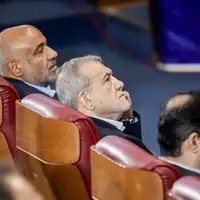
Former President Hassan Rouhani extended his congratulations to President-elect Masoud Pezeshkian.
Rouhani said that the people voted for constructive engagement with the world and the revival of the 2015 nuclear deal (Joint Comprehensive Plan of Action), signed during Rouhani’s tenure.
He also stressed that the government and authorities must not ignore those who did not participate in the election.
Rejecting allegations by other presidential runners who described Pezeshkian’s administration as the continuation of Rouhani’s, he said that “the 14th administration is the first government of Dr. Pezeshkian, not a continuation of previous administrations.”

Former chief of Iran’s Central Bank, Abdolnaser Hemmati, told local media that one of the first tasks for the new president should be reaching an agreement with the West to lift sanctions.
In the first 100 days, “it is important to establish a policy of understanding with the United States and the three European powers to reduce sanctions and thus lower inflationary expectations. The government's first step should be to suppress these inflationary expectations,” Hemmati, a critic of Iran’s hardliners stated.
Nuclear negotiations by the Biden administration and Britain, France and Germany, which started in April 2021 failed to forge a new agreement to revive the Obama-era JCPOA nuclear deal. As a result, Trump administration’s oil export and international banking sanctions remained in place seriously impacting Iran’s weak economy.
Hemmati and numerous other experts and analysts in Tehran have long called for a change of course by the Islamic government, which has increasingly adopted a more hardline posture since 2020, not only in foreign policy but also in its repressive measures against social and political freedoms. Many hope that the election of the relatively moderate Masoud Pezeshkian can bring about a measure of change in both foreign and domestic policies.
The former chief banker is considered a ‘reformist’ who was a candidate in the 2021 presidential election when the hardliner candidate Ebrahim Raisi was elected amid heavy-handed engineering of the election process. He registered as a candidate again for the latest presidential elections but the notorious Guardian Council rejected his qualification.
“In the first 100 days, the government must demonstrate that it does not intend to continue the previous erroneous path,” Hemmati said. Although the new president, Masoud Pezeshkian has made many promises, he has offered few concrete plans for change. He has emphasized the need to improve relations with the international community, but when it comes to the United States, everyone believes the key is in Supreme Leader Ali Khamenei’s hand.
However, beyond improving ties with the West and lifting of sanctions, the government needs to open up the state-controlled economy to more market competition, Hemmati emphasized. “It is important to announce the main economic policy of distancing from a command economy and implementing primary policies based on competitive strategies to align and integrate the private sector with the state economy.”
Hemmati also highlighted his concern about Iran’s annual inflation rate hovering around 50 percent. The government must “correct wrong decisions to control the budget deficit and manage variables that lead to increased inflation."
With sanctions stifling oil revenues, the government has resorted to printing money to balance its budget, which has fueled runaway inflation in the past five years.
Calling for the president to be able to exercise his constitutional power, Hemmati said there is no need for a stronger or weaker president, but the constitution should be respected and applied in regards with presidential authority.
Supreme Leader Ali Khamenei has thanked all candidates and people involved in holding the presidential elections, saying that the nearly 50-percent voter turnout neutralized calls to boycott the elections.
“This grand act of defiance against the fabricated uproar of election boycott, which the enemies of the Iranian nation had orchestrated to instill despair and deadlock, is a brilliant and unforgettable feat,” he said.
After a lackluster voter turnout in the first round of elections on June 28, Khamenei admitted that the participation rate was disappointing and “less than expected.” After he cast his vote in the runoff, he expressed hope that more people would show up for the second round."I have heard that people's enthusiasm and interest is higher than before (the previous round), I hope it is true" he said trying to sound positive.
In his message on Saturday, Khamenei also called on the newly elected president to continue the path of the late President Ebrahim Raisi.
Syrian President Bashar Assad congratulated Masoud Pezeshkian on his election as the Iranian president.
In his message, Assad said that Syria and the Islamic Republic would work towards "strengthening strategic relations and opening new horizons for bilateral cooperation."
Saudi Arabia's king and crown prince congratulated Masoud Pezeshkian on his election as Iran's president, state news agency SPA reported on Saturday.
"I affirm my keenness on developing and deepening the relations between our countries and people and serve our mutual interests," SPA quoted Saudi Crown Prince Mohammed bin Salman as saying.
In March 2023, Iran and Saudi Arabia signed a landmark China-brokered deal to re-establish relations after years of regional rivalry. Since then, officials from both sides continued talks to bolster ties.

Zeinab Jalalian, one of the longest-serving female political prisoners in Iran, is in her 17th year of life imprisonment in the central city of Yazd, enduring severe health issues without proper medical care.
On Friday, the Human Rights Activist Network in Iran (HRANA) reported that Jalalian, despite suffering from multiple physical ailments, has been consistently denied the necessary medical attention and hospital transfers.
“Ms. Jalalian suffers from pterygium (an eye disease) as well as kidney and gastrointestinal diseases. Recently, due to pain in her right side, she was transferred to the prison infirmary. She was examined by the prison doctor, but no specialized treatment was provided. This political prisoner requires hospitalization and specialized care, yet the relevant authorities continue to prevent her transfer,” wrote HRANA.
Jalalian was arrested on February 26, 2008, while traveling on an intercity minibus in western Iran. Agents of the Ministry of Intelligence apprehended her at the entrance to the city, in front of dozens of passengers. During her detainment, Jalalian was subjected to severe physical and psychological torture, as reported by multiple rights groups.
In December 2008, she was sentenced to death by the Revolutionary Court in Kermanshah on charges of “enmity against God” (moharebeh) through “armed action against the Islamic Republic, membership of PJAK, possession and maintenance of military weapons and equipment, and propaganda activities in favor of anti-state groups” according to Kurdistan Human Rights Network (KHRN). Her sentence was commuted from execution to life imprisonment in October 2011.
In 2016, the UN Working Group on Arbitrary Detention determined that she was detained for the peaceful exercise of her rights to freedom of expression and association and denied her right to a fair trial. Amnesty International has repeatedly called on the Iranian authorities for her immediate release.
In January this year, Amnesty urged for her release again and stated that despite the findings of the UN Working Group on Arbitrary Detention, “Iranian authorities continued to subject Zeynab Jalalian to torture by deliberately denying her healthcare to coerce her into providing a videotaped ‘confession’ and ‘repenting’ for her past activities. Following at least two COVID-19 infections, Zeynab Jalalian has developed a lung condition and has trouble breathing – a condition that needs proper treatment.”
Jalalian has been transferred multiple times between various prisons, including Khoi, Qarchak, Varamin, Evin, Kerman, Kermanshah, and Yazd, without any leave. Her health has deteriorated significantly, with no respite from the prison authorities.
Numerous reports have highlighted the systemic neglect of medical treatment for political prisoners in Iran, resulting in the deaths of several inmates in the past.