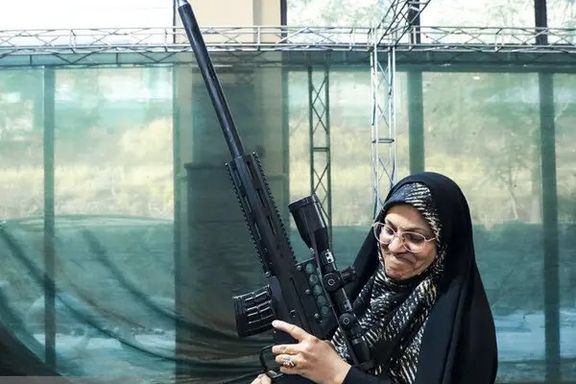
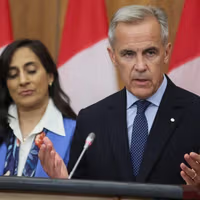
Zohreh Elahian, in a military weapons exhibition in Tehran in August 2023
Former female lawmaker Zohreh Elahian has registered to run in Iran's June 28 snap presidential vote, potentially becoming the first woman ever allowed to stand if approved by the Guardian Council.
Elahian, 57, is a physician and former member of the parliament’s National Security and Foreign Policy Committee. She was elected to parliament twice on the hardliners’ slate.
In her speech following registration, Elahian declared her motto: “Sound government, sound economy, sound society,” and pledged to combat corruption.
Like other hardliners, Elahian supports compulsory hijab rules. In March, Canada imposed sanctions against her for endorsing the death penalty for protesters involved in the “Woman, Life, Freedom” movement. Her candidacy comes after months of harsh policies and actions by the government against women who defy compulsory hijab.
Zohreh Elahian enters interior ministry to register
Elahian’s qualification to run hinges on the Guardian Council's interpretation of a controversial article of the Constitution. The Guardian Council, the sole body empowered by the Constitution to interpret it, has historically disqualified female candidates. This disqualification is based on Article 115, which stipulates that candidates must be from among political or religious "rijal" (the plural of "rajul"), a masculine Arabic noun meaning "men."
However, some constitutional experts and politicians interpret "rijal" to mean "figures" or "persons" irrespective of gender, rather than exclusively "men."
Azam Taleghani, a veteran reformist politician and journalist, registered to run in every presidential election from 1997 until her death in 2019. Despite being described as an “Islamic feminist,” Taleghani was rejected by the Guardian Council every time.
In 2009, populist Mahmoud Ahmadinejad proposed Elahian as Minister of Welfare and Social Security. However, she declined the nomination, citing opposition from senior Shia clerics (maraje’) to women serving as ministers.
Another of Ahmadinejad’s female nominees, hardliner Marzieh Vahid-Dastjerdi, a physician and former lawmaker, was approved by parliament as Minister of Health, making her the first and only female minister in the history of the Islamic Republic.
Several other political figures registered to run on Saturday, including ultra-hardliner Tehran mayor Alireza Zakani, reformist lawmaker and former first deputy speaker Masoud Pezeshkian, and Vahid Haghanian, a member of Supreme Leader Ali Khamenei’s office.
Haghanian’s registration, dubbed by social media users as the “biggest surprise” of the election registrations, and his motives has baffled observers. Like Elahian, many believe there is no chance he will be qualified to run. Some people even claim he no longer holds a position at Khamenei’s office.
“We were quick to judge about him. He is known as the black box, but he has apparently not held any positions in a long time,” Hossein Ebrahimi, a conservative cleric and politician, tweeted. Ebrahimi added that there is a high possibility of Haghanian’s disqualification, apparently due to open cases with the judiciary.
This may refer to allegations of espionage against him that surfaced in January after the execution of Mohsen Saravani, 24, on charges of spying for Israel. Saravani had been photographed with Haghanian and was said to be close to him. Around the same time Haghanian ceased to appear in public.
Behnam Gholipour, expatriate journalist, in a tweet on Saturday called Haghanian an “scapegoat candidate”. “He will be sacrificed to mask disqualification of others. Then everyone will say Larijani and Ahmadinejad don’t even count [because] Khamenei’s right-hand man was disqualified,” he wrote.
Iran’s presidential election headquarters, housed within the ministry of interior, suffered multiple power outages affecting its operations three times on Saturday.
The blackouts have become a symbol of Iran’s broader struggle with an aging and inefficient power grid, impacting everything from ordinary households and industrial centers to major public events and now, political campaigns.
As Vahid Haghanian, a senior figure in the Office of the Supreme Leader, was delivering a speech after registering his candidacy, the lights went out, plunging the event into darkness in front of live media and audience.
The incident has fueled mockery and criticism on social media, with commentators highlighting the irony of power failures amid election promises to solve infrastructure decay.
Critics argue that rather than witnessing progress, Iran is merely scrambling to patch up its crumbling infrastructure. Power cuts are also the result of energy shortage that affects Iran during hot summer and cold winter months, despite the country having the world's second largest natural gas reserves.
The power crisis has already caused disruptions in the industrial sector, triggering a drop in production and rising costs due to frequent power cuts and voltage instability.
Recent data from Iranian officials show a sharp decline in the country’s net electricity exports, attributed to several factors, including high domestic consumption fueled by heavily subsidized electricity rates, which the government fears to adjust due to potential public unrest.
Furthermore, the Iranian government's economic policies, marked by inefficiency and mismanagement, along with the impact of international sanctions, have deteriorated the energy sector's performance.
As registration of candidates for the June 28 presidential election started in Iran on Thursday, some of the candidates have issued videos on social media to show off grassroot support.
Former President Mahmoud Ahmadinejad's aides and supporters posted several of such videos even before the registration started.
In a poorly produced videoposted by a former Ahmadinejad aide, the former President is seen outside his home in the Narmak neighborhood of east Tehran, surrounded by a small group of supporters from Gilan Province. One of the supporters is seen pleading with Ahmadinejad to announce his candidacy to save the country from its current difficult situation. The man claims that thousands would have come to his house if they had known about the meeting.
In another video, that was deleted later, a group of people from the city of Jahrom in Fars province gather at the same place with the same demand. Again, Ahmadinejad said he is summing up the situation and calculating whether to register, which could mean he is waiting for the go-ahead from Khamenei.
Supporters of Ahmadinejad seen in a rally in May 2022
Despite Ahmadinejad's perceived popularity for his criticisms of the ruling elite, voter turnout has plummeted in recent elections. In both 2021 and 2024, most voters shunned the ballot box. Official figures for the March 1 parliamentary election reported 40% participation, though many believe the actual number to be lower. Voters are increasingly disillusioned, doubting that the highly stage-managed elections can address their severe economic hardships. Inflation hovers around 50%, and the national currency is near its all-time lows.
Meanwhile, Tehran Mayor Alireza Zakani's team apparently made a propaganda blunder by calling on everyone to invite Zakani to register. Twitter user Mohammad Parsi quoted the statementon Jahan News and wrote that Zakani is in fact inviting himself to become a candidate.
Tehran mayor Zakani showing his iD card during registration on June 1, 2024
Meanwhile, some potential candidates are trying to generate excitement and speculation about their participation in the election, aiming to stir interest and anticipation around their potential candidacy.
The reform camp that has been doing the same during the past week by trying to create a mood of suspense, finally announced that it will take part in the election only if the government accepts its conditions. The main condition set by the reform front is that the government and the Guardian Council should accept at least one of the candidates exclusively introduced by the reform camp.
Many ‘reformist’ activists on social media described the decision that was made after a five-hour long meeting Wednesday night as "clever." Others advised that so-called reformist figures close to the core of the government such as Massoud Pezeshkian should not be named as the front's candidate. Pezeshkian whose credentials were rejected for the March parliamentary elections, was later allowed to run after Khamenei told the Guardian Council to avert its decision about him. He registered as a candidate on Saturday, but it is not certain if ‘reformists’ will designate him as their candidate.
Another one of those ‘reformist’ figures who lacks the backing of the Reform Front is Mostfa Kavakebian the leader of Mardom Salari [Democracy] party, a low-profile proreform party with no defined agenda.
Journalist and political activist Sajjad Abedi wrote in a May 30 tweet: "It is interesting that there is still no invitation campaign to call on the main choice for presidency to come forward. I can say with certainty that he is going to surprise all those who have been furthering their early campaigns." Abedi could have been talking about Acting President Mohammad Mokhber or Roads Minister Mehrdad Bazrpash who was present at Khamenei's meeting with Syria's Basahar Asad visiting Tehran this week.
Alireza Zakani, the current Mayor of Tehran and a hardliner politician, has formally registered to run in Iran's presidential election scheduled for June 28.
Known for his conservative stance and nicknamed the "revolutionary tank," Zakani is returning to the presidential fray after withdrawing in 2021 to support Ebrahim Raisi, who died in a helicopter crash on May 19.
Zakani's political career has been marred by controversy for his aggressive tactics, particularly against reformists. Despite his bold rhetoric, he has faced significant criticism, even from state media, which questions his suitability for higher office.
His tenure as mayor has not been without its problems, including disputes over urban policies like mosque constructions in parks and the enforcement of the hijab on public transport, which have sparked internal conflicts within the conservative camp and the city council.
Financial and familial scandals have also dogged Zakani. His administration's decision to provide financial deposits to municipal managers for housing needs led to a backlash from several city council members. More personal allegations have surfaced, including nepotism involving his son-in-law and questionable financial dealings by his daughter and her husband with the Islamic Development Organization.
Zakani’s political past includes a stint as the chair of the JCPOA - nuclear deal - commission in the parliament in 2010s, where he transitioned from presenting an impartial stance to becoming a vocal opponent of the agreement.
Asadollah Badamchian, the secretary-general of the Islamic Coalition Party and an insider, has openly stated the need for a presidential candidate who can reassure Supreme Leader Ayatollah Khamenei about the future.
Speaking about the upcoming elections, Badamchian expressed, "The next president must be someone who can put Khamenei at ease."
Badamchian, a hardline Islamist politician with a history deeply embedded in Iran’s political fabric, emphasized that the ideal candidate must adeptly represent the revolutionary values and speak fluently on issues concerning the ruling regime and the nation.
"We need someone who, wherever he goes, knows how to speak on behalf of the revolution, the regime, and the nation," he added.
Having served two terms in parliament, his comments reflect the Islamic Republic's ongoing strategy to ensure that leadership remains aligned with Khamenei’s vision, amid growing domestic and international challenges.
So far, 12 individuals have registered for the presidential race, including former Speaker Ali Larijani and ultra-conservative Saeed Jalili. Their eligibility to officially compete in the elections will be determined after the approval of the Guardian Council, an unelected body made up of appointees loyal to Supreme Leader Ali Khamenei
Vahid Haghanian, a prominent and mysterious figure within the Office of the Supreme Leader of Iran, has registered as a candidate for the upcoming presidential election.
Haghanian, known for his elusive background and secretive role within the inner circles of the Iranian regime, has historically been a key player in facilitating the Supreme Leader's directives across Iran's military, cultural, economic, and political spheres.
After formally registering his candidacy Haghanian, told reporters that "Based on a personal decision, I have made up my mind to register as a candidate for the presidential election."
He expressed his intent to transition from "the deepest layer of the system's brain to the first and most visible layer," moving from behind-the-scenes influencer to front-line electoral politics and public engagement.
During his address, he discussed his experience within the government, emphasizing his commitment to understanding and addressing people's issues.
"Over these 45 years, due to my duties, by traveling to all provinces, preparing ongoing reports, and presenting them for decision-making, being directly involved in the [Iran-Iraq] war and other areas, I have been able to establish sufficient connections with all segments of society," he explained.
“I have never been and will never be a member or adherent to the principles of any factions, but I have and will continue to cooperate and engage with all of them."
In this undated photo, Vahid Haghanian (L) is seen with the Supreme Leader's son, Mojtaba Khamenei.
Haghanian's is speech was interrupted several times due to unexpected power cuts. He responded to the embarrassing situation by saying, "I hope it wasn't intentional."
Despite his efforts to maintain a low profile, Haghanian came under international scrutiny in 2019 when he, along with eight other officials from the Supreme Leader's office, was sanctioned by the US Treasury.
Described as "the Supreme Leader’s right hand" and a former military commander, his close association with Khamenei during public engagements further cemented his status.
However, recent years have seen a noticeable reduction in Haghanian's public appearances alongside Supreme Leader Khamenei, sparking speculation about his current standing within the system.
Media in Tehran characterize his role in different ways, including giving him the title of "deputy for special projects," but there is no official indication of his current position. Many figures close to Khamenei are expected to enter the race, including current acting president Mohammad Mokhber. So far, Saeed Jalili, a staunch hardliner and Khamenei loyalist, has registered as a candidate. Former Parliament Speaker Ali Larijani, who is considered a political heavyweight among former officials and long-time Khamenei loyalist has also announced his candidacy, although he has been pushed aside from the center of power since 2020.
Meanwhile, Alireza Zakani, the hardliner Mayor of Tehran, officially entered the race for Iran's presidential election on Saturday. With his conservative views, Zakani reenters the political scene after stepping aside in 2021 to endorse Ebrahim Raisi.
Masoud Pezeshkian, a known reformist lawmaker and former First Deputy Speaker of the Iranian Parliament also registered. Pezeshkian, brings a limited measure of diversity to the race, emphasizing reforms and openness. His previous tenure as Minister of Health under President Mohammad Khatami highlights his reformist closer ties to the 'reformists.'.
In a related development, conservative politician Parviz Fattah has confirmed he will not be entering the race. Fattah, a former IRGC officer known for his leadership of the economic conglomerate Execution of Imam Khomeini's Order, was widely expected to declare his candidacy for the June 28 snap elections. His withdrawal has left room for new conservative figures to emerge, potentially altering the dynamics of the electoral contest.