• العربية
  • فارسی
Brand
  • Iran Insight
  • Politics
  • Economy
  • Analysis
  • Special Report
  • Opinion
  • Podcast
  • Live TV
  • Iran Insight
  • Politics
  • Economy
  • Analysis
  • Special Report
  • Opinion
  • Podcast
  • Live TV
  • Theme
  • Language
    • العربية
    • فارسی
  • Iran Insight
  • Politics
  • Economy
  • Analysis
  • Special Report
  • Opinion
  • Podcast
  • Live TV
All rights reserved for Volant Media UK Limited
volant media logo

Oil Sales Alone Can't Sustain Iran, Says Conservative Politician

Iran International Newsroom
May 17, 2024, 15:00 GMT+1
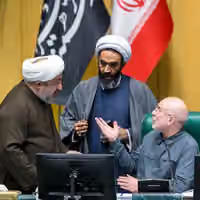
Politician Mohammad Reza Bahonar

Prominent conservative politician Mohammad Reza Bahonar says that government funds are scarce and oil sales alone cannot meet the country’s basic needs, adding to the recent criticism of President Ebrahim Raisi's economic policies.

On Thursday, Bahonar, a member of the influential Expediency Council, an advisory body to the Supreme Leader, highlighted the country's severe deficits in energy, government budgets, and banking systems. He also stressed the "untapped economic potential."

"The government does not have money to invest, and the oil market does not provide enough for our basic needs," he said. “Gone are the days when governments could sell oil and develop the country.”

Bahonar is the latest politician to express concern about the economy while decrying Raisi's economic policies.

Last week, Iran's top clerics voiced concern about high inflation and fluctuating exchange rates, blaming the government for these issues. This week, the parliament seemingly voted for a two-day work week, with the apparent hope that it could aid some of the country’s economic struggles.

The Raisi administration and its hard-line policies have traditionally been supported by conservative figures, who are now voicing concerns about inflation. Iran's Central Bank reported 52.3% inflation for 2023 last month, while gasoline continues to be in short supply.

While President Raisi and his predecessors have often been blamed for the country’s current economic woes, it is the Islamic Republic’s Supreme Leader, Ali Khamenei, who is the top decision maker for domestic and foreign policy.

Khamenei’s leadership and legitimacy are heavily tied to the Islamic Revolutionary Guards’ (IRGC) – whose control over the Iranian economy extend across virtually every sector of the Iranian market.

Most Viewed

UAE outmaneuvers Iran’s Hormuz strategy, state TV analysts say
1

UAE outmaneuvers Iran’s Hormuz strategy, state TV analysts say

2

Iran’s shrinking air links raise costs, strain regional ties

3

Iran’s rial hits another record low under economic and military pressure

4
EXCLUSIVE

Key IRGC intelligence figure in Iran’s oil sales identified: Who is Mostafa Ahadi?

5

IRGC outlet accuses reformists of feeding Trump's pressure campaign

Banner
Banner
Banner

Spotlight

  • Iranian hardliners turn on Ghalibaf and judiciary after lawmaker’s sentencing
    INSIGHT

    Iranian hardliners turn on Ghalibaf and judiciary after lawmaker’s sentencing

  • The body as a battleground: Iran's resistance etched in ink and blood
    SPECIAL REPORT

    The body as a battleground: Iran's resistance etched in ink and blood

  • Khamenei’s vision of Iranian power faces a test of reality
    ANALYSIS

    Khamenei’s vision of Iranian power faces a test of reality

  • Iran’s shrinking air links raise costs, strain regional ties

    Iran’s shrinking air links raise costs, strain regional ties

  • Why Trump said no to Iran’s Hormuz proposal
    ANALYSIS

    Why Trump said no to Iran’s Hormuz proposal

  • Iran’s oil industry has too many masters
    OPINION

    Iran’s oil industry has too many masters

  • Iran wrong to expect midterms to restrain Trump, former US official says

    Iran wrong to expect midterms to restrain Trump, former US official says

Banner