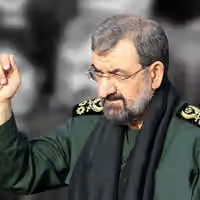
Iran's Chief Justice has ordered prosecutors to take "decisive" action against those who are allegedly encouraging defiance of hijab rules in an "organized manner."
Gholamreza Mohseni-Ejei directed prosecutors this week to act in the name of the public and identify those "organized and foreign-affiliated elements" who oppose hijab rules. They are to be put on trial and punished within the framework of the law with the assistance of law enforcement.
This directive suggests a shift in focus from merely not wearing hijab to charging individuals involved in "organized" opposition to hijab with offenses such as "collusion and assembly to act against national security." In recent years, anti-compulsory hijab activists have faced fabricated charges, with some sentenced to prison, like Vida Movahed, who received a one-year sentence for her protest against mandatory hijab in 2017.
The 32-year-old woman had climbed a utility box in a busy Tehran Street, removed her headscarf, tied it to a stick and silently waved it in protest to mandatory hijab in Iran in 2017.
Iran's Chief Justice Gholamreza Mohseni-Ejei (right) speaking during a meeting with Iran's ruler Ali Khamenei
Mohseni-Ejei emphasized the Islamic principle of "amr-e be marouf va nahy az monkar," which urges Muslims to encourage good deeds and discourage forbidden ones. However, he noted that not all problems can be solved through preaching and called for legal action against those with ties to foreign countries who resist Iran's values and security.
“People who have ties to foreign [countries] and intend to resist the people's values, their chastity, and [harm] their psychological and physical security should be dealt with the sword of justice,” he said.
Iranian authorities often use the tactic of accusing dissidents of having ties to foreigners, in order to charge them with security crimes, rather than just political offences.
In recent years, many Iranian women have protested mandatory hijab, leading to arrests and imprisonment. Authorities have also impounded thousands of cars and closed businesses for failing to enforce hijab rules.
A police official in the religious city of Qom, where most of Iran's Shiite seminaries are located, said last week that in the past ten months owners of 74,000 cars had received warnings for hijab violations with nearly 20,000 impounded and nearly 2,000 cases referred to courts.
These numbers showed a six-fold increase in comparison to the same period last year, he said.
This move by the chief justice appears to address criticism from high-ranking clerics and seminary teachers who have expressed concerns about the perceived weakening of hijab enforcement. Grand Ayatollah Hossein Nouri-Hamedani and a group of seminary teachers in Qom have called for stronger measures to address defiance of hijab rules, expressing fears that it could lead to "extensive immorality" and harm the country's independence.
In a letter addressed to the president, chief justice, and parliament speaker earlier this week, one hundred teachers of Qom seminaries demanded decisiveness in dealing with what they called the “phenomenon” of defiance of hijab.
The signatories of the letter insisted on enforcing Islamic rules and alleged that the refusal of women to abide by mandatory hijab rules could be used by “enemies” and “feminists”.
“Enforcement of the law and prevention of [moral] corruption, of course, entails costs which we have to pay if we want to implement Islam,” they wrote.
“One hundred have written a petition to the heads of the state under the name of seminarians and complained about everything, from cinema and women's sports to hijab, but said nothing about inflation, the state of people’s livelihood, and the country's economy!” dissident journalist Saeed Maleki tweeted, suggesting that after the upcoming elections authorities will be taking tougher measures to address the concerns of these clerics.