Jailed Sociologist Calls For Resistance Ahead Of Iranian Elections
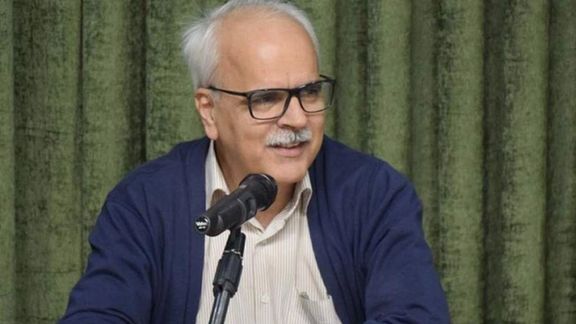
Iranian sociologist Saeed Madani
Saeed Madani, a jailed Iranian sociologist, has issued a statement from Evin Prison emphasizing the political opportunity for civil resistance in the upcoming parliamentary elections.
While the election Scheduled for March 1, Madani highlighted the chance to capitalize on the momentum of the 2022 uprising which has called for a nationwide shift away from the regime.
In February, Mousavi, from his confinement, called for the preparation of a new constitution to save Iran. Mousavi outlined the core principles of the new constitution within the framework of the Women, Life, Freedom movement.
Madani was sentenced to nine years in prison in January on charges of "forming and managing dissident groups against the system" and "propaganda against the Islamic Republic."
He called for international standards for the elections, expressing that “those advocating for change would support boycotting the elections if these standards are not met.”
Referring to the stance of Mir Hossein Mousavi, a leader of the Green Movement who opposes symbolic elections and advocates for a boycott, Madani asserted, "It is time for reformists to prioritize justice and truth."
The statement by the imprisoned researcher and national-religious political activist coincides with reports of widespread disqualifications of lawmakers critical of President Ebrahim Raisi's government. As of Sunday, approximately 40 current members of parliament and several former lawmakers or top officials were barred by the interior ministry from running in the elections.
The mass disqualifications have raised concerns among regime insiders about the potential for low voter turnout in the upcoming parliamentary elections.
Zahra Saeedianjoo, the sister of a protester who lost his life during the Women, Life, Freedom protests in Iran, has been arrested once again.
The arrest occurred three days before the anniversary of her brother's death. Fatemeh Heydari, sister of another victim of the nationwide protests, Javad Heydari, disclosed on Monday that Saeedianjoo was detained when the Islamic Republic forces forcefully entered their residence in Izeh, located in the southern part of Iran.
The arrest comes on the heels of news in mid-October, which reported Saeedianjoo's dismissal from her job and the reception of "death threats" from unidentified motorcyclists.
There is a growing concern about the intensified pressure from security forces on the families of individuals who lost their lives during the protests. Numerous reports have surfaced in recent days detailing efforts to hinder commemoration ceremonies for those who were killed.
In a related incident, Maysam Pirfalak, the father of Kian Pirfalak, an 8-year-old boy who lost his life in Izeh last year during the protests, made an announcement on November 9. Through a video posted on his Instagram page, Pirfalak revealed that the commemoration ceremony for his son took place a week earlier beside Kian's grave in the village of Parchestan in Izeh, amid what he described as "tightened security."
Further exacerbating the situation, reports from human rights media indicate the separate detentions of Mahnaz Tarrah and Shaqayeq Moradi, by security agencies in Tehran. The Follow-up Committee of Iranian Detainees reported on Tuesday that security forces conducted a search at Moradi's residence.
Mahnaz Tarrah, with a history of past detentions and enduring judicial sentences, was released from prison in February following the “amnesty” granted to some political prisoners.
As of now, no information has been made public regarding the reasons for the recent detentions and the charges brought against the two citizens.
The United States and Britain imposed a fresh round of sanctions on Tuesday targeting Hamas as they seek to cut off funding for the militant Palestinian group.
The United States announced its third round of sanctions since the October 7 Hamas terror attack on Israel. The measures target key Hamas officials and the mechanisms through which Iran provides support to Hamas and its ally Palestinian Islamic Jihad (PIJ), another militant group.
US State Department in announcing the sanctions particularly focused on the financial and military support by the Iranian regime to Hamas and other militant groups.
Secretary of State Antony Blinken in a statement highlighted that “Iran’s support, primarily through its Islamic Revolutionary Guard Corps, enables Hamas and PIJ’s terrorist activities, including through the transfer of funds and the provision of both weapons and operational training. Iran has trained PIJ fighters to produce and develop missiles in Gaza while also funding groups that provide financial support to PIJ-affiliated fighters.”
Britain added six new designations to its counter-terrorism sanctions list, including four individuals linked to Hamas, an update to the UK government website showed.
"The United States will continue to work with our partners, including the U.K., to deny Hamas the ability to raise and use funds to carry out its atrocities," Treasury Secretary Janet Yellen said in a statement.
Antony Blinken attending a regional meeting in the Middle East in March 2022
"Hamas’s actions have caused immense suffering and shown that terrorism does not occur in isolation. Together with our partners we are decisively moving to degrade Hamas's financial infrastructure, cut them off from outside funding, and block the new funding channels they seek to finance their heinous acts."
Israel vowed to wipe out Hamas after the militant group's fighters burst across the fence around the Gaza enclave on October 7 and rampaged through Israeli towns killing civilians. Israel says 1,200 people were killed and around 240 were dragged back to Gaza as hostages in the deadliest day of its 75-year history.
There are also thousands of casualties in Gaza as a result of Israeli attacks, although there is no independent estimate of the exact numbers.
FINANCES TARGETED
Since the terror attack, Washington has imposed three rounds of sanctions on Hamas. It has targeted the group's investment portfolio and issued an alert to financial institutions on countering Hamas financing while senior officials have discussed the group's access to funds on trips abroad.
Hamas is designated a terrorist group by Israel, the United States, the European Union, Britain and others.
Washington's action on Tuesday specifically targeted Mahmoud Khaled Zahhar, a senior member and co-founder of Hamas, the PIJ's representative to Iran and the Damascus-based Deputy Secretary General of PIJ and leader of its militant wing.
Lebanon-based money exchange company Nabil Chouman & Co was also targeted, along with its owner and founder. Treasury said Hamas uses the company to transfer money from Iran to Gaza and accused it of having transferred tens of millions of dollars to the group.
Washington's move freezes any US assets of those targeted and generally bars Americans from dealing with them. Those who engage in certain transactions with them also risk being hit with sanctions.
US Deputy Treasury Secretary Wally Adeyemo told Reuters last week that efforts to cut off Hamas funding would increasingly focus on facilitators in third countries, and that it would take coordination with allies and partners to shut off those avenues. His recent trip to Europe centered on fostering more cooperation in this area.
Iranian dissidents continue to suffer threats from the Islamic Republic's agents and live in fear of imminent harm in Canada, according to a report published by the Canadian outlet Global News.
The report covers not only the lives of journalists and political activists but also those from other professions living abroad who feel unsafe.
Canada has a particularly serious problem with hundreds, perhaps thousands, of regime-connected officials on its soil, according to a lengthy Global News investigation. An infamous example is Mahmoud Khavari, ex-CEO of Iran’s national bank who has been wanted by Interpol and reportedly fled to Canada in 2011 after being accused of embezzling $2.6 billion.
As part of its efforts to address this issue, Canada has expanded targeted sanctions against certain members of the IRGC group and amended its Magnitsky legislation in order to allow the government to go after the assets of Iranians implicated in human rights abuses and corruption, but the dissidents say that these measures do not suffice.
Prime Minister Trudeau has refused to declare the IRGC a terror group because some Iranians are compelled to join the group as part of their mandatory military service.
Nonetheless, the diaspora contends that if the IRGC were on the terrorist list, members who have gained Canadian citizenship would be liable for crimes committed overseas and subject to much harsher penalties.
Iranian police have arrested 300 people who attended a mixed-gender party in a wedding venue as the regime cracks down further on gender segregation.
The deputy police chief of Semnan province, Ali Mirahmadi, said the arrest happened while the officers on patrol noticed an “unrestrained night party” in a hall located on the outskirts of Shahrood city.
Iran’s Sharia law forbids men and women who are not related from mingling together, and it is forbidden to dance with the opposite gender. Also, both sexes are prohibited from having out-of-wedlock relations. Mirahmadi added that the venue had been sealed due to trade violations.
There has been an increase in the number of reports about young people being detained for participating in "mixed parties" and "refusal to wear hijab" across Iran as morality police step up actions across the board.
Authorities have increased their surveillance of businesses and recreational venues, closing down cafes, restaurants and halls across the country for not complying with the government's mandatory hijab law. .
The hijab law has raised anger since the death in custody of Mahsa Amini in September 2022, arrested for not wearing her headscarf properly. Following the incident, a nationwide uprising was sparked, and demands went beyond the hijab and included protests over the regime's corruption, mismanagement, and oppression.
Satellite imagery shows progress in the construction in Russia of a plant that will mass produce Iranian-designed kamikaze drones, a research organization said on Monday.
Despite the headway, neither the United States nor its allies have imposed sanctions on the plant's owner, JSC Alabuga, or its associated companies, the Institute for Science and International Security said in a report report.
Iran began supplying hundreds of kamikaze drones to Russia in mid-2022 that have been extensively used against civilian targets in Ukraine.
The report said a mid-September satellite image showed that new construction at the plant "directly" correlated with a leaked building floor plan that the Washington Post shared with the institute earlier this year.
The building, according to other leaked documents, will be used for the mass production of Iran's Shahed-136 that will include improving Iranian fabrication processes "and ultimately advancing the drone's capabilities," the report said.
"With winter fast approaching ... Russia can be expected to accelerate its Shahed-136 attacks against Ukraine's vital energy infrastructure, causing brutal living conditions for the civilian population," the report said.
"A key overdue step" is for Washington to sanction Alabuga and its associated companies, the report continued. The United States and its NATO allies have already imposed sanctions on individuals and entities engaged in supplying Iranian drones to Russia.
Ukrainian President Volodymyr Zelenskiy on Sunday warned his country to prepare for Russian strikes on energy infrastructure. Last winter, Russia unleashed waves of such attacks, prompting rolling blackouts.
The plant is located 500 miles (800 km) east of Moscow in the Tartarstan Republic.
The White House in June said Russia and Iran appeared to be deepening their defense cooperation and that in addition to supplying drones, Tehran was working with Moscow to produce Iranian drones in Alabuga.