Kurdish Teachers In Iran Call For Release Of Sunni Clerics

A group of teachers’ organizations in Iran’s Kordestan province have expressed concern about the situation of Sunni clerics (Mamoustas) arrested for supporting popular protests.

A group of teachers’ organizations in Iran’s Kordestan province have expressed concern about the situation of Sunni clerics (Mamoustas) arrested for supporting popular protests.
In a statement, "Working and Retired Teachers Association of Kordestan" stated that after the popular uprising against the regime following the death of Mahsa Amini, “a large number of the Mamoustas stood by the people and on the right side of history with brave stances, statements and participation in protests.”
The statement, published on Friday, stated that "Mamousta Loqman Amini, Seifollah Hosseini, Ebrahim Karimi and dozens of other Sunni clerics" from Kordestan are "influential figures" who supported the protests and must be released.
“The intelligence and security organizations imprisoned them, but they don’t know that by imprisoning each fighter, thousands of other fighters are born,” added the statement.
The statement also calls for the “quick and unconditional” release of all protesters.
The Kurdish teachers also warned the government that “no amount repression” will stop the people, stressing that “torture and prison will no longer work.”
In November, a group of Sunni religious leaders and Friday prayer Imams in Kordestan called for a referendum under the supervision of international bodies in the country.
Earlier, Molavi Abdolhamid, the top Sunni cleric of Zahedan in the southeast had also called for an internationally monitored referendum, saying by killing and suppressing protesters the government cannot push back a nation.


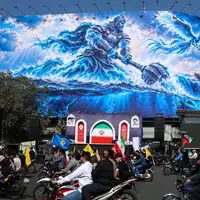
Iran’s regime is forcing students and civil servants to participate in the revolution anniversary parade to show it is more popular than the protest movement.
The state television reported Friday that seventy foreign journalists are visiting the country to report the celebrations of Ten Days of Dawn. “Apparently this year they have issued visas to more foreign journalists to report the end of the protests as well as the freeing of the prisoners, and may be other things that could be announced in the next few days,” Hossein Derakhshan, a journalist and former political prisoner said in a tweet Tuesday.
The ten days starting on the first of February mark the period between the arrival of Ayatollah Ruhollah Khomeini, founder of the revolution, in Tehran from Paris in 1979 and the victory of the revolution on February 11th.
Street protests have ebbed in the past month, but the Youth of Tehran, an underground protester group, in a recent statement urged the residents of the capital to shout anti-regime slogans every night from their rooftops and windows during the ten-day period including the slogan “We swear on the blood of our fallen ones to endure till the end.
Expatriates are planning their own show of strength through protest rallies on the day of the anniversary in many cities around the world. Iran's exiled crown prince, Reza Pahlavi, has urged all Iranians abroad to participate in the rallies against the Islamic Republic.
Those opposed to the regime often mockingly refer to the Ten Days of Dawn as Ten Days of Torment (zajr) and in the past few days have burned or destroyed many of the banners and other decorations put up in the streets by the state propaganda apparatus.
According to social media reports, education departments in many places have not only issued directives to schools demanding full participation of students, teachers and other staff but also threatened that not attending could negatively affect their chances of getting into higher education or promotion in their jobs.
Mohammad Renani, a professor of theology at Esfahan University and a cleric, said on Twitter a few days ago that his daughter’s class have been promised extra points would be added to their grades if they participated in the parade and that students were even asked to take pictures at the parade as evidence.
Renani called such directives “ethically and politically corrupt” and shared a screenshot of a directive sent by the education department of a small town in West Azarbaijan Province to schools that clearly stated that the attendance of teachers and other employees would be recorded and be the “basis of [future] rating and evaluation.”
Others say protesters who have recently been freed from prison on bail have been forced to give written guarantee that they would take part in the march Saturday.
“Do you think it’s an important occurrence if a total of two million people attend the state-sponsored march out of the eighty-five million population of Iran, by forcing students, civil servants, and mobilizing the armed forces?” London-based journalist Dariush Memar asked other twitterati Wednesday.
“Yes, it is important because the regime is investing in it. What the regime hugely needs now is gaining legitimacy through a massive march to tell the world that those who support it outnumber its opposition. The Islamic Republic needs to rebuild its lost dignity,” one of the respondents to Memar’s question wrote.

Iranian-French academic Fariba Adelkhah was released from Iran’s Evin prison, France's foreign ministry said in a statement on Friday.
The statement added it was essential that all her freedoms are restored, including returning to France as she wishes. Adelkhah was detained while visiting Iran in June 2019.
The Islamic Republic announced a partial amnesty for prisoners arrested during recent protests, on condition that they repent and pledge not to continue antigovernment activities. Some prominent political prisoners have been released, but it is not clear if all their legal issues are now considered resolved.
A source close to her, who asked not to be named, earlier told AFP that Adelkhah had been freed from Evin but added it was not clear if she would be able to leave Iran and return to France.
Up until Adelkhah's release, seven French citizens were being held as hostage by the Iranian government, according to the French foreign ministry.
They are among two dozen foreigners Iran has jailed in a strategy of hostage-taking to extract concessions from the West.
In January, Foreign Minister Catherine Colonna had demanded the "immediate release of the seven French hostages arbitrarily detained" by Tehran in telephone talks with her Iranian counterpart Hossein Amir-Abdollahian.
Iran’s brutal suppression of protests has led to new tensions with the United States and European countries.

In a historic event eight leading Iranian opposition figures have called for support from democratic countries to change the regime in Iran and establish democracy.
At an event at Georgetown University's Institute for Women, Peace and Security (GIWPS) -- titled ‘The Future of Iran’s Democracy Movement' -- held on Friday on the eve of the 44th anniversary of the establishment of the Islamic Republic, the prominent activists pledged unity for the single purpose of bringing democracy to Iran.
The speakers, all emphasizing the importance of unity against the Islamic Republic also argued that now is not the time to argue about the exact form of a future democratic government in Iran.
Both constitutional monarchy and a republican form of government have their supporters among Iranians.
Exiled Prince Reza Pahlavi, Nobel laureate Shirin Ebadi and Canada-based activist Hamed Esmaeilion, whose daughter and wife were killed in the shooting down of Flight PS752 downed by Iran’s Revolutionary Guard in 2020, as well as US-based author, journalist and women’s rights activist Masih Alinejad, actresses and activists Nazanin Boniadi and Golshifteh Farahani, former captain of Iran’s national soccer team Ali Karimi and Secretary General of Komala Iranian Kurdish party Abdullah Mohtadi were four women and four men who spoke at the event.
Pahlavi, Boniadi, Alinejad and Esmaeilion were present in the room, while Ebadi, Mohtadi and Farahani delivered video messages.

The event can become a turning point in shaping a united leadership abroad to represent the democracy movement in Iran, where activists have no chance of publicly defending it. Thousands of protesters are still in prison and dozens face the death sentence.
All speakers emphasized that the protest movement is alive and strong in Iran and it needs support from democratic countries. They pledged to work for a new form of government that would be democratic, secular and bring equality, justice and progress to Iran.
The activists representing the protest movement said that they are working on a charter for their group by the end of February and hope to lay the foundations for political representation of the aspirations of protesters in Iran and gain support for isolating the Islamic Republic.
Nobel Laureate Shirin Ebadi referring to the Islamic Republic's ruler Ali Khamenei said, "Dictator say hello to the end."
"It's not a time for infighting. The overthrow of the regime is not possible without unity and empathy," said Ebadi.
"Let's leave differences for the election. We will move hand-in-hand to a better future," she said in her video message.
Abdullah Mohtadi, a Kurdish political leader said that because of Mahsa Amini's killing by the regime, Islamic Republic's falsehood has been shattered.
Actress Golshifteh Farahani, also speaking on behalf of Ali Karimi, said that now is the time for unity and any Iranian sowing divisiveness is committing treason.
Well-known US-based activist Masih Alinejad emphasized the urgency of isolating the Islamic Republic in the world arena.
Hamed Esmaeilion, Nazanin Boniadi and Prince Reza Pahlavi emphasized emphasized equality, justice freedom and the common destiny binding Iranians.
Alinejad said that the group was working on a charter for a transition that would be ready at the end of the month. "We must agree on minimal principles," she said, adding: "The world must prepare itself for a day without the Islamic republic."
"The next wave [of protests] will come and it will be heavier," Esmaeilion said.
"We can organize and plan so, when the next wave comes, all of us are ready and we can transition away from the Islamic republic."
Prince Reza Pahlavi, who has long campaigned for a secular and democratic Iran rather than any restoration of the monarchy, said, "The time has come to consolidate our positions, put aside differences. The time has come to put aside slogans, roll up our sleeves and begin our work."
Updated at 22:00 GMT

Iranian political prisoner Farhad Meysami, whose photos after long and repeated hunger strikes shocked the world earlier, has been freed after more than four years in detention.
Social media exploded after photos of Meysami along with his letter from Rajaei-Shahr prison in Karaj were published on social media on February 1, showing him in a horrible state after losing almost half his body weight. Himself a physician, Meysami had announced he would not stop his strike.
Many Iranian dissident figures and foreign officials expressed outrage and concern over his deteriorating health condition.
According to his lawyer, the 53-year-old prisoner of conscience, who has been in jail since 2018 for supporting women activists protesting against the mandatory Islamic dress code – or hijab -- began his hunger strike on October 7 to protest recent government killings of demonstrators.
In his letter from prison, Maysami announced that he plans to make the water he drinks bitter for the next 10 days as a symbolic move against "these times that are more bitter than poison." He held the Iranian government creating unbearable condition for "everyone in all aspects".
The political activist also wrote that “I will still insist on my three demands of stopping the execution of protesters, releasing six political-civil prisoners, and stopping forced-hijab harassment.” "I will continue my impossible mission in the hope that it may become possible later on with a collective effort,” he wrote. The title of the political activist's letter is "For the days of suffering and suffering and suffering".

While many Iranian hardliners deny the damaging impact of protests for the regime, others now claim that the unrest has strengthened the Islamic Republic.
Conservative lawmaker Behrouz Mohebbi has claimed the protests revealed the weakness of the opposition. In an interview he said that the Iranian opposition is not powerful and influential because of the discord in its ranks. Meanwhile, the opposition does not have a leader the regime's serious critics would accept.
He further claimed that there is no alternative to the Islamic Republic, and its opposition is not capable of paving the way for democracy in Iran. Mohebbi also added that the Iranian public did not take the opposition seriously.
"The opposition has no acceptable track record. On the other hand, the cultural and political celebrities who opposed the regime have been unmasked during the past months," he said.
The emergence of opposition figures in the diaspora since protests began in September, is a new phenomenon on the Iranian political landscape, as gradually they can coalesce and present a more formidable challenge to the clerical regime.
At the same time, former regime insiders such as ex-prime minister and Green Movement leader Mir-Hossein Mousavi and others made strong public statements this month challenging the regime and demanding a referendum.

Meanwhile, some ask if the protest will empower radical elements in the regime. The fact is that radicals are already in power and even if they increase their influence, it can play into the hands of the opposition and expand the protests.
According to Rouydad24 website in Tehran, protesters demanding an end to the Islamic Republic created the most important challenge for the Islamic Republic since 1979, giving rise to the assumption that the so-called theocratic government in Iran could collapse as the monarchy did 44 years ago.
The report, however, acknowledged that for the time being the Islamic Republic has still the upper hand in the confrontation with the people as a result of the repressive measures taken by security forces, but maintained that the people's anger and the worsening economic situation in Iran will inevitably lead to more protests.

The report added: "The situation is so volatile that even many regime insiders have separated their path from the government. Some top clerics in Qom and An-Najaf and even some military officials have criticized the circle around President Ebrahim Raisi. Even some hardliner news agencies openly criticize Raisi for his economic mismanagement and former insiders, such as ex-President Mohammad Khatami and former Parliamentary Speaker Ali Larijani have condemned the violent crackdown. Yet, there is no indication that anyone in the regime has listened to their complaints."
The report quoted Reza Nasr, a professor of Political Science at Johns Hopkins University, as having said in an article in the Foreign Policy magazine, "Since the start of the crisis, hard-liners have tightened their grip on the reins of power. This faction opposes engagement with the West and does not wish to return to the 2015 nuclear deal. At home, it favors isolationism and tight control of the social and political spheres. Abroad, it favors aggressive regional policies and increasing collaboration with Russia. Far from chastened by the protests, in other words, the regime that is now emerging from the initial phase of the unrest is even more intransigent and potentially aggressive than ever before."
Despite evidence of hardliners having the upper hand for the time being, Expediency Council member Mohammad Javad Bahonar has argued that the protests are deeper and more widespread than in the past five years and that even some of the supporters of the regime have their own grievances and complaints. Meanwhile, former lawmaker and international wrestling champion Amir Reza Khadem has saidthat "Nearly 100 percent of Iranian are unhappy about the current situation. Even the grey strata of the Iranian society, the silent majority, sympathizes with the protests."
Responding to Iranian conservatives' criticism of celebrities' intervention in political affairs, Khadem said that "Celebrities understand the society better than government officials."