US Refuses To Characterize Iran's Protests As Movement For Democracy

US State Department Thursday refused to characterize Iran's protests as a quest for democracy, repeating that its up to the protesters to say what they aspire to.
US State Department Thursday refused to characterize Iran's protests as a quest for democracy, repeating that its up to the protesters to say what they aspire to.
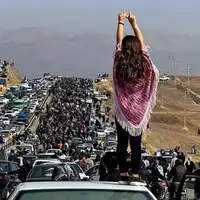
The antigovernment movement is clearly seeking to overthrow the Islamic regime, judging by daily slogans demonstrators chant and their social media posts, but the United States refuses to say that Iranian protesters want to change the regime and establish a democratic, secular form of government.
In his media briefing November 10, spokesperson Ned Price refused to say what the protest movement is about, insisting that it is up to the people involved to characterize their movement.
But before that, Price had already uttered words that essentially did characterize the movement. Speaking earlier during the briefing he said demonstrators demand reforms.
"We have spent a good deal of time at senior levels…speaking about ways that we can demonstrate our support for those brave Iranians, including many women and girls, who are peacefully demonstrating, taking to the streets, to call for the reforms that they’re demanding," Price said.
The Biden Administration’s reluctance to call the protests a movement demanding democracy and a new form of government started after its special envoy for Iran Rob Malley in October sent a tweet that sparked strong objections by Iranians.
Malley in his tweet said that Iranians were protesting to have the Islamic Republic “respect their human rights and dignity.” Iranians on social media strongly objected, saying ordinary people risking their lives in the streets had proven that they reject the clerical regime and want a new, democratic government and not just respect from an oppressive regime.
Malley apologized and the administration adopted its current position of refusing to characterize the demands of the protest movement, while it does call other movements around the world as protests for democracy.
Some argue that the administration is still interested in returning to the 2015 nuclear accord known as the JCPOA, and is reluctant to further antagonize the Iranian regime, which is already blaming “enemies” for instigating the protests.
After 18 months of JCPOA negotiations, Iran put forward demands in August that Washington rejected, but it has not declared an end to the talks.
Meanwhile, there have been many demands by US lawmakers and Iranian Americans to replace Malley as Iran envoy. An online petition launched in October has collected more than 127,000 signatures.
The petition was launched after Malley’s tweet. The sponsor said that the special envoy “minimized the Iran protest movement by portraying it as merely a quest by Iranians to have the government in Tehran ‘respect their human rights and dignity’.”
But the remark by Price about reforms, however, revealed that the administration still regards the protests as a reform movement despite the debacle with Malley’s tweet. Price was trying to argue that the administration is trying to galvanize support for Iranians, when he said demonstrators are taking to the streets, “to call for the reforms that they’re demanding.”
Already, several well-known Iranian Americans on social media have criticized Price for his remark.