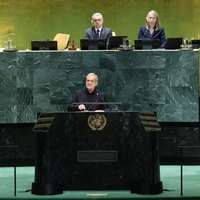
Grossi (C) holding a pres conference with head of Iran's nuclear program. March 3, 2022
The director of UN's nuclear watchdog says talks with Iran over the origin of uranium particles found at undeclared sites are at "a very difficult juncture."
"I suppose I should abstain from having a final conclusion at this point since we haven't finished the process yet but let me say that we are at a very difficult juncture at the moment," Rafael Grossi who will report on the issue to the International Atomic Energy Agency (IAEA) Board of Governors on June 6 told a panel at the World Economic Forum in Davos, Switzerland on Wednesday.
During Grossi’s visit to Tehran on March 5, Iran and the IAEA agreed a three-month procedure for a series of exchanges for Tehran to clarify outstanding questions about the unexplained uranium particles found in old, undeclared sites.
Grossi complained earlier in May that Iran was not forthcoming over its past nuclear activities and the origin of traces of enriched uranium in places that had never been declared and said he was “extremely concerned” about Iran’s lack of cooperation.
Tehran's demands for the closure of the IAEA investigation into the issue has remained a source of tension and distrust between Tehran and the West.
Iran has always insisted that it has fully cooperated with the UN nuclear watchdog over the matter while Grossi has said that efforts to restore the 2015 nuclear deal between Iran and world powers, known as the Joint Comprehensive Plan of Action (JCPOA), may not be possible without resolving the issue of undeclared past activities.
The United States withdrew from the JCPOA in May 2018 and imposed ‘maximum pressure’ sanctions on Iran.
Talks which began in Vienna in April 2021 to restore the 2015 nuclear deal have stalled since mid-March. Major issues reportedly include Washington’s refusal to delist Iran’s Revolutionary Guards (IRGC)which the Trump administration designated as a ‘foreign terrorist organization’. Iran also insists on avenging the US killing of IRGC’s Qods Force Commander Ghasem (Qasem) Soleimani who was killed in Baghdad in 2020 in a US targeted drone attack.
"I hope that the time ... between now and the issuance of my report [in June] will [be] put to good use to come [up] at least with a start of a credible answer to these things," Grossi told the forum in Davos.
The WSJ reported Wednesday that documents it has reviewed suggest that Iran had acquired some secret IAEA reports nearly two decades ago and provided them to top political, military, and nuclear officials between 2004 and 2006 in a bid to devise answers to IAEA’s questions over its allegedly secret nuclear activities prior to 2003.
Some such IAEA documents that were among over 100,000 documents stolen by the Mossad from a warehouse near Tehran were annotated in Persian by officials who apparently used them to come up with answers that would satisfy the IAEA about undeclared activities. The archives were disclosed in 2018 by then Prime Minister Benjamin Netanyahu.
The interplay between the Vienna talks and IAEA’s monitoring of Iran is a complex one. As a signatory of the Nuclear Non-Proliferation treaty (NPT), Iran is subject to IAEA inspections and monitoring under its NPT ‘safeguards’ agreement.
The agency’s role was enhanced under the JCPOA which limited Iran’s nuclear program in scale and nature. Since 2019, a year after the United States left the JCPOA and began ‘maximum pressure’ sanctions, Iran has both expanded its nuclear program and limited IAEA access almost to the lower level required under safeguards.