• العربية
  • فارسی
Brand
  • Iran Insight
  • Politics
  • Economy
  • Analysis
  • Special Report
  • Opinion
  • Podcast
  • Live TV
  • Iran Insight
  • Politics
  • Economy
  • Analysis
  • Special Report
  • Opinion
  • Podcast
  • Live TV
  • Theme
  • Language
    • العربية
    • فارسی
  • Iran Insight
  • Politics
  • Economy
  • Analysis
  • Special Report
  • Opinion
  • Podcast
  • Live TV
All rights reserved for Volant Media UK Limited
volant media logo

Iran nuclear industry cannot be destroyed by strikes, atomic chief tells IAEA

Sep 15, 2025, 11:10 GMT+1Updated: 00:41 GMT+0
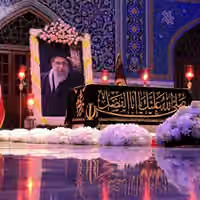
Mohammad Eslami, head of the Atomic Energy Organization of Iran (AEOI), speaks at the opening of the International Atomic Energy Agency (IAEA) General Conference at the agency's headquarters in Vienna, Austria, September 15, 2025.

Iran’s nuclear chief Mohammad Eslami told the International Atomic Energy Agency’s annual general conference in Vienna on Monday that Tehran’s atomic program will not be destroyed by military operations, accusing Israel and the United States of illegal strikes on its facilities.
“Enemies of Iran should know that our nuclear industry has deep roots and cannot be eliminated through military action,” Eslami said in his address to the 69th General Conference.

He added that “Iran will not yield to political or military pressure and will not give up its inherent rights.”

The head of the Atomic Energy Organization of Iran said Tehran’s cooperation with the IAEA “has been broad and consistent,” but accused the agency of failing to condemn what he called aggressive acts against Iranian nuclear sites.

“Despite our formal request, the agency did not condemn the attacks by the United States and Israel on the nuclear centers of the Islamic Republic,” he said. “This silence and inaction will remain as a stain on the Agency’s history.”

Eslami also criticized European efforts to trigger the “snapback” mechanism to restore UN sanctions on Iran, calling them illegal.

He said the 2015 nuclear deal, formally known as the Joint Comprehensive Plan of Action (JCPOA), had shown diplomacy could succeed, but argued that Western states had undermined it.

“Today, on the anniversary of the JCPOA, we see unlawful attempts to activate the snapback mechanism,” he said. “These efforts are a mockery of Resolution 2231.”

Eslami also said Israel’s attacks on Iranian nuclear facilities had targeted not only infrastructure but also diplomacy itself. “The Zionist regime’s goal is not merely to destroy our nuclear centers but to derail the path of diplomacy and peace,” he said.

Eslami also Iran would table a resolution at the conference to ban attacks on nuclear facilities and would hold meetings with states cooperating with Tehran.

The comments come as Iran’s Supreme National Security Council has laid out conditions for future IAEA inspections under a new arrangement signed in Cairo last week by Foreign Minister Abbas Araghchi and IAEA Director General Rafael Grossi.

The council said any inspection of damaged facilities would require its approval, and warned that implementation would stop if hostile actions, including reinstated UN resolutions, were taken against Iran.

Britain, France and Germany triggered the snapback process on August 28, demanding Iran return to talks and account for missing uranium stockpiles. Unless the Security Council blocks the move, sanctions will automatically resume by late September.

The IAEA reported earlier this month that Iran’s 60% enriched uranium stockpile rose to 440.9 kilograms before the June strikes on its facilities. Grossi said the Cairo deal aims to re-establish monitoring once technical procedures are agreed.
Most Viewed

Washington’s economic war on Iran starts in Dubai, not Beijing
1
ANALYSIS

Washington’s economic war on Iran starts in Dubai, not Beijing

2
ANALYSIS

What the US-Venezuela oil model could mean for Iran’s energy future

3

Iran sanctions reach education: Duolingo blocked, TOEFL and GRE in doubt

4

Poverty pushes Iranian children into hazardous border work

5

Iran court sentences 10 protesters to death in Isfahan

Banner
Banner
Banner

Spotlight

  • What the US-Venezuela oil model could mean for Iran’s energy future
    ANALYSIS

    What the US-Venezuela oil model could mean for Iran’s energy future

  • Washington’s economic war on Iran starts in Dubai, not Beijing
    ANALYSIS

    Washington’s economic war on Iran starts in Dubai, not Beijing

  • Iran’s political prisoners are being executed. Why is supporting them controversial?
    PODCAST

    Iran’s political prisoners are being executed. Why is supporting them controversial?

  • Iran’s missing fuel: Can border smuggling explain it all?
    ANALYSIS

    Iran’s missing fuel: Can border smuggling explain it all?

  • Iran bets on China to blunt Trump’s economic offensive
    INSIGHT

    Iran bets on China to blunt Trump’s economic offensive

  • Iran or the dollar? US makes an example of Banque Misr
    ANALYSIS

    Iran or the dollar? US makes an example of Banque Misr

  • War or deal? Rezaei begins to define Iran’s price
    ANALYSIS

    War or deal? Rezaei begins to define Iran’s price

  • Khamenei's office rejects calls to halt uranium enrichment, missile program

    Khamenei's office rejects calls to halt uranium enrichment, missile program

  • Iran to table resolution against attacks on nuclear sites at IAEA conference

    Iran to table resolution against attacks on nuclear sites at IAEA conference

  • Araghchi tells MPs IAEA deal follows law, critics demand text be public

    Araghchi tells MPs IAEA deal follows law, critics demand text be public